Advertisements
Advertisements
प्रश्न
Name one radiation having the wavelength longer than the wavelength of these radiations.
Advertisements
उत्तर
Visible or infrared or microwaves or radio waves.
APPEARS IN
संबंधित प्रश्न
State the approximate range of wavelength associated with the ultraviolet rays.
Can a hydrogen atom emit characteristic X-rays?
If the operating potential in an X-ray tube is increased by 1%, by what percentage does the cutoff wavelength decrease?
(Use Planck constant h = 6.63 × 10⁻³⁴ Js= 4.14 × 10⁻¹⁵ eVs, speed of light c = 3 × 10⁸ m/s.)
The short-wavelength limit shifts by 26 pm when the operating voltage in an X-ray tube is increased to 1.5 times the original value. What was the original value of the operating voltage?
(Use Planck constant h = 6.63 × 10⁻³⁴ Js= 4.14 × 10⁻¹⁵ eVs, speed of light c = 3 × 10⁸ m/s.)
Continuous X-rays are made to strike a tissue paper soaked with polluted water. The incoming X-rays excite the atoms of the sample by knocking out the electrons from the inner shells. Characteristic X-rays are analysed and the intensity is plotted against the wavelength. Assuming that only Kα intensities are detected, list the elements present in the sample from the plot. Use Moseley's equation v − (25 × 1014Hz)(Z − 1)2.
(Use Planck constant h = 6.63 × 10⁻³⁴ Js= 4.14 × 10⁻¹⁵ eVs, speed of light c = 3 × 10⁸ m/s.)
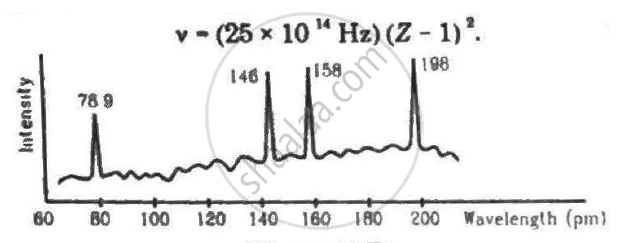
Solve the numerical problem.
The speed of light is 3 × 10⁸ m/s. Calculate the frequency of red light of a wavelength of 6.5 × 10⁻⁷ m.
The area to be covered for T.V telecast is doubled then the height of transmitting antenna (T.V tower) will have to be:-
Given below in the left column are different modes of communication using the kinds of waves given in the right column.
| A. | Optical Fibre Communication |
P. | Ultrasound |
| B. | Radar | Q. | Infrared Light |
| C. | Sonar | R. | Microwaves |
| D. | Mobile Phones | S. | Radio Waves |
From the options given below, find the most appropriate match between entries in the left and the right column.
How are the electric and magnetic fields oriented in an electromagnetic wave?
How do ultraviolet rays compare with visible light?
