Advertisements
Advertisements
Question
Solve the numerical problem.
Calculate the wavelength in nm of an X-ray wave of frequency 2.0 × 10¹⁸ Hz.
Advertisements
Solution
Given: c = 3 × 10⁸ , ν = 2 × 10¹⁸ Hz
To find: Wavelength (λ)
Formula: c = νλ
Calculation: From formula,
λ = `"c"/ν=(3xx10^8)/(2xx10^18)` = 1.5 × 10−10 = 0.15 nm
The wavelength of an X-ray is 0.15 nm.
APPEARS IN
RELATED QUESTIONS
Why are microwaves considered suitable for radar systems used in aircraft navigation?
Name the parts of the electromagnetic spectrum which is
used to treat muscular strain.
Write in brief, how these waves can be produced.
What do you understand by the invisible spectrum?
In a Coolidge tube, electrons strike the target and stop inside it. Does the target get more and more negatively charged as time passes?
Can X-rays be polarised?
X-ray and visible light travel at the same speed in vacuum. Do they travel at the same speed in glass?
For harder X-rays,
(a) the wavelength is higher
(b) the intensity is higher
(c) the frequency is higher
(d) the photon energy is higher.
Consider a photon of continuous X-ray and a photon of characteristic X-ray of the same wavelength. Which of the following is/are different for the two photons?
The wavelength of Kα X-ray of tungsten is 21.3 pm. It takes 11.3 keV to knock out an electron from the L shell of a tungsten atom. What should be the minimum accelerating voltage across an X-ray tube having tungsten target which allows production of Kα X-ray?
(Use Planck constant h = 6.63 × 10⁻³⁴ Js= 4.14 × 10⁻¹⁵ eVs, speed of light c = 3 × 10⁸ m/s.)
The distance between the cathode (filament) and the target in an X-ray tube is 1.5 m. If the cutoff wavelength is 30 pm, find the electric field between the cathode and the target.
(Use Planck constant h = 6.63 × 10⁻³⁴ Js= 4.14 × 10⁻¹⁵ eVs, speed of light c = 3 × 10⁸ m/s.)
The stopping potential in a photoelectric experiment is linearly related to the inverse of the wavelength (1/λ) of the light falling on the cathode. The potential difference applied across an X-ray tube is linearly related to the inverse of the cutoff wavelength (1/λ) of the X-ray emitted. Show that the slopes of the lines in the two cases are equal and find its value.
(Use Planck constant h = 6.63 × 10⁻³⁴ Js= 4.14 × 10⁻¹⁵ eVs, speed of light c = 3 × 10⁸ m/s.)
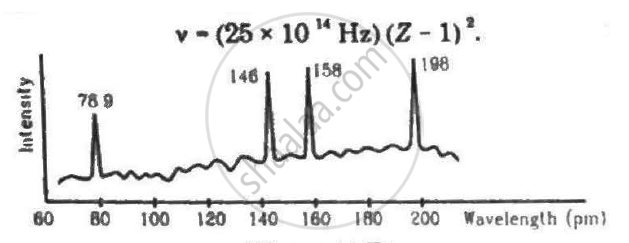
Continuous X-rays are made to strike a tissue paper soaked with polluted water. The incoming X-rays excite the atoms of the sample by knocking out the electrons from the inner shells. Characteristic X-rays are analysed and the intensity is plotted against the wavelength. Assuming that only Kα intensities are detected, list the elements present in the sample from the plot. Use Moseley's equation v − (25 × 1014Hz)(Z − 1)2.
(Use Planck constant h = 6.63 × 10⁻³⁴ Js= 4.14 × 10⁻¹⁵ eVs, speed of light c = 3 × 10⁸ m/s.)
Name three radiations and their wavelength range which are invisible and beyond the violet end of the visible spectrum.
Calculate the shortest wavelength of electromagnetic radiation present in Balmer series of hydrogen spectrum.
State three properties of infrared radiations similar to that of visible light.
Answer briefly.
Does an ordinary electric lamp emit EM waves?
Answer briefly.
Why light waves travel in a vacuum whereas sound waves cannot?
Answer briefly.
Why high-frequency carrier waves are used for the transmission of audio signals?
Solve the numerical problem.
Calculate the frequency in MHz of a radio wave of wavelength 250 m. Remember that the speed of all EM waves in a vacuum is 3.0 × 10⁸ m/s.
A car is moving towards a high cliff. The car driver sounds a horn of frequency f. The reflected sound heard by the driver has a frequency 2f. If v be the velocity of sound, then the velocity of the car, in the same velocity units, will be:
Find the photon energy in units of ev for electromagnetic wave if waves length 40 m. Given h = 6.63 × 10⁻³⁴ J.
All components of the electromagnetic spectrum in a vacuum have the same ______
Electromagnetic waves of wavelengths λ1, λ2 and λ3 are used in a radar system, in water purifiers and in remote switches of TV, respectively.
- Identify the electromagnetic waves.
- Write one source for each of them.
The half-value thickness of an absorber is defined as the thickness that will reduce exponentially the intensity of a beam of particles by a factor of 2. The half-value thickness in (µm) for lead assuming X-ray beam of wavelength 20 pm, µ = 50 cm-1 for X-rays in lead at wavelength λ = 20 pm, is ______ µm.
Identify the electromagnetic wave whose wavelength range is from about 10-3 m to about 10-1 m. Write one use of this.
Choose the correct option related to wavelengths (λ) of different parts of the electromagnetic spectrum.
What is the speed of radio waves in vacuum?
