- In a rectangular glass block, the emergent ray is parallel to the incident ray, but laterally displaced.
- The angle of emergence (e) is equal to the angle of incidence (i).
- The perpendicular distance XY between the emergent ray and the incident ray's direction is called the lateral displacement.
- Lateral displacement increases with the thickness of the block, the angle of incidence, and the refractive index, and is greater for violet light than red light.
Definitions [13]
Definition: Normal
A normal is an imaginary line drawn perpendicular to the boundary at the point of incidence.
Definition: Refraction
The change in the direction of the path of light when it passes from one transparent medium to another transparent medium is called refraction. The refraction of light is essentially a surface phenomenon.
or
When light passes from one transparent medium to another, its speed and direction change. This is called refraction.
Definition: Refraction of Light
When travelling obliquely from one medium to another, the direction of propagation of light in the second medium changes. This phenomenon is known as refraction of light.
OR
Light changes its direction when going from one transparent medium to another transparent medium. This is called the refraction of light.
OR
The bending of the light ray from its path in passing from one medium to the other medium is called 'refraction' of light.
OR
When a ray of light impinges on a polished, smooth, shiny surface, the rebounding of light within the same medium is called reflection of light.
Define the following terms used in the study of reflection of light by drawing a labelled ray-diagram:
- Incident ray
- Point of incidence
- Normal
- Reflected ray
- Angle of incidence
- Angle of reflection
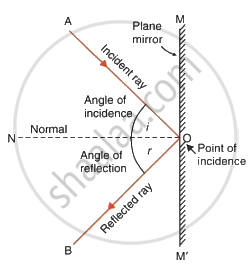
- Incident ray: The ray of light which falls on the mirror surface is called the incident ray.
- Point of incidence: The point at which the incident ray falls on the mirror is called the point of incidence.
- Normal: The normal is a line at right angles to the mirror surface at the point of incidence.
- Reflected ray: The ray of light which is sent back by the mirror is called the reflected ray.
- Angle of incidence: The angle of incidence is the angle made by the incident ray with the normal at the point of incidence.
- Angle of reflection: The angle of reflection is the angle made by the reflected ray with the normal at the point of incidence.
Define the principal focus of a concave mirror.
Light rays that are parallel to the principal axis of a concave mirror converge at a specific point on its principal axis after reflecting from the mirror. This point is known as the principal focus of the concave mirror.
Definition: Refracted Light
Refracted light is the part of light enters into the other medium and travels in a straight path but in a direction different from its initial direction and is called the refracted light.
Definition: Refracted Ray
The ray that enters the second medium after crossing the boundary is called the refracted ray.
Define the absolute refractive index of a medium.
The absolute refractive index is the ratio of the velocity of light in a vacuum to that of the medium.
Define the term refractive index of a medium in terms of velocity of light.
It is defined as the ratio of the velocity of light in medium 1 to the velocity of light in medium 2.
Definition: Lateral Displacement
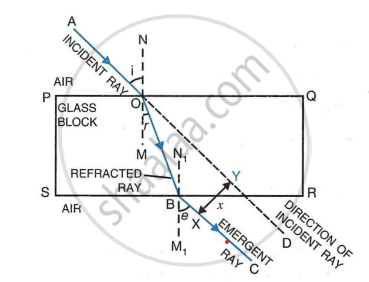
The perpendicular distance XY between the path of the emergent ray BC and the direction of the incident ray OD is called the lateral displacement.
Definition: Mirage
The optical illusion of water or distant objects caused by refraction of light due to temperature differences in air layers is called a mirage.
Definition: Secondary Rainbow
An arc of seven colours with red on the inner edge and violet on the outer edge, caused by double total internal reflection inside water droplets, is called a secondary rainbow.
Definition: Primary Rainbow
An arc of seven colours formed in the sky with red on the outer edge and violet on the inner edge, caused by single total internal reflection inside water droplets, is called a primary rainbow.
Theorems and Laws [4]
Law: Laws of Refraction
The laws of refraction are fundamental for board examinations and objective tests.
First law
The incident ray, the refracted ray, and the normal at the point of incidence all lie in the same plane.
Second law
For a given pair of media, the ratio of the sine of the angle of incidence to the sine of the angle of refraction remains constant.
\[\frac {\text {sin i}}{\text {sin r}}\] = constant
This constant is called the refractive index of the second medium with respect to the first medium.
A ray of light moves from a rare medium to a dense medium as shown in the diagram below. Write down the number of the ray which represents the partially reflected ray.

Ray 2 shows partially reflected ray.
Law: Snell's Law
- The incident ray, the refracted ray and the normal to the interface of two transparent media at the point of incidence all lie in the same plane.
- The ratio of the sine of the angle of incidence to the sine of the angle of refraction is a constant, for the light of a given colour and for the given pair of media. This law is also known as Snell’s law of refraction. (This is true for angle 0 < i < 90°)
If i is the angle of incidence and r is the angle of refraction, then,
\[\frac {\text{sin i}}{\text{sin r}}\] = constant
This constant value is called the refractive index of the second medium with respect to the first.
Law: Laws of Refraction
-
First Law: Incident ray, refracted ray, and normal to the interface at the point of incidence all lie in the same plane.
-
Second Law (Snell's Law): \[\frac{\sin i}{\sin r}=\mathrm{constant}=\frac{\mu_2}{\mu_1}\]
Extended Snell's Law: \[\frac{\sin i}{\sin r}=\frac{\mu_2}{\mu_1}=_1\mu_2=\frac{v_1}{v_2}=\frac{\lambda_1}{\lambda_2}\]
Key Points
Key Points: Refraction of Light Through a Rectangular Glass Block
Key Points: Some Natural Phenomena Due to Sunlight
- A rainbow forms due to refraction, dispersion, and internal reflection inside a single raindrop.
- Primary rainbow → 2 refractions + 1 internal reflection; red outer, violet inner (θR = 43°, θV = 41°).
- Secondary rainbow → 2 refractions + 2 internal reflections; red inner, violet outer (θR = 51°, θV = 54°).
- Mirage is an optical illusion of water on a hot day caused by upward bending of light due to temperature differences in air layers.
Important Questions [23]
- What is refraction of light?
- The Phenomenon of Change in the Direction of Light When It Passes from One Transparent Medium to Another is Called ___________
- Match the Columns
- We can see the sun even when it is little below the horizon because of ______.
- Explain how the formation of a rainbow occurs.
- Write a Short Note on Dispersion of Light.
- Define Refraction and State the Laws of Refraction.
- Explain How the Formation of a Rainbow Occurs.
- Why Do We Get a Spectrum of Seven Colours When White Light is Dispersed by a Prism?
- Draw the Diagram of Refraction of Light in Glass Slab
- Observe the Following Figure and Answer the Questions Given Under It: What Happens to the Ray of Light When It Passes from Air to Glass? What Happens to the Ray of Light When It Passes from Glass to Air? What Are the Rays Ab and Cd in the Figure Called?
- Choose the Correct Alternative and Rewrite the Following: a Glass Slab is Placed in the Path of Convergent Light. the Point of Convergence of Light
- Observe the figure and name the ray AB, ray CD, ray GH.
- Explain How Spectrum is Formed.
- When Rays of Light Are Incident on a Glass Slab Then the Incident Ray and Emergent Ray Are
- What is a spectrum?
- Choose the Correct Alternative and Rewrite the Following Sentence. a Ray of Light Strikes the Glass Slab at an Angle of 50°. What is the Angle of Incidence?
- Rewrite the Following Statement by Selecting the Correct Options: If a Ray of Light Strikes a Glass Slab at an Angle of 600 with the Surface of the Slab, the Angle of Incidence Must Be
- When a Ray of Light Travels from Air to Glass Slab and Strikes the Surface Of Separation at 90°, Then It
- Fill in the Blank and Rewrite the Completed Statement: Very Fine Particles Mainly Scatter ______ Light.
- Explain: ‘How is a Rainbow Formed’?
- Fill in the Blank:Very Fine Particles Mainly Scatter
- Give a scientific reason: Danger signal lights are red in colour.
