Advertisements
Advertisements
प्रश्न
Which stage of man’s life is associated with the ‘shrunk shank’?
Advertisements
उत्तर
In the sixth stage, man becomes thin and weak. His fashionable dresses of youthful days have now become too loose to use for his shrunk shank (i.e.) legs that have become very lean with age.
APPEARS IN
संबंधित प्रश्न
How long had the soldiers been in the castle?
Why were the secret galleries bare?
What was the ‘shameful act’?
Read the given line and answer the question that follow in a line or two.
We could do nothing, being sold.
- Why couldn’t they do anything?
- Why did they feel helpless?
Our captain was brave and we were true
Underline the alliterated word in the following line.
With our arms and provender, load on load.
Underline the alliterated word in the following line.
The wizened warder let them through.
Does nature communicate with human beings?
The casuarina tree will be remembered forever. Why?
Identify the figure of speech used in each of the extract given below and write down the answer in the space given below.
“ LIKE a huge Python, winding round and round
The rugged trunk indented deep with scars”,
Identify the figure of speech used in each of the extract given below and write down the answer in the space given below.
“ A creeper climbs, in whose embraces bound
No other tree could live. But gallantly
The giant wears the scarf, and flowers are hung......”
Discuss with your partner the different stages in the growth of man from a new born to an adult

Why is the last stage called second childhood?
Read the given line and answer the question that follow.
Then a soldier,
full of strange oaths, and bearded like the pard,
Jealous in honour, sudden and quick in quarrel,
Seeking the bubble reputation
Even in the cannon's mouth.
- What is the soldier ready to do?
- Explain ‘bubble reputation’.
- What are the distinguishing features of this stage?
Introduction
The poem ‘Ulysses’ is a dramatic monologue that contains 70 lines of blank verse. Ulysses, the King of Ithaca, gathers his men together to prepare for the journey and exhorts them not to waste their time left on earth. Ulysses has grown old, having experienced many adventures at the battle of Troy and in the seas. After returning to Ithaca, he desires to embark upon his next voyage. His inquisitive spirit is always looking forward to more and more of such adventures.
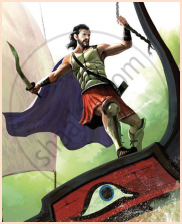
‘Ulysses is not happy to perform his duties as a king.’ Why?
Pick out the lines which convey that his quest for travel is unending.
Why did Ulysses want to hand over the kingdom to his son?
What could be the possible outcomes of their travel?
Identify the figure of speech employed in the following line.
To follow knowledge like a sinking star.
Read the set of line from the poem and answer the question that follow.
Yet all experience is an arch wherethrough
Gleams that untravelled world, whose margin fades
For ever and for ever when I move
- What is experience compared to?
- How do the lines convey that the experience is endless?
Explain with reference to the context the following line.
....you and I are old;
Old age hath yet his honour and his toil;
What is Ulysses’ clarion call to his sailors? How does he inspire them?
‘A tough will counts.’ Explain.
The poet says
‘Without rich wanting nothing arrives’ but he condemns ‘the quest of lucre beyond a few easy needs.’ Analyse the difference and write.
Read the line given below and answer the question that follow.
“Life is a soft loam; be gentle; go easy.” And this too might serve him.
- Why does the poet suggest to take life easy?
- Identify the figure of speech in the above line.
Explain how the poet guides his son who is at the threshold of manhood, to face the challenges of life.
Describe the posture of Napoleon.
Where did the rider plant the French flag after Ratisbon was captured?
