Topics
Gravitation
- Concept of Gravitation
- Force and Motion
- Circular Motion and Centripetal Force
- Kepler’s Laws
- Law of Orbit or Kepler's First Law
- Law of Areas or Kepler's Second Law
- Law of Periods or Kepler's Third Law
- Newton's Universal Law of Gravitation
- Uniform Circular Motion (UCM)
- Earth’s Gravitational Force
- Earth’s Gravitational Acceleration
- Mass and Weight
- Gravitational Waves
- Free Fall
- Gravitational Potential Energy
- Escape Velocity
- Weightlessness in Space
Periodic Classification of Elements
- Classification of Elements
- Dobereiner’s Triads
- Newland's Law of Octaves
- Mendeleev’s Periodic Table
- Insights into Mendeleev’s Periodic Table
- Modern Periodic Law
- Modern Periodic Table
- Structure of the Modern Periodic Table
- Modern Periodic Table and Electronic Configuration of Elements
- Groups and Electronic Configuration
- Periods and Electronic Configuration
- Periodic Trends in the Modern Periodic Table
- Atomic Size
- Metallic and Non-metallic Characters
- Gradation in Halogen Family
Chemical Reactions and Equations
- Chemical Reaction
- Chemical Equations
- Balancing Chemical Equation
- Types of Chemical Reactions > Combination Reaction
- Types of Chemical Reactions > Decomposition Reaction
- Types of Chemical Reactions > Single Displacement Reaction
- Types of Chemical Reactions > Double Displacement Reaction
- Endothermic and Exothermic Processes
- Rate of Chemical Reaction
- Types of Chemical Reactions > Oxidation and Reduction Reactions
- Corrosion of Metals
- Factors Affecting the Rate of a Chemical Reaction
- Rancidity
Effects of Electric Current
- Electric Circuit
- Heating Effect of Electric Current
- Magnetic Effect of Electric Current
- Right-hand Thumb Rule
- Applications of Biot-Savart's Law > Magnetic Field at the Axis of a Circular Current-carrying Loop
- Applications of Ampere’s Circuital Law > Magnetic Field of a Long Straight Solenoid
- Force on a Current-Carrying Conductor Placed in a Uniform Magnetic Field
- Fleming’s Left Hand Rule
- Electric Motor
- Introduction to Electromagnetic Induction
- Galvanometer
- Faraday's Laws of Electromagnetic Induction
- Fleming’s Right Hand Rule
- Alternating current (AC) and Direct Current (DC)
- Electric Generator
Heat
Refraction of Light
Lenses
- Concept of Lenses
- Images Formed by Convex Lenses
- Images Formed by Concave Lenses
- Sign Convention
- Lens Formula and Magnification
- Magnification
- Power of a Lens
- Combination of Lenses
- Human Eye
- Defects of Vision and Their Corrections > Myopia
- Defects of Vision and Their Corrections > Hypermetropia
- Defects of Vision and Their Corrections > Presbyopia
- Apparent Size of an Object
- Use of Concave Lenses
- Use of Convex Lenses
- Persistence of Vision
Metallurgy
- Physical Properties of Metal
- Physical Properties of Non-metal
- Chemical Properties of Metal
- Reactions of Metals
- Reactivity Series of Metals
- Chemical Properties of Non-metal
- Ionic Compounds
- Metallurgy
- Basic Principles of Metallurgy > Concentration of Ores
- Basic Principles of Metallurgy > Extraction of Metals
- Basic Principles of Metallurgy > Refining of Metals
- Corrosion of Metals
- Prevention of Corrosion
Carbon Compounds
- Bonds in Carbon Compounds
- Carbon: A Versatile Element
- Hydrocarbons
- Straight chains, Branched chains, and Rings of Carbon atoms
- Functional Groups in Carbon Compounds
- Nomenclature
- The IUPAC System of Nomenclature
- Homologous Series
- Chemical Properties of Carbon Compounds > Combustion
- Chemical Properties of Carbon Compounds > Oxidation
- Chemical Properties of Carbon Compounds > Addition Reaction
- Chemical Properties of Carbon Compounds > Substitution Reaction
- Ethanol
- Ethanoic Acid
- Macromolecules and Polymers
Space Missions
School of Elements
The Magic of Chemical Reactions
- Types of Chemical Reactions > Combination Reaction
- Types of Chemical Reactions > Decomposition Reaction
- Types of Chemical Reactions > Single Displacement Reaction
- Types of Chemical Reactions > Double Displacement Reaction
- Chemical Properties of Carbon Compounds > Oxidation
- Types of Double Displacement: Neutralization Reaction
The Acid Base Chemistry
The Electric Spark
All about Electromagnetism
- Magnetic force
- Bar Magnet and Solenoid Analogy
- Right-hand Thumb Rule
- Applications of Biot-Savart's Law > Magnetic Field at the Axis of a Circular Current-carrying Loop
- Applications of Ampere’s Circuital Law > Magnetic Field of a Long Straight Solenoid
- Force on a Current-Carrying Conductor Placed in a Uniform Magnetic Field
- Electric Motor
- Introduction to Electromagnetic Induction
- Alternating-Current Generator
- Simple D.C. Motor
- Household Electrical Circuits
Wonders of Light 1
Wonders of Light 2
Striving for better Environment 1
- Abatement of Pollution
- Sustainable Use of Resources
Maharashtra State Board: Class 10
Persistence of Vision in Daily Life
Persistence of vision is the phenomenon where an image remains on the retina for 1/16th of a second after the object is removed. This occurs because the retina retains the image temporarily before transmitting it to the brain. The brain processes continuous images rapidly, creating the illusion of a smooth, continuous motion.
Examples of Persistence of Vision in Daily Life:
- Movies and Animation: Films and animations run at 24 frames per second (fps) or more. The rapid sequence of images appears as a smooth motion due to persistence of vision.
- Spinning Fan Blades: When a ceiling fan rotates quickly, the blades appear to merge into one blurred disk. This is because each blade's image remains on the retina before the next blade reaches that position.
- Light Trails of Fireworks or Sparklers: When a sparkler or firework moves quickly, it leaves a light trail in the air. This is due to the retina holding onto the previous light image as the spark moves.
- Flipping Book Animations (Flipbooks): A series of slightly different images are drawn on pages. When flipped rapidly, the pictures appear to move, thanks to persistence of vision.
- Digital Screens (TVs and Monitors): Screens refresh at high speeds (e.g., 60 Hz, 120 Hz). Even though pixels are turned off and on, the eye perceives a continuous image.
Maharashtra State Board: Class 10
Role of Rod and Cone Cells in Vision
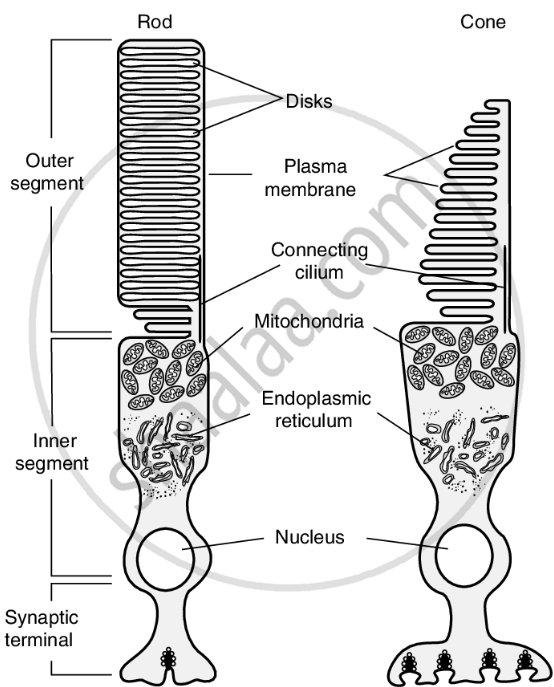
| Feature | Rod Cells | Cone Cells |
|---|---|---|
| Shape | Rod-shaped photoreceptors | Cone-shaped photoreceptors |
| Function | Detect light intensity (brightness/dimness) | Detect colors (Red, Green, Blue) |
| Vision Type | Low-light vision (scotopic vision) | Bright-light vision (photopic vision) |
| Color Vision | No color detection (black & white vision) | Responsible for color vision |
| Location in Retina | Periphery of the retina | Center (fovea) of the retina |
| Number | 120 million (out of 125 million) | 5 million (out of 125 million) |
| Light Sensitivity | Highly sensitive to dim light | Less sensitive to dim light |
| Response Time | Slow response (long integration time) | Fast response (short integration time) |
| Directional Selectivity | No | Yes |
| Amplification | High | Low |
| Convergence in Retinal Pathways | Highly convergent | Less convergent |
| Acuity (Sharpness) | Low (poor detail vision) | High (sharp, detailed vision) |
| Outer Segment Pigment | Rhodopsin (Vitamin A) | Iodopsin (Violet pigment) |
| Wavelength Sensitivity | Peak sensitivity: 480 nm | Sensitive at 420 nm, 534 nm, 563 nm |
| Deficiency Effects | Night blindness (poor night vision) | Color blindness |
| Best Suited For | Dim light and peripheral vision | Detailed and color vision in bright light |
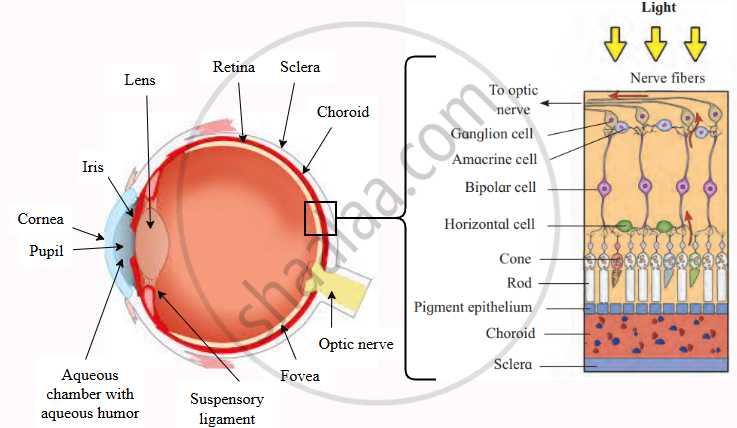
Structure of the Human Eye and Photoreceptor Cells (Rods & Cones)
Maharashtra State Board: Class 10
Definition: Persistence of Vision
Persistence of vision is the phenomenon where an image stays on the retina for about 1/16th of a second even after the object is removed.
Maharashtra State Board: Class 10
Key Points: Persistence of Vision
- Rod cells in the retina detect light intensity and help in vision under dim light, while cone cells detect colour and function in bright light.
- Cone cells are sensitive to red, green, and blue light; the brain processes their signals to produce the perception of colour.
- Colour blindness occurs when certain cone cells are absent or non-functional, causing difficulty in distinguishing specific colours, though general eyesight remains normal.
