मराठी
Maharashtra State BoardSSC (English Medium) 10th Standard

Laws of Refraction

Advertisements

Topics

  • Key Points: Laws of Refraction
Maharashtra State Board: Class 10

Laws of Refraction

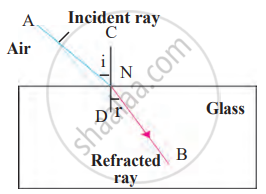
Refraction occurs when a light ray passes from one medium to another, causing it to bend due to a change in speed. The diagram illustrates light entering a glass slab from air.

  • AN is the incident ray in air.
  • NB is the refracted ray inside the glass slab.
  • CD is the normal at the point of incidence N.

At N, the light bends following the laws of refraction.

Light ray entering a glass slab from air

Laws of Refraction:

  1. The incident ray, refracted ray, and the normal at the point of incidence all lie in the same plane.
  2. For a given pair of media (e.g., air and glass), the ratio of the sine of the angle of incidence (i) to the sine of the angle of refraction (r) is constant.

This is mathematically expressed as : `"sin i"/"sin r"` = constant

This principle is known as Snell’s Law, named after Willebrord Snell, who discovered it. Snell’s Law relates the angles of incidence and refraction to the refractive indices of the two media. These laws explain why light bends at boundaries and are fundamental in optical physics, influencing the design of lenses, prisms, and optical instruments.

Maharashtra State Board: Class 10

Introduction

The refractive index measures how much a light ray bends when entering a different medium due to a change in speed. The refractive index of a medium depends on the velocity of light in that medium and is given by:

`n = "Speed of Light in Vacuum (c)"/"Speed of Light in Medium (v)"`

where:

  • n = Refractive index of the medium
  • c = Speed of light in a vacuum
  • v = Speed of light in the given medium

Since the refractive index is inversely proportional to the velocity of light in a medium:

  • Higher velocity → Lower refractive index (light travels faster).
  • Lower velocity → Higher refractive index (light slows down).

If light moves between two different media, the refractive index is calculated as:

\[\mathrm{Refractive~index~^1n_2=\frac{Velocity~of~light~in~medium~1~(v_1)}{Velocity~of~light~in~medium~2~(v_2)}}\]

If one of the media is a vacuum, the refractive index of the second medium is called the absolute refractive index, denoted by n:

`n = "Speed of Light in Vacuum (c)"/"Speed of Light in Medium (v)"`

For example, the refractive index of water is 1.33, meaning light travels 1.33 times slower in water than in a vacuum.

Maharashtra State Board: Class 10

Absolute Refractive Indices and Applications

The refractive index varies for different materials. Some common absolute refractive indices are:

Substance Refractive Index Substance Refractive Index Substance Refractive Index
Air 1.0003 Fused Quartz 1.46 Carbon Disulphide 1.63
Ice 1.31 Turpentine Oil 1.47 Dense Flint Glass 1.66
Water 1.33 Benzene 1.50 Ruby 1.76
Alcohol 1.36 Crown Glass 1.52 Sapphire 1.76
Kerosene 1.39 Rock Salt 1.54 Diamond 2.42

Applications of Refractive Index:

  1. It is used in lenses, microscopes, and cameras to focus light.
  2. Helps explain mirages and the bending of light in water.
  3. It is used in optical fibre communication to guide light signals.
  4. Determines the purity of substances like oils and liquids in laboratories.
Maharashtra State Board: Class 10
CISCE: Class 10, 12

Key Points: Laws of Refraction

  • The incident ray, the refracted ray, and the normal all lie in the same plane at the point of incidence.
  • For a given pair of media, the ratio sin i/sin r = constant, where i is the angle of incidence and r is the angle of refraction.
Advertisements
Share
Notifications

Englishहिंदीमराठी


      Forgot password?
Use app×