Topics
Electric Charges and Fields
- Electric Charge
- Conductors and Insulators
- Basic Properties of Electric Charge
- Coulomb’s Law
- Forces between Multiple Charges
- Electric Field
- Electric Field Due to a System of Charges
- Physical Significance of Electric Field
- Electric Field Lines
- Electric Flux
- Electric Dipole
- Dipole in a Uniform External Field
- Continuous Charge Distribution
- Gauss’s Law
- Application of Gauss' Law
Electrostatics
Current Electricity
Electrostatic Potential and Capacitance
- Electric Potential and Potential Energy
- Electrostatic Potential
- Electric Potential Due to a Point Charge
- Potential Due to an Electric Dipole
- Potential due to a System of Charges
- Equipotential Surfaces
- Relation Between Electric Field and Electrostatic Potential
- Potential Energy of a System of Charges
- Potential Energy of a Single Charge
- Potential Energy of a System of Two Charges in an External Field
- Potential Energy of a Dipole in an External Field
- Electrostatics of Conductors
- Dielectrics and Polarisation
- Capacitors and Capacitance
- The Parallel Plate Capacitor
- Effect of Dielectric on Capacitance
- Combination of Capacitors
- Energy Stored in a Charged Capacitor
- Overview: Electric Potential
- Overview: Capacitors and Dielectrics
Magnetic Effects of Current and Magnetism
Current Electricity
- Electric Current
- Electric Currents in Conductors
- Ohm's Law
- Drift of Electrons and the Origin of Resistivity
- Mobility of Electrons
- Limitations of Ohm’s Law
- Resistivity of Various Materials
- Temperature Dependence of Resistivity
- Electrical Energy and Power in Conductors
- Cells, EMF, and Internal Resistance
- Cells in Series and in Parallel
- Kirchhoff’s Laws
- Wheatstone Bridge
- Overview: Electric Resistance and Ohm's Law
- Overview: DC Circuits and Measurements
Electromagnetic Induction and Alternating Currents
Moving Charges and Magnetism
- Electromagnetism
- Magnetic force
- Motion in a Magnetic Field
- Biot-Savart Law
- Magnetic Field on the Axis of a Circular Current-Carrying Loop
- Ampere’s Circuital Law
- Solenoid
- Force Between Two Parallel Currents (Ampere’s Law)
- Torque on a Rectangular Current Loop in a Uniform Magnetic Field
- Circular Current Loop as a Magnetic Dipole
- Moving Coil Galvanometer
- Overview: Moving Charges and Magnetic Field
- Overview: Torque on a Current-Loop : Moving-Coil Galvanometer
Electromagnetic Waves
Magnetism and Matter
- Concept of Magnetism
- The Bar Magnet
- Magnetic Field Lines
- Bar Magnet as an Equivalent Solenoid
- The Dipole in a Uniform Magnetic Field
- The Electrostatic Analog
- Magnetism and Gauss’s Law
- Magnetisation and Magnetic Intensity
- Magnetic Properties of Materials
- Overview: Magnetism and Mater
Electromagnetic Induction
Optics
Dual Nature of Radiation and Matter
Alternating Current
- AC Voltage Applied to a Resistor
- Representation of AC Current and Voltage by Rotating Vectors - Phasors
- AC Voltage Applied to an Inductor
- AC Voltage Applied to a Capacitor
- AC Voltage Applied to a Series LCR Circuit
- Phasor-diagram Solution
- Resonance
- Power in AC Circuit
- Transformers
- Overview: AC Circuits
Atoms and Nuclei
Electromagnetic Waves
- Concept of Electromagnetic Waves
- Displacement Current
- Sources of Electromagnetic Waves
- Nature of Electromagnetic Waves
- Electromagnetic Spectrum
- Overview of Electromagnetic Waves
Electronic Devices
Ray Optics and Optical Instruments
- Ray Optics Or Geometrical Optics
- Reflection of Light by Spherical Mirrors
- Sign Convention for Reflection by Spherical Mirrors
- Focal Length of Spherical Mirrors
- Mirror Equation of Spherical Mirrors
- Refraction of Light
- Total Internal Reflection
- Applications of Total Internal Reflection
- Refraction at a Spherical Surfaces
- Refraction by a Lens
- Power of a Lens
- Combined Focal Length of Two Thin Lenses in Contact
- Refraction of Light Through a Prism
- Optical Instruments
- Microscope and it’s types
- Telescope
- Overview of Ray Optics and Optical Instruments
Wave Optics
- Concept of Wave Optics
- Huygens Principle
- Refraction of a Plane Wave
- Refraction at a Rarer Medium
- Reflection of a Plane Wave by a Plane Surface
- Coherent and Incoherent Addition of Waves
- Interference of Light Waves and Young’s Experiment
- Diffraction of Light
- The Single Slit
- Seeing the Single Slit Diffraction Pattern
- Polarisation of Light
- Overview: Wave Optics
Communication Systems
The Special Theory of Relativity
Dual Nature of Radiation and Matter
- Dual Nature of Radiation
- Electron Emission
- Photoelectric Effect - Hertz’s Observations
- Photoelectric Effect - Hallwachs’ and Lenard’s Observations
- Experimental Study of Photoelectric Effect
- Effects of Intensity and Frequency on Photocurrent
- Photoelectric Effect and Wave Theory of Light
- Einstein’s Photoelectric Equation: Energy Quantum of Radiation
- Particle Nature of Light: The Photon
- Wave Nature of Matter
- Overview: Dual Nature of Radiation and Matter
Atoms
Nuclei
- Atomic Masses and Composition of Nucleus
- Size of the Nucleus
- Mass - Energy
- Nuclear Binding Energy
- Nuclear Force
- Radioactivity
- Forms of Energy > Nuclear Energy
- Nuclear Fission
- Nuclear Fusion
- Controlled Thermonuclear Fusion
- Overview: Nuclei
Semiconductor Electronics - Materials, Devices and Simple Circuits
- Concept of Semiconductor Electronics
- Classification of Metals, Conductors and Semiconductors
- Intrinsic Semiconductor
- Extrinsic Semiconductor
- n-type Semiconductor
- p-type Semiconductor
- Diode or p-n Junction
- Semiconductor Diode
- Application of Junction Diode as a Rectifier
- Overview: Semiconductor Electronics
Communication Systems
- Detection of Amplitude Modulated Wave
- Production of Amplitude Modulated Wave
- Basic Terminology Used in Electronic Communication Systems
- Sinusoidal Waves
- Modulation and Its Necessity
- Amplitude Modulation (AM)
- Need for Modulation and Demodulation
- Satellite Communication
- Propagation of EM Waves
- Bandwidth of Transmission Medium
- Bandwidth of Signals
The Special Theory of Relativity
- The Special Theory of Relativity
- The Principle of Relativity
- Maxwell'S Laws
- Kinematical Consequences
- Dynamics at Large Velocity
- Energy and Momentum
- The Ultimate Speed
- Twin Paradox
CISCE: Class 12
Definition: Electric Cell
An electric cell is a source of electrical energy which maintains a continuous flow of charge in a circuit.
CISCE: Class 12
Definition: Electromotive Force
The work done by the cell in forcing a unit positive charge to flow in the whole circuit (including the cell) is called the ‘electromotive force' (emf) of the cell.
Mathematically,
E = \[\frac {dW}{dq}\]
OR
The potential difference between the positive and negative terminals of a cell in an open circuit (when no current flows).
Definition: Volt
If in the flow of 1 C of charge in a circuit, the work done by the cell be 1 J, then the emf of the cell is 1 V.
Definition: Terminal Potential Difference
The terminal potential difference of a cell is equal to the work done for the flow of a unit charge in the external circuit only.
Mathematically,
V = \[\frac {W_{ext}}{q}\]
Definition: Meter Bridge
Metre bridge is a sensitive device based on the principle of Wheatstone's bridge, for the determination of the resistance of a conductor (wire).
Definition: Potentiometer
It is an important instrument for measuring the emf of a cell or the potential difference between two points of an electric circuit.
CISCE: Class 12
Formula: Internal Resistance of a Cell
r = R\[\left[\frac{E}{V}-1\right]\]
Cells in Series:
req = r1 + r2 + …
CISCE: Class 12
Formula: Series combination of cells
I = \[\frac{nE}{nr+R}\]
\[\frac{1}{r_{eq}}=\frac{1}{r_1}+\frac{1}{r_2}+\ldots\]
Formula: Parallel combination of cells
I = \[\frac{E}{\left(\frac{r}{n}+R\right)}=\frac{nE}{r+nR}\]
Formula: Mixed grouping of cells
I = \[\frac{mnE}{nr+mR}\]
CISCE: Class 12
Law: Kirchhoff's First Law or Junction Rule
Statement
In an electric circuit, the 'algebraic' sum of the currents meeting at any junction in the circuit is zero, that is, ∑ I = 0.
Proof
When applying this law, currents entering the junction are taken as positive, while currents leaving the junction are taken as negative.
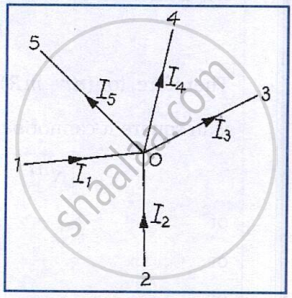
Consider a junction O where five conductors meet, carrying currents I1, I2, I3, I4 and I5.
Let I1 and I2 enter the junction, and I3, I4 and I5 leave the junction.
According to Kirchhoff’s first law,
∑ I = 0
That is,
I1 + I2 − I3 − I4 − I5 = 0
or,
I1 + I2 = I3 + I4 + I5
Thus, the sum of incoming currents is equal to the sum of outgoing currents.
Conclusion
Kirchhoff’s first law, also called Kirchhoff’s current law (KCL), states that when a steady current flows in a circuit, no charge accumulates at any junction. Hence, the law is a direct consequence of the principle of conservation of electric charge.
CISCE: Class 12
Law: Kirchhoff's Second Law or Loop Rule
Statement
In any closed loop of a circuit, the algebraic sum of the products of current and the resistance in each part of the loop is equal to the algebraic sum of the emfs in that loop, that is,
∑ IR = ∑ E
Proof
While applying Kirchhoff’s second law, the following sign conventions are used:
- When we traverse a resistance in the direction of current, the product I R is taken as positive.
- The emf is taken as positive when we traverse from the negative to the positive electrode of the cell through the electrolyte.
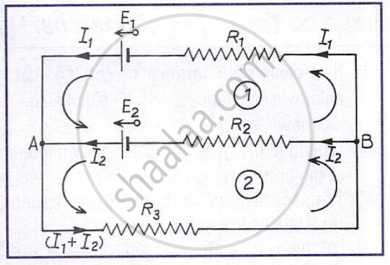
Consider the circuit shown, containing two cells of emfs E1 and E2 and three resistances R1, R2, and R3. Let the currents in R1 and R2 be I1 and I2, respectively. Applying Kirchhoff’s first law at junction A, the current through R3 is I1 + I2.
The circuit has two closed loops.
For loop 1, applying Kirchhoff’s second law:
I1R1 − I2R2 = E1 − E2
For loop 2, applying Kirchhoff’s second law:
I2R2 + (I1 + I2)R3 = E2
CISCE: Class 12
Law: Wheatstone's Bridge
Statement
When a Wheatstone bridge is balanced, that is, when there is no deflection in the galvanometer, the ratio of the resistances of any two adjacent arms is equal to the ratio of the resistances of the remaining two adjacent arms, i.e.,
\[\frac {P}{Q}\] = \[\frac {R}{S}\]
Explanation/Proof
In a Wheatstone bridge, four resistances P, Q, R, and S are connected to form the four arms of a parallelogram. A galvanometer is connected across one diagonal and a cell across the other diagonal.
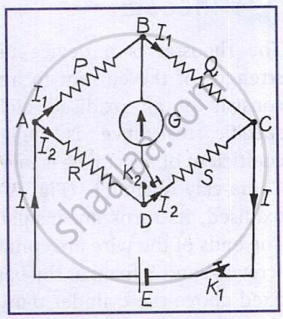
When the key is pressed, the current entering the junction is divided into two parts: current I1 flows through arm AB, and current I2 flows through arm AD. The resistances are adjusted such that there is no current through the galvanometer, indicating that the bridge is balanced.
Since there is no current in the diagonal BD, the same current I1 flows through arms AB and BC, and the same current I2 flows through arms AD and DC.
Applying Kirchhoff’s second law to loop ABDA,
I1P − I2R = 0 ⇒ I1P = I2R ---(i)
Applying Kirchhoff’s second law to loop BCDB,
I1Q − I2S = 0 ⇒ I1Q = I2S ---(ii)
Dividing equation (i) by equation (ii),
CISCE: Class 12
Key Points: Combinations of Cells
- Battery and the need for a combination of cells
A single cell cannot give a strong current, so two or more cells are combined to form a battery to obtain a suitable current or emf. - A series combination of cells
In a series combination, emfs and internal resistances add up. It is useful when the external resistance is much larger than the internal resistance. - Parallel combination of cells
In parallel combination, the emf remains the same as one cell, but the internal resistance decreases. It is useful when the external resistance is small. - Mixed grouping of cells
In mixed grouping, cells are connected in series and parallel to obtain both a large current and a suitable emf.
Imax = \[\frac {nE}{2R}\] - Condition for maximum current in mixed grouping
Maximum current flows when the battery's internal resistance equals the external resistance. i.e. \[\frac {nr}{m}\] = R
Key Points: Rheostat
- Purpose of a rheostat: A rheostat is used to control the current in an electric circuit by changing resistance.
- Construction: It has a Nichrome wire wound on a china-clay cylinder with a sliding contact.
- As a current controller: When connected through A–C or B–C, moving the sliding contact changes the current in the circuit.
- As a potential divider: When connected across A and B, and the circuit is taken from A–C (or B–C), the rheostat provides a variable fraction of the applied potential difference.
- Working principle: Sliding the contact changes the wire's effective length, thereby changing its resistance.
Key Points: Metre Bridge
- Principle: The metre bridge works on the Wheatstone bridge principle, and balance is obtained at the null point where the galvanometer shows no deflection.
- Null point condition: At the null point, points B and D are at the same potential and
\[\frac {P}{Q}\] = \[\frac {R}{S}\] - Finding unknown resistance: If the wire is divided into lengths l and 100 − l, the unknown resistance is
S = R\[\frac {(100−l)}{l}\]. - Reducing errors: Errors are reduced by interchanging the known and unknown resistances and taking the mean value.
- Precautions: Keep the null point near the middle, avoid heating the wire, and press the jockey lightly without rubbing.
Key Points: Potentiometer
- Null-deflection method: At balance, no current flows through the galvanometer, making the measurement independent of the cell's internal resistance.
- Uniform wire requirement: The potentiometer wire must have a uniform cross-section and material so that the potential drop along the wire is uniform.
- True emf measurement: The emf is measured in open circuit, ensuring the true value of the emf is obtained without energy loss in the cell.
- Sensitivity dependence: The sensitivity of a potentiometer increases as the potential gradient decreases, using a long wire and low current.
- Experimental precautions: Current should not flow for a long time to avoid heating of the wire, and touch the jockey lightly to prevent wire damage.
