Topics
Electric Charges and Fields
- Electric Charge
- Properties of Electric Charge
- Simple Atomic Structure
- Conductors and Insulators
- Mechanism of Charging of an Object
- Charging by Friction
- Charging by Conduction
- Charging by Induction
- Coulomb's Law (Scalar Form): Force Between Two Point-Charges
- Coulomb's Law in Vector Form
- Forces Between Multiple Charges: Superposition Principle
- Equilibrium of System of Charges
- Electric Field
- Intensity of Electric Field
- Electric Field Intensity Due to a Point-Charge
- Intensity of Electric Field due to a Continuous Charge Distribution
- Electric Lines of Force
- Electric Dipole
- Electric Field due to an Electric Dipole
- Motion of an Electric Dipole in a Uniform Electric Field
- Effect of a Uniform Electric Field on the Motion of a Charged Particle
- Equilibrium of a Charged Body in a Uniform Electric Field
- Introduction to Gauss' Theorem of Electrostatics
- Area Vector
- Flux of a Vector Field
- Gauss' Theorem
- Gaussian Surface and its Properties
- Applications of Gauss' Theorem > Electric Field due to a Point Charge
- Applications of Gauss' Theorem > Electric Field due to an Infinite Line of Charge
- Applications of Gauss' Theorem > Electric Field due to an Infinite Plane Sheet of Charge
- Applications of Gauss' Theorem > Electric Field due to Two Infinite Parallel Sheets of Charge
- Applications of Gauss' Theorem > Electric Field Intensity Just Outside a Charged Conductor
- Applications of Gauss' Theorem > Electric Field due to a Uniformly Charged Thin Spherical Shell
- Applications of Gauss' Theorem > Electric Field due to a Uniformly Charged Sphere
- Overview: Gauss' Theorem
Electrostatics
Current Electricity
Electrostatic Potential, Potential Energy and Capacitance
- Introduction to Electric Potential
- Electric Potential: A Quantitative Approach
- Potential Difference
- Work Done in Moving a Charge in an Electric Field
- Acceleration of a Charged Particle Between Two Points in an Electric Field
- Electric Potential Due to a Point Charge
- Potential due to a Group of Point Charges
- Potential Gradient
- Electric Field as Gradient of Electric Potential: Relation between E and V
- Equipotential Surfaces
- Electric Potential Energy of a System of Charges
- Charged Body Between Parallel Plates
- Potential Due to an Electric Dipole
- Work Done in Rotating an Electric Dipole in an Electric Field
- Electric Potential Energy of an Electric Dipole in an Electrostatic Field
- Electrostatics of Conductors
- Free and Bound Charges
- Dielectrics
- Electric Polarisation of Dielectrics
- Capacitance of a Conductor
- Capacitance of an Isolated Spherical Conductor
- Potential Energy of a Charged Conductor
- Redistribution of Charges: Common Potential
- Introduction to a Capacitor
- The Parallel Plate Capacitor
- Expression for Capacitance of a Parallel-Plate Capacitor
- Dependence of the Capacitance of a Capacitor
- Capacitance of a Parallel-Plate Capacitor with Dielectric Slab between Plates
- Combination of Capacitors
- Energy Stored in a Charged Capacitor
- Force between the Plates of a Charged Parallel-Plate Capacitor
- Effect of Dielectric Insertion on a Capacitor: with and Without a Battery
- Variation of Electric Field and Potential Due to a Charged Sphere
Magnetic Effects of Current and Magnetism
Electric Resistance and Ohm's Law
- Introduction Tо Current Electricity
- Electric Current
- Current Density
- Electric Resistance
- Ohm's Law
- Experimental Verification of Ohm’s Law and Ohmic Resistors
- Exceptions of Ohm's Law : Non-Linear V-I Characteristics
- Mechanism of Flow of Electrons Through the Metal Conductors
- Mobility of Electrons
- Current, Drift Velocity Relation
- Derivation of Ohm's Law with Current Drift Velocity Relation
- Specific Resistance or Electrical Resistivity
- Ohm's law in Vector Form
- Colour Code of Carbon Resistors
- Combinations of Resistances
- An Important Deduction
- Electric Energy and Power
- Commercial Units of Electricity Consumption
- Introduction: D.C. Circuits and Measurements
- Electric cell
- Electromotive Force of a Cell
- Terminal Potential Difference
- Internal Resistance of a Cell
- Relation between E, V, and r
- Combinations of Cells
- Kirchhoff’s Laws
- Wheatstone Bridge
- Metre Bridge: Slide-Wire Bridge
- Potentiometer
- Overview: Electric Resistance and Ohm's Law
Electromagnetic Induction and Alternating Currents
Moving Charges and Magnetism
- Introduction to Magnetic Effect of Current
- Oersted's Experiment
- Concept of Magnetic Field
- Force on a Moving Charge in a Uniform Magnetic Field
- Definition of Magnetic Field on the Basis of Magnetic Force
- Motion of Charged Particles in a Uniform Magnetic Field
- Lorentz Force
- Cyclotron
- Force on a Current-Carrying Conductor Placed in a Uniform Magnetic Field
- Magnetic Field Due to a Current-carrying Conductor: Biot-savart's Law
- Comparison of Coulomb's Law and Biot-Savart's Law
- Rules to Determine the Direction of Magnetic Field
- Applications of Biot-Savart's Law > Magnetic Field at the Axis of a Circular Current-carrying Loop
- Applications of Biot-Savart's Law > Magnetic Field Due to a Straight Current-carrying Conductor of Finite Size
- Applications of Biot-Savart's Law > Magnetic Field at the Centre of a Circular Current-carrying Loop
- Ampere’s Circuital Law
- Applications of Ampere’s Circuital Law > Magnetic Field of a Long Straight Thin Wire
- Applications of Ampere’s Circuital Law > Magnetic Field of a Long Straight Solenoid
- Applications of Ampere’s Circuital Law > Magnetic Field of a Toroidal Solenoid
- Force Between Two Parallel Current-Carrying Conductors : Definition of Ampere
- Comparison Between Electric and Magnetic Forces
- Torque on a Current-Loop in a Uniform Magnetic Field
- Atom as a Magnetic Dipole
- Moving Coil Galvanometer
- Sensitivity of a Galvanometer
- Conversion of a Galvanometer into an Ammeter
- Conversion of a Galvanometer into a Voltmeter
- Overview: Moving Charges and Magnetic Field
- Overview: Torque on a Current-Loop : Moving-Coil Galvanometer
Magnetism and Matter
- Current Loop as a Magnetic Dipole
- Magnetic Dipole Moment of a Revolving Electron
- Magnetic Field of a Magnetic Dipole (Small Bar Magnet)
- Torque on a Magnetic Dipole (Bar Magnet) in a Uniform Magnetic Field
- Potential Energy of a Magnet in a Magnetic Field
- Current-Carrying Solenoid as an Equivalent to a Bar Magnet
- Magnetic Lines of Force
- Earth’s Magnetic Field
- Elements of the Earth's Magnetic Field > Angle of Declination
- Elements of the Earth's Magnetic Field > Angle of Dip or Magnetic Inclination
- Elements of the Earth's Magnetic Field > Horizontal Component of Earth's Magnetic Field
- Overview: Magnetic Field and Earth's Magnetism
- Classification of Substances According to their Magnetic Behaviour
- Terms Used in Magnetism
- Properties of Dia-, Para-, and Ferromagnetic Substances
- Explanation of Dia-, Para-, and Ferromagnetism based on the Atomic Model of Magnetism
- Hysteresis: Retentivity and Coercivity
- Differences in Magnetic Properties of Soft Iron and Steel
- Magnetic Materials
- Overview: Magnetic Classification of Substances
Electromagnetic Waves
Optics
Electromagnetic Induction
- Magnetic Flux
- Electromagnetic Induction
- Faraday's Laws of Electromagnetic Induction
- Induced Current and Induced Charge
- Methods of Changing the Magnetic Flux
- Motion of a Straight Conductor in a Uniform Magnetic Field (Motional EMF)
- Explanation of Electromagnetic Induction in Terms of Lorentz Force: Proof of Faraday's Law
- Motional emf in Rotating a Conducting Rod in a Uniform Magnetic Field
- Self – Induction
- Self-Inductance of a Long Solenoid
- Energy Stored in an Inductor
- Examples of the Effects of Self-Induced Current
- Mutual Induction
- Mutual Inductance
- Eddy Currents or Foucault Currents
- Overview: Electromagnetic Induction
Dual Nature of Radiation and Matter
Alternating Current
- Alternating Voltage and Current in a Rotating Coil
- Definitions Regarding Alternating Voltage and Current
- Mean (or Average) Value of Alternating Current (or Voltage)
- Root-Mean-Square Value of Alternating Current
- Phasors and Phasor Diagrams
- Types of AC Circuits
- Circuit containing Resistance Only
- Circuit containing Inductance Only
- Circuit containing Capacitance Only
- Circuit containing Inductance and Resistance in Series (L-R Series Circuit)
- Circuit containing Capacitance and Resistance in Series (C-R Series Circuit)
- Circuit containing Inductance and Capacitance (L-C Circuit)
- Circuit containing Inductance, Capacitance and Resistance in Series (L-C-R Series Circuit)
- Power in AC Circuit
- Wattless Current
- Half Power Points, Bandwidth and Q-Factor
- Choke Coil
- Electrical Oscillations in L-C Circuit
- Resonant Circuits
- Frequency Response of AC Circuits
- A.C. Generator
- Transformers
- Utility of Alternating Current in Comparison to Direct Current
- Overview: Alternating Current
Atoms and Nuclei
Electromagnetic Waves
- Displacement Current
- Relation between Conduction and Displacement Current
- Maxwell's Equation
- Concept of Electromagnetic Waves
- Field Magnitude Relation in Free Space
- Energy Density in Electromagnetic Waves
- Transverse Nature of Electromagnetic Waves
- Electromagnetic Spectrum
- Overview: Electromagnetic Waves
Ray Optics and Optical Instruments
- Spherical Mirrors
- Fundamental Terms Related to Spherical Mirrors
- Relation Between Focal Length and Radius of Curvature of a Spherical Mirror
- Rules to Trace the Image Formed by Spherical Mirrors
- Conditions of Image Formation
- Position and Nature of Image Formed by Spherical Mirrors
- Sign Convention
- Mirror Formula for Concave Mirror
- Mirror Formula for Convex Mirror
- Linear Magnification by Spherical Mirrors
- Uses of Spherical Mirrors
- Refraction of Light
- Laws of Refraction
- Cause of Refraction
- Physical Significance of Refractive Index
- Reversibility of Light
- Refraction of Light Through a Rectangular Glass Block
- Refraction through Parallel Multiple Media
- Real and Apparent Depths: Normal Displacement
- Critical Angle
- Total Internal Reflection
- Applications of Total Internal Reflection
- Coordinate Geometry Sign Convention for Measuring Distances and Lengths
- Refraction at Concave Spherical Surface
- Refraction at a Convex Spherical Surface
- Concept of Lenses
- Converging and Diverging Actions of Lenses
- Lens Maker's Formula
- Factors Affecting Focal Length of a Lens
- Image Formation by Thin Lenses
- Ray Diagrams for Formation of Image by a Convex Lens
- Ray Diagram for Formation of Image by a Concave Lens
- Linear Magnification by Spherical Lenses
- Power of a Lens
- Combined Focal Length of Two Thin Lenses in Contact
- Combination of Lenses and Mirrors
- Overview: Reflection of Light: Spherical Mirrors
- Overview: Refraction of Light at Spherical Surfaces: Lenses
- Overview: Refraction of Light at a Plane Interface
- Overview: Optical Instruments
- Overview: Refraction and Dispersion of Light through a Prism
Electronic Devices
Communication Systems
Wave Optics
Dual Nature of Radiation and Matter
Atoms
Nuclei
Semiconductor Electronics
Junction Diodes
Junction Transistors
Logic Gates
Communication Systems
Definition: Magnetic Field
The region near a magnet, where a magnetic needle experiences a torque and rests in a definite direction, is called 'magnetic field'.
Definition: Magnetic Field on the Basis of Magnetic Force
A charged particle when moving in a region experiences a deflecting force then a magnetic field is said to exist in that region. This field is denoted by \[\vec B\] and is also called ‘magnetic induction’.
Definition: Tesla
If a charge of 1 coulomb moving with a velocity of 1 metre per second perpendicular to a uniform magnetic field experiences a force of 1 newton, then the magnitude of the field is 1 tesla.
Definition: Direction of Magnetic Field
The direction in the magnetic field along which a current-carrying conductor does not experience any force is called the direction of the magnetic field.
Definition: Right-hand Palm Rule No. 2
If we stretch our right-hand palm such that the thumb points in the direction of the current (I) and the stretched fingers in the direction of the magnetic field \[\vec B\], then the force \[\vec F\] on the conductor will be perpendicular to the palm in the direction of pushing by the palm.
Definition: Fleming's Left-hand Rule
If the forefinger, the middle finger, and the thumb of the left hand are stretched at right angles to one another, such that the forefinger points in the direction of the magnetic field \[\vec B\] and the middle finger in the direction of the current I, then the thumb will point in the direction of the force \[\vec F\] on the conductor.
CISCE: Class 12
Definition: 1 Ampere
1 ampere is the current which when flowing in each of two infinitely-long parallel conductors 1 metre apart in vacuum, produces between them a force of exactly 2 × 10⁻⁷ newton per metre of length.
Formula: Magnetic Induction
F = Bq v sin θ
or,
B = \[\frac{F}{qv\sin\theta}\]
Units: 1 T = 1 NA-1 m-1 = 1 Wb m-2
Dimensions: [M T-2A-1].
CISCE: Class 12
Formula: Lorentz Force
\[\vec F\] = q(\[\vec E\] + \[\vec v\] × \[\vec B\])
CISCE: Class 12
Formula: Force Between Parallel Current-Carrying Conductors
\[\frac{F}{L}=\frac{\mu_0}{2\pi}\frac{I_1I_2}{r}\]
OR
\[F=\frac{\mu_0I_aI_bL}{2\pi d}\]
CISCE: Class 12
Law: Biot-Savart's Law
Statement
The magnetic field produced at a point due to a small current element is directly proportional to the current through the element, the length of the element, and the sine of the angle between the element and the line joining it to the point, and inversely proportional to the square of the distance of the point from the element.
Proof
Consider a conductor of arbitrary shape carrying a current I. Let dl be a small current element of the conductor and r the distance of this element from a point P.
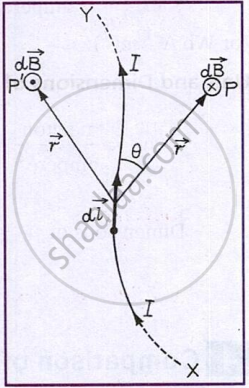
According to experimental observations:
-
The magnetic field dB at point P is proportional to the current I:
dB ∝ I
-
It is proportional to the length of the current element dl:
dB ∝ dl -
It is proportional to sin θ, where θ is the angle between dl and the line joining the element to point P:
dB ∝ sinθ
-
It is inversely proportional to the square of the distance r:
dB ∝ \[\frac {1}{r^2}\]
Combining all these relations: dB ∝ \[\frac{Idl\sin\theta}{r^2}\]
For air or vacuum, this proportionality is written as:
dB = \[\frac{\mu_{0}}{4\pi}\frac{Idl\sin\theta}{r^{2}}\]
The direction of dB is perpendicular to the plane containing dl and the position vector \[\vec r\]. Hence, in vector form:
d\[\vec B\] = \[\frac{\mu_{0}}{4\pi}\frac{I(d\vec l\times \vec r)}{r^{3}}\]
The magnetic field due to the entire conductor is obtained by integrating over its length:
\[\vec B\] = ∫ d\[\vec B\] = \[\frac{\mu_0I}{4\pi}\int\frac{d\vec l\times\mathbf{\vec r}}{r^3}\]
Conclusion
Biot–Savart’s law gives the magnitude and direction of the magnetic field produced by a current-carrying conductor. It shows that the magnetic field depends on the current element, its orientation, and its distance from the point, and that it forms the basis for calculating magnetic fields due to finite-sized conductors.
Biot-Savart Law in Terms of Current Density j
\[j=\frac{I}{A}=\frac{Idl}{Adl}=\frac{Idl}{dV},\]
where dV is the volume of current element.
\[\therefore\] Idl = j dV
d\[\vec B\] = \[\frac{\mu_0}{4\pi}\frac{\vec j\times\vec r}{r^3}\]
Units: kg m s2 A-2
Dimensions: [M L T2A-2].
CISCE: Class 12
Law: Ampere’s Circuital Law
Statement:
The line integral of the magnetic field B around any closed path in free space is equal to μ0 times the net steady current enclosed by the path.
\[\oint\vec{B}\cdot d\vec{l}=\mu_0I\]
Explanation/Proof (for a long straight conductor):
Consider a long, straight conductor carrying a steady current I.
The magnetic field at a distance r from the conductor is
B = \[\frac{\mu_0I}{2\pi r}\]
The field lines are circular, and B is tangential and constant in magnitude along a circular path of radius r.
Hence,
\[\oint\vec{B}\cdot d\vec{l}=B\oint dl=B(2\pi r)\]
Substituting the value of B,
\[\oint\vec{B}\cdot d\vec{l}=\mu_0I\]
Thus, Ampere’s circuital law is verified.
Conclusion:
- Ampere’s circuital law is valid for steady currents and time-independent magnetic fields.
- It is applicable to any closed path.
- It is especially useful for conductors with high symmetry, where calculating the magnetic field is easier.
- It is analogous to Gauss’s law in electrostatics.
Key Points: Oersted's Experiment
- Current produces magnetism: Oersted showed that a current-carrying conductor produces a magnetic field around it, as indicated by the deflection of a magnetic needle.
- Direction and strength: Reversing the direction of the current reverses the needle’s deflection, and increasing the current or reducing the distance increases the deflection.
- Moving charges and force: Since current is the flow of moving charges, the experiment shows that moving charges create magnetic fields and exert forces.
Key Points: Comparison of Coulomb's Law and Biot-Savart's Law
- Coulomb’s law describes the electric field due to charges, while Biot–Savart law describes the magnetic field due to a current.
- In both cases, the field strength decreases with the square of the distance.
- Biot–Savart law is the magnetic counterpart of Coulomb’s law.
- The electric field depends only on distance, but the magnetic field also depends on the angle of the current element.
- The electric field acts along the line joining the source and the point, while the magnetic field acts perpendicular to it.
Key Points: Simple Direction Rules for Magnetic Field
- Right-hand palm rule: Thumb shows current direction; perpendicular from the palm gives magnetic field direction.
- Right-hand thumb rule: Thumb points along current; curled fingers show magnetic field direction.
- Maxwell’s right-hand screw rule: Direction of screw motion gives current; direction of rotation gives magnetic field.
Key Points: Applications of Biot-Savart's Law
- The magnetic field at a point P at a distance r from a finite straight current-carrying conductor is
B = \[\frac{\mu_0I}{4\pi r}(\sin\phi_1+\sin\phi_2)\]
where ϕ1 and ϕ2 are the angles subtended by the conductor at P. - For special cases of a straight conductor:
Infinite length: B = \[\frac{\mu_0I}{2\pi r}\]
Point near one end: B = \[\frac{\mu_0I}{4\pi r}\]
The magnetic field is directly proportional to current I and inversely proportional to distance r. - The magnetic field at a point on the axis of a circular loop of radius a, carrying current I, at a distance x from the centre is
B = \[\frac{\mu_0Ia^2}{2(a^2+x^2)^{3/2}}\]For a coil of N turns, the field is multiplied by N. - At the centre of a circular current-carrying loop, the magnetic field is
B = \[\frac{\mu_0I}{2a}\]For a coil of N turns,
B = \[\frac{\mu_0NI}{2a}\] - The direction of the magnetic field is given by the right-hand rule. At the centre of a circular coil, magnetic field lines are nearly straight, parallel, and perpendicular to the plane of the coil, indicating a nearly uniform magnetic field.
Key Points: Applications of Ampere's Circuital Law
- For a long straight current-carrying wire, the magnetic field at a distance r is
B = \[\frac{\mu_0I}{2\pi r}\]The field lines are concentric circles and B ∝ \[\frac {1}{r}\] - Inside a long, straight solenoid, the magnetic field is uniform and given by
B = μ0nI
where n is the number of turns per unit length; the field outside the solenoid is nearly zero. - The magnetic field at the end of a long solenoid is half of that at the centre:
Bend = \[\frac {1}{2}\]μ0nI - For a solenoid with a magnetic core of relative permeability μr, the field becomes
B = μ0μrnI - In a toroidal (endless) solenoid, the magnetic field exists only inside the core and is
B = \[\frac{\mu_0NI}{2\pi a}\] = μ0nI
The field is zero outside the toroid and varies with the radial distance a.
Key Points: Force on a Moving Charge in a Uniform Magnetic Field
- A charged particle q moving with velocity v in a uniform magnetic field B experiences a force
F = Bqv sinθ or \[\vec F\] = q(\[\vec v\] × \[\vec B\])
where θ is the angle between \[\vec v\] and \[\vec B\]. - The magnetic force acts perpendicular to both the velocity \[\vec v\] and the magnetic field \[\vec B\]; its direction is given by the right-hand screw rule for positive charges and is opposite for negative charges.
- Fleming’s left-hand rule can also be used: forefinger → magnetic field, middle finger → current (direction of positive charge motion), and thumb → direction of magnetic force.
CISCE: Class 12
Key Points: Motion in Magnetic Field
- Magnetic force on a moving charge: A charged particle of charge q moving with velocity v in a uniform magnetic field B experiences a force
F = qv B sin θ,
where θ is the angle between \[\vec V\] and \[\vec B\]. - Case θ = 0∘(velocity parallel to field): When the particle moves parallel to the magnetic field, the magnetic force is zero, and the particle moves in a straight line without deviation.
- Case θ = 90∘ (velocity perpendicular to field): When the velocity is perpendicular to the magnetic field, the particle experiences a constant force perpendicular to its velocity and moves in a circular path at a constant speed.
- Radius of circular path: In perpendicular entry, the magnetic force provides the centripetal force, giving the radius:
r = \[\frac {mv}{qB}\]Hence, the radius is proportional to the momentum of the particle. - Time period and frequency: The time period of the revolution is
T = \[\frac {2πm}{qB}\]and is independent of the speed of the particle. The angular frequency is
ω = \[\frac {qB}{m}\]. - Case 0∘ < θ < 90∘ (oblique entry): When the particle enters at an angle, it follows a helical path formed by the combination of circular motion (due to perpendicular component) and linear motion (due to parallel component).
- Speed and energy remain constant: For all angles between \[\vec v\] and \[\vec B\], the speed, kinetic energy, and time period remain unchanged, but the direction of momentum changes when θ ≠ 0∘.
Key Points: Cyclotron
- Principle: A cyclotron accelerates charged particles using an alternating electric field and a magnetic field to bring them repeatedly to the accelerating gap.
- Construction: It has two D-shaped hollow electrodes (dees) placed in a uniform magnetic field perpendicular to their plane.
- Motion of Particle: Inside the dees, the particle moves in a circular path with radius
r = \[\frac {mv}{qB}\]and gains energy only in the gap. - Resonance Condition: For continuous acceleration, the frequency of the applied voltage equals the particle’s cyclotron frequency:
ν = \[\frac {qB}{2πm}\] - Limitations: A cyclotron cannot accelerate neutral particles or electrons and is ineffective at very high (relativistic) speeds.
CISCE: Class 12
Key Points: Force on Current in Magnetic Field
- Existence of Force: A current-carrying conductor placed in a uniform magnetic field experiences a force perpendicular to both the direction of current and the magnetic field.
- Direction of Force: The direction of force can be determined by Fleming’s Left-Hand Rule or Right-Hand Palm Rule.
- Expression for Force
The magnitude of force acting on a straight conductor of length l is
F = B I l sin θ
where θ is the angle between the conductor and the magnetic field. - Special Cases:
When θ = 0∘, the force is zero.
When θ = 90∘, the force is maximum, Fmax = B I l. - Vector Form: The magnetic force on a current-carrying conductor can be written as
\[\vec F\] = I \[\vec l\] × \[\vec B\]
