Estimated time: 137 minutes
CISCE: Class 12
Definition: Photoelectric Effect
The phenomenon of emission of electronsfrom metals under the effect of light is called 'photoelectric effect'.
CISCE: Class 12
Definition: Matter Waves
According to de-Broglie, all material particles in motion have wave nature. The waves associated with moving particles of matter are called ‘de-Broglie waves' or 'matter waves'.
Maharashtra State Board: Class 12
Definition: Electromagnetic Radiation
Electromagnetic radiation consists of mutually perpendicular oscillating electric and magnetic fields, both perpendicular to the direction of propagation of the wave.
CISCE: Class 12
Definition: X-rays
X-rays are electromagnetic waves having wavelengths from 0.5 Å to 15 Å. X-rays of long wavelength are called soft X-rays and those of short wavelength are called hard X-rays.
CISCE: Class 12
Formula: de Broglie Wavelength
λ = \[\frac {h}{p}\]
OR
λ = \[\frac {h}{mv}\]
Maharashtra State Board: Class 12
Definition: Photoelectric Effect
The phenomenon of emission of electrons from a metal surface when radiation of appropriate frequency is incident on it is called the photoelectric effect.
CISCE: Class 12
Definition: Stopping Potential
The negative potential of P2 (relative to P1) at which the photoelectric current becomes zero is called 'stopping potential' or 'cut-off potential'.
CISCE: Class 12
Definition: Bremstrahlung or Braking Radiation
The continuous X-rays are produced by the slowing or braking down of the incident charged particles, the radiations are called bremstrahlung or braking radiation.
CISCE: Class 12
Definition: Compton Scattering
The scattering of a photon by an electron is called the Compton effect. This effect verifies quantum theory and particle nature of electromagnetic waves. The longer wavelength in the scattered beam are called Compton lines.
Maharashtra State Board: Class 12
Definition: Photosensitive Surface
A surface that emits electrons when illuminated with suitable radiation is called a photosensitive surface.
CISCE: Class 12
Definition: Threshold Frequency or Cut-off Frequency
The lowest frequency of light which can emit photoelectrons from a material is called the 'threshold frequency' or 'cut-off frequency' of that material.
CISCE: Class 12
Formula: de-Broglie Wavelength of Electron
λ = \[\frac {12.27}{\sqrt {V}}\]Å = \[\sqrt{\frac{150}{V}}\]Å
CISCE: Class 12
Formula: Maximum Kinetic Energy of Electrons
vmax = \[\frac {1}{2}\]mv2 = hvmax
Maharashtra State Board: Class 12
Definition: Photoelectrons
Electrons emitted from a metal surface due to incident light are called photoelectrons.
CISCE: Class 12
Definition: Work Function
The minimum energy required for the emission of photoelectron from a metal is called the 'work function' of that metal.
CISCE: Class 12
Key Points: Particle Nature of Radiation
- Interference, diffraction, and polarisation are explained by the wave nature of radiation, whereas the photoelectric and Compton effects require the particle (photon) nature of radiation.
- Radiation exhibits dual behaviour, behaving as a wave or a particle depending on the experimental context.
- Planck (1900) proposed that radiation is emitted in discrete packets of energy, now known as photons.
- Each photon has definite energy E = hν and momentum p = \[\frac {hν}{c}\], moving with the speed of light.
- A photon has zero rest mass, but has kinetic (equivalent) mass \[\frac {hv}{c^2}\].
- For a given frequency, all photons have the same energy and momentum, irrespective of intensity.
- In photon–particle collisions, energy and momentum are conserved, and photons may be absorbed or newly created.
CISCE: Class 12
Key Points: de-Broglie Wavelength
- de Broglie proposed that moving material particles have an associated wave nature, analogous to that of photons.
- The wavelength decreases with an increase in momentum or mass, and increases when the particle’s velocity decreases.
- Matter waves exist only for moving particles and are independent of whether the particle is charged or uncharged, showing they are not electromagnetic in nature.
CISCE: Class 12
Definition: Intensity of Wave
The energy crossing per unit area per unit time perpendicular to the direction of propagation of wave is called the intensity of wave.
CISCE: Class 12
Law: Moseley’s Law
Statement
The frequency of a spectral line in the X-ray spectrum varies as the square of the atomic number of the element emitting it.
\[\sqrt ν\] = k(Z − b)
or
ν = constant (Z − b)2
where
Z = atomic number,
b = screening factor,
k = constant.
Proof / Explanation:
Moseley studied characteristic X-rays emitted by different elements used as targets in an X-ray tube and determined their frequencies.
He plotted a graph with:
For Kα and Kβ lines, the graph was a straight line.
Thus,
\[\sqrt ν\] ∝ (Z − b)
or
ν ∝ (Z − b)2
For Kα line:
ν = \[\frac {1}{4}\]Rc(Z−1)2
This is similar to Bohr’s formula and shows that Kα radiation is produced by the transition of an electron from the L-shell (n = 2) to the K-shell (n = 1). The term (Z−1) appears because one electron is removed from the K-shell.
Conclusion:
The frequency of characteristic X-rays depends on the atomic number of the element.
Importance of Moseley’s Law:
- It proved that atomic number, not atomic weight, determines the physical and chemical properties of elements.
- It helped refine the periodic table.
- It helped in the discovery of new elements such as hafnium, illinium, and rhenium.
- It helped to determine the atomic numbers of rare-earth elements and fix their correct positions in the periodic table.
Maharashtra State Board: Class 12
Definition: Accelerating Potential
When the anode is at positive potential with respect to the cathode, it accelerates the emitted electrons. This potential is called accelerating potential.
CISCE: Class 12
Formula: Kinetic Mass of Photon
m = \[\frac {E}{c^2}\] = \[\frac {hv}{c^2}\] = \[\frac {h}{cλ}\]
Maharashtra State Board: Class 12
Definition: Retarding Potential
When the anode is at negative potential with respect to the cathode, it opposes the motion of electrons. This is called retarding potential.
CISCE: Class 12
Key Points: Davisson–Germer Experiment (Electron Diffraction)
- Davisson and Germer (1927) experimentally demonstrated electron diffraction, confirming the wave nature of electrons.
- In the experiment, electrons accelerated by a potential difference are directed onto a nickel crystal, and the diffracted electrons are detected using a Faraday cylinder.
- A prominent intensity peak (bump) is observed for electrons accelerated through 54 V, indicating diffraction.
- The wavelength calculated using the de Broglie hypothesis matches closely with the wavelength obtained from Bragg’s diffraction condition.
- The experiment directly verifies de Broglie’s hypothesis, demonstrating that moving particles exhibit wave-like behaviour.
CISCE: Class 12
Key Points: Production, Intensity and Quality of X-Rays
- Coolidge X-ray tube (1913) uses thermionic emission—electrons are produced by heating a tungsten filament in a vacuum.
- Electrons are accelerated by a high potential difference and strike a tungsten or molybdenum target, producing X-rays.
- About 99.8% of the electron energy converts into heat, so copper mounting and water/oil cooling are used.
- The intensity of X-rays depends on the filament current, which controls the number of electrons hitting the target.
- The quality (penetrating power) of X-rays depends on the anode potential; a higher anode potential produces hard X-rays, a lower potential produces soft X-rays.
Maharashtra State Board: Class 12
Key Points: Photoelectric Effect – Key Observations
- Electrons are emitted only if the light frequency is greater than a minimum value, the threshold frequency (ν₀), which differs for different metals.
- Emission of electrons is instantaneous; there is no time delay between light falling and electrons coming out.
- At a fixed frequency, photocurrent increases with increasing light intensity.
- Photocurrent increases with accelerating potential and then becomes constant; this maximum value is called the saturation current.
- Saturation current depends on light intensity, not on its frequency (if ν > ν₀).
- The maximum kinetic energy of emitted electrons depends only on the frequency of light, not on its intensity.
- Stopping potential is the minimum negative potential needed to stop the photocurrent; it depends on frequency, not on intensity.
CISCE: Class 12
Formula: Momentum of Photon
p = \[\frac {E}{c}\] = \[\frac {h}{λ}\]
CISCE: Class 12
Key Points: Properties of X-Rays
- X-rays are electromagnetic waves with wavelengths from 0.01 nm to 10 nm, overlapping UV and gamma rays.
- They travel in straight lines with the speed of light.
- X-rays are uncharged, so they are not deflected by electric or magnetic fields.
- X-rays affect photographic plates.
- They ionise gases through which they pass.
- X-rays produce fluorescence in substances like barium platinocyanide and zinc sulphide.
- X-rays show wave properties such as reflection, diffraction, interference, and polarisation.
- X-rays are highly penetrating, can produce the photoelectric effect, and prolonged exposure is harmful to human tissues.
CISCE: Class 12
Formula: Photon Emission Rate
Maharashtra State Board: Class 12
Definition: Work Function
The minimum energy required to remove an electron from the surface of a metal is called the work function of the metal.
It is denoted by ϕ0.
CISCE: Class 12
Key Points: X-Ray Spectra
- A continuous spectrum consisting of radiations of all possible wavelengths with a lower wavelength limit.
- A line spectrum or characteristic spectrum consisting of definite wavelengths superimposed on the continuous spectrum. The spectral lines are characteristic of the material used.
CISCE: Class 12
Formula: Radiation Power (Photon Form)
CISCE: Class 12
key Points: Duane and Hunt Relation
- Let λmin be the minimum wavelength of the X-ray corresponding to the maximum frequency vmax· This limiting value of X-rays is independent of the material of the target.
Maharashtra State Board: Class 12
Key Points: Failure of Wove Theory
- Wave theory could not explain the instant emission of electrons; it predicted a time delay.
- It said higher intensity should give higher kinetic energy, but actually, kinetic energy depends on frequency, not intensity.
- Wave theory predicts emission at any frequency when intensity is high, but emission occurs only when the frequency is above the threshold frequency (ν₀).
- Even very low intensity light causes immediate emission, which contradicts wave theory.
- Hence, the photoelectric effect supported the particle (quantum) nature of light rather than the wave theory.
Maharashtra State Board: Class 12
Definition: Photon
The quantum (bundle) of electromagnetic radiation having energy E = hν is called a photon.
CISCE: Class 12
Key Points: Origin of Line Spectra
- X-rays have very high energy and can remove inner-shell electrons, unlike optical light, which excites outer electrons.
- Characteristic X-rays are produced when an inner electron is knocked out, and a higher-level electron fills the vacancy.
- K-series lines (Kα, Kβ, Kγ) are formed when electrons fall to the K-shell from L, M, and N shells.
- X-rays are produced either by bombarding a metal target with high-speed electrons or by using high-energy primary X-rays.
- A minimum high voltage is required to eject inner-shell electrons; otherwise, no X-ray line spectrum is produced.
CISCE: Class 12
Law: Laws of Photoelectric Emission
- The rate of emission of photoelectrons from the surface of a metal varies directly as the intensity of the incident light falling on the surface.
- The maximum kinetic energy of the emitted photoelectrons is independent of the intensity of the incident light.
- The maximum kinetic energy of the photoelectrons increases linearly with an increase in the frequency of the incident light.
- If the frequency of the incident light is below a certain lowest value, then no photoelectron is emitted from the metal. This lowest frequency (threshold frequency) is different for different metals.
- As soon as the light is incident on the surface of the metal, the photoelectrons are emitted instantly; that is, there is no time-lag between the incidence of light and the emission of electrons.
CISCE: Class 12
Key Points: Photoelectric Effect
- Hertz (1887) observed that ultraviolet light makes electric discharge easier from a metal surface.
- Hallwachs’ experiment showed that current flows only when ultraviolet light strikes the negative plate, not the positive plate.
- J.J. Thomson (1898) proved that light falling on a metal surface causes the emission of electrons.
- Lenard (1900) explained that electrons emitted from the negative plate are attracted to the positive plate, producing current.
- Short-wavelength (high-frequency) light is more effective in producing photoelectric emission than long-wavelength light.
Maharashtra State Board: Class 12
Definition: Einstein’s Relation
The relation E = hν, which connects the energy of a photon with its frequency, is called Einstein’s relation.
Maharashtra State Board: Class 12
Definition: Threshold Frequency
The minimum frequency of incident radiation required to eject electrons from a metal surface (ν0 = ϕ0/h) is called the threshold frequency.
CISCE: Class 12
Key Points: Hertz and Lenard's Observations
- Photoelectric current increases with incident light intensity when the frequency is kept constant.
- For sufficiently high anode potential, the photoelectric current reaches a maximum (saturation current).
- Stopping potential is independent of light intensity and depends on the maximum kinetic energy of photoelectrons.
- A higher frequency of incident light produces photoelectrons with greater maximum kinetic energy.
- No photoelectric emission occurs below a certain frequency, regardless of the intensity or duration of light.
CISCE: Class 12
Key Points: Failure of Wave Theory
- Wave theory fails because it predicts that electron energy should increase with light intensity, but experiments show that it does not.
- Wave theory cannot explain the existence of a threshold frequency, below which no photoelectrons are emitted.
- Wave theory predicts a time lag in emission, but photoelectrons are emitted instantaneously.
Maharashtra State Board: Class 12
Definition: Stopping Potential
The minimum negative potential applied to the collector to reduce the photocurrent to zero is called the stopping potential (cut-off potential).
CISCE: Class 12
Key Points: Planck's Photon Hypothesis
- Wave theory failed to explain experimental observations of the photoelectric effect.
- Black-body radiation contains all wavelengths, and classical theories could not explain its energy distribution.
- Planck proposed that radiation is emitted discontinuously in small energy packets, now known as quanta (photons).
- The energy of a photon is hνh\nuhν, and radiation energy is emitted only in integral multiples of hνh\nuhν.
- Einstein (1905) explained the photoelectric effect using Planck’s photon hypothesis.
Maharashtra State Board: Class 12
Definition: Einstein’s Photoelectric Equation
The maximum kinetic energy of emitted photoelectrons given by KEmax = hν − ϕ0 is called Einstein’s photoelectric equation.
CISCE: Class 12
Key Points: Photoelectric Equation
- Light consists of photons, each having energy hνh\nuhν; light intensity depends on the number of photons.
- A photon transfers its entire energy to a single electron during photoelectric emission.
- Part of the photon energy is used to overcome the work function, and the rest appears as kinetic energy of the electron.
- Electrons emitted from the metal surface have maximum kinetic energy because they experience no energy loss in collisions.
- Einstein’s photoelectric equation is
Ek = hν − W = h(ν − ν0)
- Increasing light intensity increases the number of photoelectrons, but not their maximum kinetic energy.
- Photoelectric emission is instantaneous, and Einstein’s explanation fully accounts for all laws of the photoelectric effect.
Maharashtra State Board: Class 12
Key Points: Einstein's Postulates
- Einstein extended Planck’s idea and proposed that light behaves as particles called photons, each carrying energy hνh\nuhν.
- A photon gives all its energy to a single electron; emission occurs only if this energy is equal to or greater than the work function of the metal.
- Photoelectric emission is instantaneous because energy transfer from photon to electron occurs in a single interaction.
- The intensity of light controls the number of emitted electrons (photocurrent), while the frequency controls the maximum kinetic energy of the electrons.
- Einstein’s photon theory successfully explained threshold frequency, stopping potential, saturation current, and all experimental observations of the photoelectric effect.
Maharashtra State Board: Class 12
Definition: Wave–particle Duality of Electromagnetic Radiation
The property of electromagnetic radiation to exhibit both wave nature and particle nature is called wave–particle duality of electromagnetic radiation.
CISCE: Class 12
Key Points: Determination of Planck's Constant
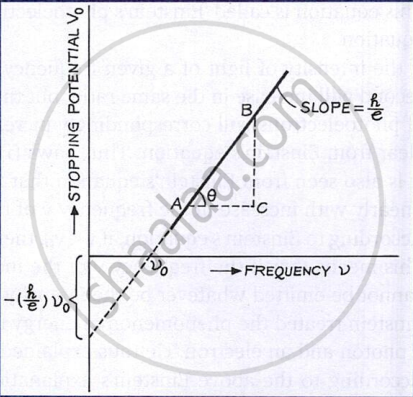
- A graph of stopping potential V0 versus frequency ν is a straight line, showing a linear relation between them.
- The slope of the V0 – ν graph equals h/e, hence Planck’s constant h can be determined using the known value of electronic charge e.
CISCE: Class 12
Key Points: Properties of Photons
- Radiation behaves like a stream of particles called photons during interaction with matter.
- Photons travel in straight lines at the speed of light.
- Each photon has energy E = hν = \[\frac {hc}{λ}\] and momentum p = \[\frac {E}{c}\].
- On a change of medium, the speed and wavelength of a photon change, but its frequency remains constant.
- Photon energy is independent of light intensity; higher intensity means more photons per second.
- A photon has zero rest mass, but an equivalent mass given by
- m = \[\frac {h}{cλ}\]
- Photons are electrically neutral and are not deflected by electric or magnetic fields.
- In photon–particle collisions, total energy and momentum are conserved.
- A photon retains its identity until absorbed by an atom, after which its identity is lost.
Maharashtra State Board: Class 12
Definition: Compton Shift
The change in wavelength of X-rays after scattering from electrons is called the Compton shift.
Maharashtra State Board: Class 12
Formula: Compton Shift
\[\Delta\lambda=\lambda^{\prime}-\lambda=\frac{h}{m_ec}(1-\cos\theta)\]
Maharashtra State Board: Class 12
Definition: Photocell
A device that uses the photoelectric effect to convert light energy into electrical energy is called a photocell.
Maharashtra State Board: Class 12
Definition: de Broglie Hypothesis
The hypothesis that matter, like radiation, exhibits both wave and particle nature is called the de Broglie hypothesis.
Maharashtra State Board: Class 12
Definition: Matter Waves
The waves associated with moving material particles are called matter waves.
Maharashtra State Board: Class 12
Definition: de Broglie Wavelength
The wavelength associated with a moving material particle is called the de Broglie wavelength.
Maharashtra State Board: Class 12
Formula: de Broglie Relation
λ = \[\frac {h}{p}\]
\[
\lambda = \frac{h}{mv}
\]
Maharashtra State Board: Class 12
Key Points: Davisson and Germer Experiment
- Davisson and Germer tested de Broglie’s idea by firing electrons at a nickel crystal.
- Electrons were accelerated through a known voltage and allowed to scatter from the crystal.
- The scattered electrons formed a diffraction pattern, showing wave behaviour.
- The measured wavelength matched the value calculated from de Broglie’s formula.
- The experiment demonstrated that electrons exhibit wave-like behaviour and confirmed wave–particle duality.
Maharashtra State Board: Class 12
Definition: Thermionic Emission
The emission of electrons from a metal surface by heating it to high temperature is called thermionic emission.
Maharashtra State Board: Class 12
Definition: Field Emission
The emission of electrons from a metal surface by applying a strong electric field is called field emission.
Maharashtra State Board: Class 12
Definition: Electron Microscope
A microscope that uses accelerated electron beams instead of visible light to obtain high-resolution images is called an electron microscope.
Maharashtra State Board: Class 12
Key Points: Wave-Particle Duality of Matter
- The wave nature of matter is important only for very small particles, not for large objects.
- A bigger mass or a higher speed means a smaller wavelength, so large objects do not show wave effects.
- Electrons show wave behaviour when their wavelength is comparable to the atomic size.
- Particle nature appears during interaction with matter, while wave nature appears during motion in space.
- Electron microscopes use very short electron wavelengths to achieve much higher resolution than optical microscopes.
