Topics
Electric Charges and Fields
- Electric Charge
- Positive and Negative Charges
- Electron Theory of Electrification
- Conductors and Insulators
- Electrostatic Induction
- Important Properties of Electric Charge
- Scalar Form of Coulomb’s Law
- Coulomb's Law in Vector Form
- Principle of Superposition
- Equilibrium of Charge and System of Charges
- Electric Field
- Intensity of Electric Field
- Electric Field Intensity Due to a Point-Charge
- Intensity of Electric Field due to a Continuous Charge Distribution
- Electric Lines of Force
- Electric Dipole
- Electric Field due to an Electric Dipole
- Torque on a Dipole in a Uniform Electric Field
- Motion of a Charged Particle in Uniform Electric Field
Electrostatics
Current Electricity
Gauss' Theorem
- Area Vector
- Solid Angle
- Electric Flux
- Gauss' Theorem
- Gaussian Surface and its Properties
- Applications of Gauss' Theorem > Electric Field due to a Point Charge
- Applications of Gauss' Theorem > Electric Field due to an Infinite Line of Charge
- Applications of Gauss' Theorem > Electric Field due to an Infinite Plane Sheet of Charge
- Applications of Gauss' Theorem > Electric Field due to Two Infinite Parallel Sheets of Charge
- Applications of Gauss' Theorem > Electric Field Intensity Just Outside a Charged Conductor
- Applications of Gauss' Theorem > Electric Field due to a Uniformly Charged Thin Spherical Shell
- Applications of Gauss' Theorem > Electric Field due to a Uniformly Charged Sphere
- Overview: Gauss' Theorem
Magnetic Effects of Current and Magnetism
Electric Potential
- Electric Potential
- Potential and Potential Difference
- Electron-volt or eV
- Electric Potential Due to a Point Charge
- Potential due to a Group of Point Charges
- Potential Gradient
- Electric Field as Gradient of Electric Potential: Relation between E and V
- Electric Potential Energy of a System of Charges
- Equipotential Surfaces
- Potential Due to an Electric Dipole
- Work Done in Rotating an Electric Dipole in an Electric Field
- Electric Potential Energy of an Electric Dipole in an Electrostatic Field
- Overview: Electric Potential
Electromagnetic Induction and Alternating Currents
Capacitors and Dielectrics
- Conductors and Insulators
- Free Charges and Bound Charges Inside a Conductor
- Capacitance of a Conductor
- Capacitance of an Isolated Spherical Conductor
- Potential Energy of a Charged Conductor
- Redistribution of Charges: Common Potential
- Capacitors
- Capacitance of a Capacitor
- Expression for Capacitance of a Parallel-Plate Capacitor
- Dependence of the Capacitance of a Capacitor
- Capacitance of a Parallel-Plate Capacitor with Dielectric Slab between Plates
- Combination of Capacitors
- Energy Stored in a Charged Capacitor
- Force between the Plates of a Charged Parallel-Plate Capacitor
- Induced Charges in a Dielectric Slab in a Capacitor
- Dielectrics
- Electric Polarisation of Matter
- Effect of Introducing a Dielectric between the Plates of a Charged Capacitor
- Overview: Capacitors and Dielectrics
Electromagnetic Waves
Electric Resistance and Ohm's Law
- Electric Current
- Current Density
- Mechanism of Flow of Charge in Metals
- Transport Properties of Free Electrons
- Mobility of Electrons
- Electric Current and Its Related Concepts
- Resistance
- Ohm's Law
- Experimental Verification of Ohm’s Law and Ohmic Resistors
- Exceptions of Ohm's Law : Non-Linear V-I Characteristics
- Dynamic Resistance
- Derivation of Ohm's Law
- Specific Resistance or Electrical Resistivity
- Ohm's law in Vector Form
- Dependence of Resistance on the Dimensions of the Conductor
- Effect of Temperature on Resistivity
- Colour Code of Carbon Resistors
- Combinations of Resistances
- On the Basis of Series and Parallel Combinations, to Prove R ∝ 1/A
- Electric Energy and Power
- Commercial Units of Electricity Consumption
- Net Power Consumption
- Overview: Electric Resistance and Ohm's Law
Optics (Ray and Wave Optics)
DC Circuits and Measurements
- Electric cell
- Electromotive Force (emf)
- Terminal Potential Difference
- Internal Resistance of a Cell
- Relation between E, V, and r
- Combinations of Cells
- Kirchhoff’s Laws
- Wheatstone Bridge
- Rheostat
- Metre Bridge: Slide-Wire Bridge
- Potentiometer
- Overview: DC Circuits and Measurements
Moving Charges and Magnetic Field
- Magnetic Field
- Oersted's Experiment
- Biot-Savart Law
- Comparison of Coulomb's Law and Biot-Savart's Law
- Rules to Determine the Direction of Developed Magnetic Field
- Applications of Biot-Savart's Law > Magnetic Field due to a Finite Straight Current-Carrying Wire
- Magnetic Field on the Axis of a Circular Current-Carrying Loop
- Applications of Biot-Savart's Law > Magnetic Field at the Centre of a Circular Loop
- Ampere’s Circuital Law
- Applications of Ampere’s Circuital Law > Magnetic Field of a Long Straight Solenoid
- Applications of Ampere’s Circuital Law > Magnetic Field of a Long Straight Thin Wire
- Applications of Ampere’s Circuital Law > Magnetic Field of a Toroidal Solenoid
- Force on a Moving Charge in a Uniform Magnetic Field
- Magnetic Field Defined by Magnetic Force
- Motion of Charged Particles in a Uniform Magnetic Field
- Lorentz Force
- Cyclotron
- Force on a Current Carrying Conductor in a Magnetic Field
- Ampere: Based on Force Between Currents
- Overview: Moving Charges and Magnetic Field
Dual Nature of Radiation and Matter
Atoms and Nuclei
Torque on a Current-Loop : Moving-Coil Galvanometer
Magnetic Field and Earth's Magnetism
- Current Loop as a Magnetic Dipole
- Magnetic Dipole Moment of a Revolving Electron
- Magnetic Field of a Magnetic Dipole (Small Bar Magnet)
- Torque on a Magnetic Dipole (Bar Magnet) in a Uniform Magnetic Field
- Potential Energy of a Magnet in a Magnetic Field
- Current-Carrying Solenoid as an Equivalent to a Bar Magnet
- Magnetic Lines of Force
- Earth’s Magnetic Field
- Elements of the Earth's Magnetic Field > Angle of Declination
- Elements of the Earth's Magnetic Field > Angle of Dip or Magnetic Inclination
- Elements of the Earth's Magnetic Field > Horizontal Component of Earth's Magnetic Field
- Overview: Magnetic Field and Earth's Magnetism
Electronic Devices
Magnetic Classification of Substances
- Classification of Substances According to their Magnetic Behaviour
- Terms Used in Magnetism
- Properties of Dia-, Para-, and Ferromagnetic Substances
- Explanation of Dia-, Para-, and Ferromagnetism based on the Atomic Model of Magnetism
- Hysteresis: Retentivity and Coercivity
- Differences in Magnetic Properties of Soft Iron and Steel
- Magnetic Materials
- Overview: Magnetic Classification of Substances
Communication Systems
Electromagnetic Induction
- Magnetic Flux
- Electromagnetic Induction
- Faraday's Laws of Electromagnetic Induction
- Induced Current and Induced Charge
- Methods of Changing the Magnetic Flux
- Motion of a Straight Conductor in a Uniform Magnetic Field (Motional EMF)
- Explanation of Electromagnetic Induction in Terms of Lorentz Force: Proof of Faraday's Law
- Motional emf in Rotating a Conducting Rod in a Uniform Magnetic Field
- Self – Induction
- Self-Inductance of a Long Solenoid
- Energy Stored in an Inductor
- Examples of the Effects of Self-Induced Current
- Mutual Induction
- Mutual Inductance
- Eddy Currents or Foucault Currents
- Overview: Electromagnetic Induction
Alternating Current
- Alternating Voltage and Current in a Rotating Coil
- Definitions Regarding Alternating Voltage and Current
- Mean (or Average) Value of Alternating Current (or Voltage)
- Root-Mean-Square Value of Alternating Current
- Phasors and Phasor Diagrams
- Types of AC Circuits
- Circuit containing Resistance Only
- Circuit containing Inductance Only
- Circuit containing Capacitance Only
- Circuit containing Inductance and Resistance in Series (L-R Series Circuit)
- Circuit containing Capacitance and Resistance in Series (C-R Series Circuit)
- Circuit containing Inductance and Capacitance (L-C Circuit)
- Circuit containing Inductance, Capacitance and Resistance in Series (L-C-R Series Circuit)
- Power in AC Circuit
- Wattless Current
- Half Power Points, Bandwidth and Q-Factor
- Choke Coil
- Electrical Oscillations in L-C Circuit
- Resonant Circuits
- Frequency Response of AC Circuits
- A.C. Generator
- Transformers
- Utility of Alternating Current in Comparison to Direct Current
- Overview: Alternating Current
Electromagnetic Waves
- Displacement Current
- Relation between Conduction and Displacement Current
- Maxwell's Equation
- Concept of Electromagnetic Waves
- Field Magnitude Relation in Free Space
- Energy Density in Electromagnetic Waves
- Transverse Nature of Electromagnetic Waves
- Electromagnetic Spectrum
- Overview: Electromagnetic Waves
Reflection of Light: Spherical Mirrors
- Spherical Mirrors
- Fundamental Terms Related to Spherical Mirrors
- Relation Between Focal Length and Radius of Curvature of a Spherical Mirror
- Rules to Trace the Image Formed by Spherical Mirrors
- Conditions of Image Formation
- Position and Nature of Image Formed by Spherical Mirrors
- Sign Convention
- Mirror Formula for Concave Mirror
- Mirror Formula for Convex Mirror
- Linear Magnification by Spherical Mirrors
- Uses of Spherical Mirrors
- Overview: Reflection of Light: Spherical Mirrors
Refraction of Light at a Plane Interface : Total Internal Reflection : Optical Fibre
- Refraction of Light
- Laws of Refraction
- Cause of Refraction
- Physical Significance of Refractive Index
- Reversibility of Light
- Refraction of Light Through a Rectangular Glass Block
- Refraction through Parallel Multiple Media
- Real and Apparent Depths: Normal Displacement
- Critical Angle
- Total Internal Reflection
- Applications of Total Internal Reflection
- Overview: Refraction of Light at a Plane Interface
Refraction of Light at Spherical Surfaces : Lenses
- Coordinate Geometry Sign Convention for Measuring Distances and Lengths
- Refraction at Concave Spherical Surface
- Refraction at a Convex Spherical Surface
- Concept of Lenses
- Converging and Diverging Actions of Lenses
- Lens Maker's Formula
- Factors Affecting Focal Length of a Lens
- Image Formation by Thin Lenses
- Ray Diagrams for Formation of Image by a Convex Lens
- Ray Diagram for Formation of Image by a Concave Lens
- Linear Magnification by Spherical Lenses
- Power of a Lens
- Combined Focal Length of Two Thin Lenses in Contact
- Combination of Lenses and Mirrors
- Overview: Refraction of Light at Spherical Surfaces: Lenses
Refraction and Dispersion of Light through a Prism
Optical Instruments
Wave Nature of Light : Huygens' Principle
Interference of Light
Diffraction of Light
Polarisation of Light
Photoelectric Effect
Matter Waves
X-Rays
Atom, Origin of Spectra : Bohr's Theory of Hydrogen Atom
Nuclear Structure
Radioactivity
Mass-Energy Equivalence : Nuclear Binding Energy
Nuclear Fission and Nuclear Fusion : Sources of Energy
Semiconductor Electronics
Junction Diodes
Junction Transistors
Logic Gates
Communication Systems
- Introduction
- Definition: Capacitor
- Principle of a Capacitor
Capacitors
A capacitor, also known as a condenser, is a key passive component in electrical and electronic circuits, used to store and release electrical energy. Capacitors have a specific charge storage capacity, measured in farads, and come in fixed and variable types, ranging from picofarads to microfarads. They consist of two parallel conducting surfaces separated by a dielectric material.
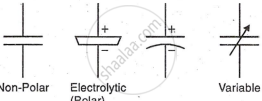
Charging & Discharging
When a battery connects to a capacitor, current flows, indicated by a meter. Initially, plates A and B have equal electrons. Upon connection, electrons accumulate on plate A, creating electrostatic induction. This forces plate B to pass electrons to the battery, resulting in a negative charge on plate A and a positive charge on plate B. Electrons flow until the capacitor voltage matches the battery voltage.

RC Time Constant
The time constant in timer circuits is the time for a capacitor to charge to 63.28% of the applied voltage or discharge to 36.72% of its initial voltage. It is calculated using the formula:
T = R x C.
Remember: In 5 time constant, capacitor gets charged to applied voltage or in 5 time constant it will get completely discharged.
Paper Capacitors (Fixed Capacitors)
All fixed non-polar capacitors have a similar construction: two conducting surfaces separated by a dielectric material. A paper capacitor is made by rolling two thin metal foils with dielectric-impregnated Kraft paper. These non-polar capacitors can be connected in any direction, as polarity is not marked.
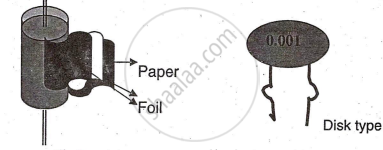
Specialty: Medium capacitance, small size, non-polar.
Range: 500pF to 1µF, voltage rating 100V to 1000V.
Mica & Ceramic Capacitor (Fixed Capacitors)
Mica: The construction is like paper capacitor, only the dielectric material used is mica foil or mica sheet as shown.
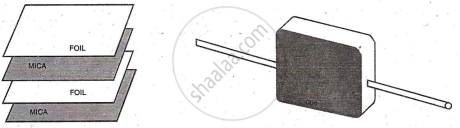
Specialty: High temperature range -55°C to 150°C, non-polar.
Range: 5pF to 10,000pF, voltage rating around 500V.
Ceramic: These capacitors are commonly observed in many circuits. The construction of ceramic capacitors is different than paper and mica capacitors. It is built by depositing silver plates on each side of a thin ceramic material disc. During the process tinned wire leads are attached to each plate.
Speciality: Economical at 1 Rs. per piece.
Range: 3pF to 2µF, voltage range 3V to 6000V, non-polar.

Aluminum Electrolytic Capacitor (Fixed Capacitors)
This polar capacitor has marked positive and negative terminals, with polarity being crucial to prevent damage. Unlike non-polar capacitors, they offer higher capacitance due to electrolyte.
Construction:
It consists of an aluminum foil electrode with an aluminum oxide film (dielectric) and an electrolyte (second plate). A plain aluminum foil layer provides electrical contact between one terminal and the electrolyte. Typically used in DC circuits, such as rectifier filters, rather than AC circuits.
Specialty: High values, high cost, polar capacitors
Range: 1µF to 3000µF, voltage rating 1V to 500V.
Air Gang Capacitor (Variable Capacitors)
An air gang condenser is a variable capacitor with two sets of parallel plates: a fixed stator and a movable rotor on a shaft. Rotating the shaft changes the plate area overlap, thus varying capacitance. Used in valve radios with two gang capacitors and miniature types in transistor receivers. Other adjustable variable capacitors are trimmers and padders.
Specialty : Used for tuning the radio, large size, high cost but high operating voltage~
Typical Range: 1 pF to 500 pF. Maximum operating voltage 1 KV
