Topics
Gravitation
- Concept of Gravitation
- Force and Motion
- Circular Motion and Centripetal Force
- Kepler’s Laws
- Law of Orbit or Kepler's First Law
- Law of Areas or Kepler's Second Law
- Law of Periods or Kepler's Third Law
- Newton's Universal Law of Gravitation
- Uniform Circular Motion (UCM)
- Earth’s Gravitational Force
- Earth’s Gravitational Acceleration
- Mass and Weight
- Gravitational Waves
- Free Fall
- Gravitational Potential Energy
- Escape Velocity
- Weightlessness in Space
Periodic Classification of Elements
- Classification of Elements
- Dobereiner’s Triads
- Newland's Law of Octaves
- Mendeleev’s Periodic Table
- Insights into Mendeleev’s Periodic Table
- Modern Periodic Law
- Modern Periodic Table
- Structure of the Modern Periodic Table
- Modern Periodic Table and Electronic Configuration of Elements
- Groups and Electronic Configuration
- Periods and Electronic Configuration
- Periodic Trends in the Modern Periodic Table
- Atomic Size
- Metallic and Non-metallic Characters
- Gradation in Halogen Family
Chemical Reactions and Equations
- Chemical Reaction
- Chemical Equations
- Balancing Chemical Equation
- Types of Chemical Reactions > Combination Reaction
- Types of Chemical Reactions > Decomposition Reaction
- Types of Chemical Reactions > Single Displacement Reaction
- Types of Chemical Reactions > Double Displacement Reaction
- Endothermic and Exothermic Processes
- Rate of Chemical Reaction
- Types of Chemical Reactions > Oxidation and Reduction Reactions
- Corrosion of Metals
- Factors Affecting the Rate of a Chemical Reaction
- Rancidity
Effects of Electric Current
- Electric Circuit
- Heating Effect of Electric Current
- Magnetic Effect of Electric Current
- Right-hand Thumb Rule
- Applications of Biot-Savart's Law > Magnetic Field at the Axis of a Circular Current-carrying Loop
- Applications of Ampere’s Circuital Law > Magnetic Field of a Long Straight Solenoid
- Force on a Current-Carrying Conductor Placed in a Uniform Magnetic Field
- Fleming’s Left Hand Rule
- Electric Motor
- Introduction to Electromagnetic Induction
- Galvanometer
- Faraday's Laws of Electromagnetic Induction
- Fleming’s Right Hand Rule
- Alternating current (AC) and Direct Current (DC)
- Electric Generator
Heat
Refraction of Light
Lenses
- Concept of Lenses
- Images Formed by Convex Lenses
- Images Formed by Concave Lenses
- Sign Convention
- Lens Formula and Magnification
- Magnification
- Power of a Lens
- Combination of Lenses
- Human Eye
- Defects of Vision and Their Corrections > Myopia
- Defects of Vision and Their Corrections > Hypermetropia
- Defects of Vision and Their Corrections > Presbyopia
- Apparent Size of an Object
- Use of Concave Lenses
- Use of Convex Lenses
- Persistence of Vision
Metallurgy
- Physical Properties of Metal
- Physical Properties of Non-metal
- Chemical Properties of Metal
- Reactions of Metals
- Reactivity Series of Metals
- Chemical Properties of Non-metal
- Ionic Compounds
- Metallurgy
- Basic Principles of Metallurgy > Concentration of Ores
- Basic Principles of Metallurgy > Extraction of Metals
- Basic Principles of Metallurgy > Refining of Metals
- Corrosion of Metals
- Prevention of Corrosion
Carbon Compounds
- Bonds in Carbon Compounds
- Carbon: A Versatile Element
- Hydrocarbons
- Straight chains, Branched chains, and Rings of Carbon atoms
- Functional Groups in Carbon Compounds
- Nomenclature
- The IUPAC System of Nomenclature
- Homologous Series
- Chemical Properties of Carbon Compounds > Combustion
- Chemical Properties of Carbon Compounds > Oxidation
- Chemical Properties of Carbon Compounds > Addition Reaction
- Chemical Properties of Carbon Compounds > Substitution Reaction
- Ethanol
- Ethanoic Acid
- Macromolecules and Polymers
Space Missions
School of Elements
The Magic of Chemical Reactions
- Types of Chemical Reactions > Combination Reaction
- Types of Chemical Reactions > Decomposition Reaction
- Types of Chemical Reactions > Single Displacement Reaction
- Types of Chemical Reactions > Double Displacement Reaction
- Chemical Properties of Carbon Compounds > Oxidation
- Types of Double Displacement: Neutralization Reaction
The Acid Base Chemistry
The Electric Spark
All about Electromagnetism
- Magnetic force
- Bar Magnet and Solenoid Analogy
- Right-hand Thumb Rule
- Applications of Biot-Savart's Law > Magnetic Field at the Axis of a Circular Current-carrying Loop
- Applications of Ampere’s Circuital Law > Magnetic Field of a Long Straight Solenoid
- Force on a Current-Carrying Conductor Placed in a Uniform Magnetic Field
- Electric Motor
- Introduction to Electromagnetic Induction
- Alternating-Current Generator
- Simple D.C. Motor
- Household Electrical Circuits
Wonders of Light 1
Wonders of Light 2
Striving for better Environment 1
- Abatement of Pollution
- Sustainable Use of Resources
Maharashtra State Board: Class 10
Rules for Image Formation by a Convex Lens
| Rule No. | Description | Diagram |
|---|---|---|
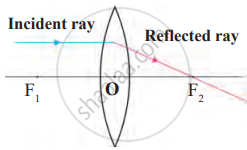
| Rule 1 | When the incident ray is parallel to the principal axis, the refracted ray passes through the principal focus (F₂). |
 |
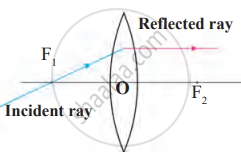
| Rule 2 | When the incident ray passes through the principal focus (F₁), the refracted ray becomes parallel to the principal axis. |
 |
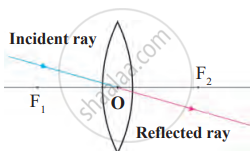
| Rule 3 | When the incident ray passes through the optical centre (O) of the lens, it does not change direction. |
 |
Maharashtra State Board: Class 10
CISCE: Class 10
CISCE: Class 10
Key Points: Characteristics and Location of Images for a Convex Lens
| S. No. | Position of the Object | Position of the Image | Size of the Image | Nature of the Image |
|---|---|---|---|---|
| 1 | At infinity | At focus (F₂) | Point image | Real and inverted |
| 2 | Beyond (2F₁) | Between (F₂) and (2F₂) | Smaller | Real and inverted |
| 3 | At (2F₁) | At (2F₂) | Same size | Real and inverted |
| 4 | Between (F₁) and (2F₁) | Beyond (2F₂) | Larger | Real and inverted |
| 5 | At focus (F₁) | At infinity | Very large | Real and inverted |
| 6 | Between (F₁) and O | On the same side of the lens as the object | Very large | Virtual and erect |
Maharashtra State Board: Class 10
Experiment
1. Aim: To study the formation of images by a convex lens at different object positions and observe the nature, size, and position of the image.
2. Requirements: convex lens, screen, meter scale, lens stand, candle, and chalk
3. Procedure
- Draw a straight line on a table and place the convex lens at the centre (O).
- Place a screen on one side and adjust it to form a clear image of a distant object, marking its focus (F₁).
- Measure the distance O to F₁ and mark 2F₁ at twice this distance. Repeat for F₂ and 2F₂ on the other side.
- Place a burning candle beyond 2F₁ and adjust the screen to obtain a clear image. Record its position, size, and nature.
- Repeat the experiment by placing the candle at different positions: beyond 2F₁, at 2F₁, between 2F₁ and F₁, at F₁, and between F₁ and O.
- Observe and record the image characteristics for each case.

4. Conclusion
- When the object is placed beyond 2F₁, the image is between F₂ and 2F₂, real, inverted, and smaller.
- If placed at 2F₁, the image is same-sized, real, and inverted at 2F₂.
- When placed between 2F₁ and F₁, the image is beyond 2F₂, real, inverted, and magnified.
- At F₁, the image is at infinity, highly magnified, real, and inverted.
- If placed between F₁ and O, the image is virtual, erect, and magnified on the same side as the object.
Maharashtra State Board: Class 10
Images formed by convex lenses for different positions of the object
| S. No. | Position of the Object | Position of the Image | Size of the Image | Nature of the Image | Ray Diagram |
|---|---|---|---|---|---|
| 1 | At infinity | At focus F₂ | Point image | Real and inverted | 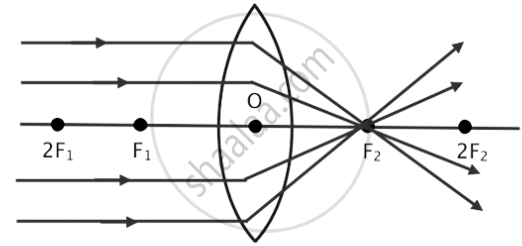 |
| 2 | Beyond 2F₁ | Between F₂ and 2F₂ | Smaller | Real and inverted | 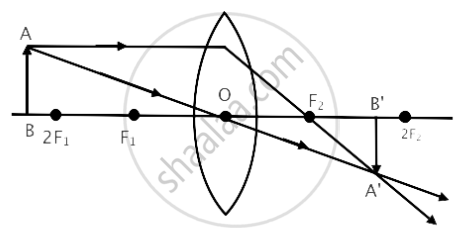 |
| 3 | At 2F₁ | At 2F₂ | Same size | Real and inverted |  |
| 4 | Between F₁ and 2F₁ | Beyond 2F₂ | Larger | Real and inverted | 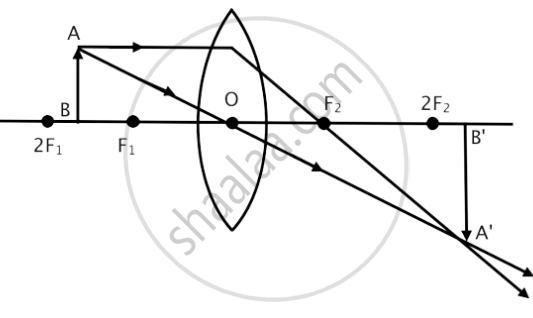 |
| 5 | At focus F₁ | At infinity | Very large | Real and inverted |  |
| 6 | Between F₁ and O | On the same side of the lens as the object | Very large | Virtual and erect | 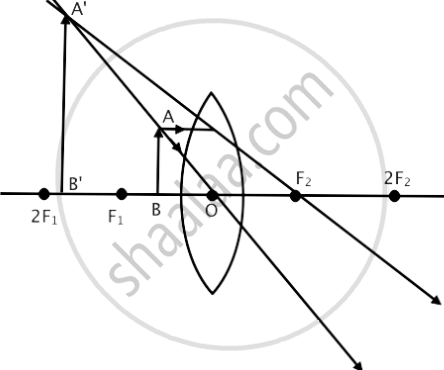 |
Related QuestionsVIEW ALL [22]
Complete the following table based on image formation by convex lens:
| Position of Object | Position of Image | Nature of Image |
| At infinity | (a) ______ | Real and inverted and highly diminished image |
| Beyond 2F1 | (b) ______ | (c) ______ |
| At 2F1 | (d) ______ | Real, inverted, same size (as object) image |
| Between F1 and 2F1 | Beyond 2F2 | (e) ______ |
| At focus F1 | (f) ______ | Real, inverted and highly enlarged image |
