मराठी
Maharashtra State BoardSSC (English Medium) 10th Standard

Twinkling of Stars

Advertisements

Topics

  • Definition: Mirage
  • Key Points: Twinkling of Stars
Maharashtra State Board: Class 10

Twinkling of Stars: A Beautiful Atmospheric Effect

Stars appear to twinkle due to atmospheric refraction. As starlight passes through layers of air with different densities and temperatures, it bends multiple times. Some light rays reach our eyes directly, while others bend away, creating a flickering effect. Stars near the horizon twinkle more because their light passes through more atmospheric layers, undergoing greater refraction.

The Role of Refraction in Twinkling:

When a ray of light travels from one medium to another, it bends due to a change in speed. This phenomenon is called refraction.

  • From a rarer to a denser medium → Light bends towards the normal.
  • From a denser to a rarer medium → Light bends away from the normal.

The Earth’s atmosphere consists of different layers of air with varying temperatures, densities, and refractive indices. As starlight passes through these layers, it refracts several times before reaching us. This continuous bending of light due to atmospheric changes makes the stars appear to twinkle.

Why Do Some Stars Twinkle More?

  • Stars closer to the horizon appear to twinkle more than those overhead.
  • This is because light from low-horizon stars passes through more layers of air, undergoing more refraction.
Maharashtra State Board: Class 10

Steady Shine of Planets

Planets do not twinkle like stars because they are much closer to Earth and appear as larger objects rather than single point sources of light.

  • Light from different parts of the planet’s surface enters the atmosphere and undergoes separate refractions.
  • The dimming of some light rays is balanced by the brightening of others, so the overall brightness remains constant.
  • As a result, planets appear steady, unlike twinkling stars.
Maharashtra State Board: Class 10

Other Effects of Atmospheric Refraction

1. Mirage Effect: A mirage is another optical illusion caused by atmospheric refraction. It occurs when light bends due to temperature differences in the air.

  • On hot roads or deserts, the air near the surface is hotter and less dense, while the air above is cooler and denser.
  • Light from the sky bends when passing through these layers, creating an illusion of water or an inverted image of distant objects.
  • This is why travellers in a desert may see what looks like a pool of water in the distance, which disappears as they move closer.
  • Similarly, near a Holi fire, the rising hot air distorts the light passing through it, making distant objects appear moving or wavy.
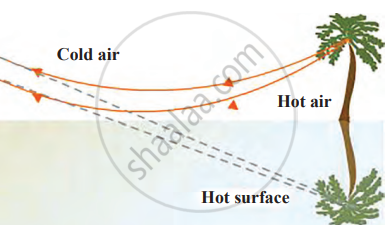
Mirage

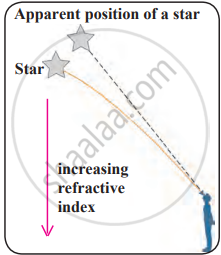
2. Apparent Position of Stars: The apparent position of a star is slightly different from its actual position due to atmospheric refraction.

  • As starlight moves towards us, it travels from rarer (upper atmosphere) to denser (lower atmosphere) layers, bending towards the normal.
  • This makes the star appear higher in the sky than its actual position.
  • Since the air is constantly moving, the density and refractive index change continuously, causing the star’s position and brightness to fluctuate, leading to twinkling.
3. Sunrise and Sunset Shift: Due to atmospheric refraction, we can see the sun before it actually rises and after it has set.

  • When the Sun is below the horizon, its light rays bend due to refraction in the atmosphere and reach our eyes along a curved path.
  • This makes the Sun appear slightly higher than it actually is, allowing us to see it before actual sunrise and after sunset.
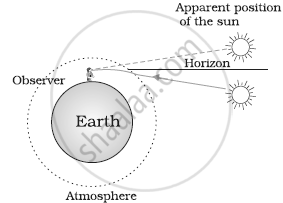
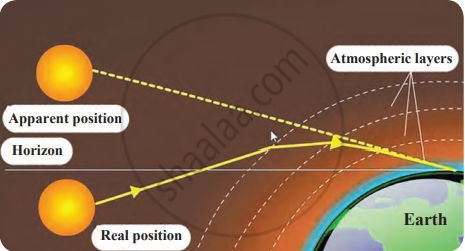
Effect of atmospheric refraction

Maharashtra State Board: Class 10

Definition: Mirage

The light rays coming from a distant object appear to be coming from the image of the object inside the ground. This is called a mirage.

Maharashtra State Board: Class 10

Key Points: Twinkling of Stars

  • Mirage: Looks like water on a hot road; caused by light bending in hot, less dense air.
  • Shaking Objects Near Fire: Hot air near the fire bends light unevenly, making objects look like they are moving.
  • Star Twinkling: Stars twinkle because their light bends through moving air layers in the atmosphere.
  • Planets Don’t Twinkle: Planets are closer and appear bigger, so changes in light cancel out.
  • Early Sunrise & Late Sunset: We see the Sun even before it rises and after it sets because of light bending in the atmosphere.
Advertisements
Share
Notifications

Englishहिंदीमराठी


      Forgot password?
Use app×