मराठी
Maharashtra State BoardSSC (English Medium) 10th Standard

Basic Principles of Metallurgy > Extraction of Metals

Advertisements

Topics

  • Key Points: Extraction of Metals
Maharashtra State Board: Class 10

Extraction of Aluminium

Aluminium is a highly reactive metal and does not occur in a free state. It is the third most abundant element in the Earth's crust, mainly found in bauxite (Al₂O₃·nH₂O).
Symbol: Al
Color: Silver white
Atomic Number: 13
Electronic Configuration: 2, 8, 3
Valency: 3 
The extraction of aluminium involves two major steps:

1. Concentration of Bauxite Ore

Bauxite contains impurities like silica (SiO₂), ferric oxide (Fe₂O₃), and titanium oxide (TiO₂), which are removed using Bayer’s process or Hall’s process.

A. Bayer’s Process (Using NaOH)

Bauxite is ground and heated with concentrated NaOH at 140–150°C under high pressure. Aluminium oxide reacts with NaOH, forming sodium aluminate (soluble). 

  • Al₂O₃⋅2H₂O + 2NaOH→2NaAlO₂ + 3H₂O

Iron oxide remains undissolved and is filtered out. Silica dissolves, forming sodium silicate. Sodium aluminate solution is cooled and diluted, causing Al(OH)₃ precipitation. 

  • NaAlO₂ + 2H₂O → NaOH + Al(OH)₃↓

Al(OH)₃ is heated at 1000°C, producing pure alumina (Al₂O₃).

  • 2Al(OH)₃→Al₂O₃ + 3H₂O₂

B. Hall’s Process (Using Na₂CO₃)

Bauxite is leached with aqueous Na₂CO₃, forming sodium aluminate.

  • Al₂O₃⋅2H₂O + Na₂CO₃ → 2NaAlO₂ + CO₂ + 2H₂

CO₂ is bubbled through the filtrate, precipitating Al(OH)₃.

  • 2NaAlO₂ + 3H₂O + CO₂ → 2Al(OH)₃↓ + Na₂CO₃

Al(OH)₃ is heated at 1000°C, yielding Al₂O₃ (same as Bayer’s process).

2. Electrolytic Reduction of Alumina

Electrolysis of molten alumina (Al₂O₃) mixed with cryolite (Na₃AlF₆) and fluorspar (CaF₂) is carried out in a steel tank.

  • The tank’s graphite lining acts as the cathode.
  • Graphite rods act as the anode.
  • Purpose of Cryolite & Fluorspar: These lower alumina’s melting point from >2000°C to ~1000°C, making the process more energy-efficient.

Extraction of aluminium

Electrode Reactions:

a. At Cathode (Reduction)

  • Al³⁺ + 3e⁻ → Al(l). 
  • Aluminium metal is deposited at the cathode and sinks to the bottom of the tank.

b. At Anode (Oxidation)

  • 2O₂⁻→O₂+4e⁻
  • Oxygen gas is released, which reacts with graphite anodes to form CO₂, requiring periodic replacement of the anodes.

Collection of Aluminium: Since molten aluminium is denser than the electrolyte, it settles at the bottom. It is periodically extracted through an outlet. This method efficiently extracts pure aluminium from its oxide (Al₂O₃) using electrolysis.
Maharashtra State Board: Class 10

Extraction of Moderately Reactive Metals

Metals in the middle of the reactivity series (e.g., iron, zinc, lead, manganese) are moderately reactive and mostly found as sulphides or carbonates. Since it is easier to extract metals from their oxides, these ores are first converted to oxides before reduction.

Conversion to Metal Oxides:

Roasting (for Sulphide Ores) → Heated in excess air

2ZnS + 3O₂ → 2ZnO + 2SO₂↑

Calcination (for Carbonate Ores) → Heated in limited air

ZnCO₃ → ZnO + CO₂↑

Reduction to Metal: The metal oxides are reduced using carbon (coke) or more reactive metals (e.g., Na, Ca, Al).

Zinc Extraction

  • From Zinc Blende (ZnS) → Roasting → ZnO
  • From Calamine (ZnCO₃) → Calcination → ZnO
  • Reduction using Carbon: ZnO + C → Zn + CO↑

Manganese Extraction (Thermite Reaction): Carbon cannot reduce MnO₂, so Aluminium is used.

3MnO₂ + 4Al → 3Mn + 2Al₂O₃ + heat

Iron Extraction (Thermite Reaction): Haematite (Fe₂O₃) is reduced using carbon or aluminium.

Fe₂O₃ + 3C → 2Fe + 3CO↑ Or Fe₂O₃ + 2Al → 2Fe + Al₂O₃ + heat

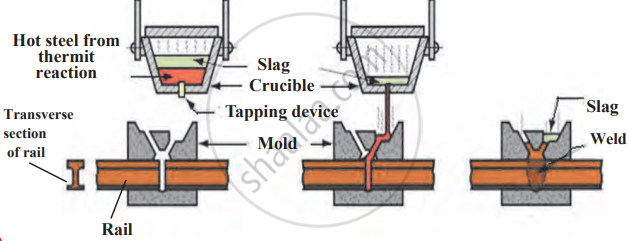
Thermite Welding: The thermite reaction (Fe₂O₃ + Al) releases high heat, melting iron. It is used for welding railway tracks and machine parts.

Methods used for welding rails:

Thermit Welding

Maharashtra State Board: Class 10

Extraction of Less Reactive Metals

Less reactive metals (e.g., gold, silver, platinum, and copper) are often found in their free state in nature due to their low reactivity. However, copper is mainly found in the form of copper sulphide (Cu₂S) and is extracted using a simple heating process.

Extraction of Copper from Cu₂S:

Roasting: Copper sulphide is heated in air, forming copper oxide.

  • 2Cu₂S + 3O₂ → 2Cu₂O + 2SO₂↑ 

Reduction: The formed Cu₂O reacts with the remaining Cu₂S, yielding pure copper:

  • 2Cu₂O + Cu₂S → 6Cu + SO₂↑

Since copper is less reactive, it does not require electrolysis or chemical reduction with carbon or aluminium. The process is straightforward and mainly involves heating in air to obtain the metal.

Maharashtra State Board: Class 10

Extraction of Reactive Metals

Metals are classified based on their reactivity. Highly reactive metals (e.g., potassium, sodium, calcium, magnesium, and aluminium) readily form cations by losing electrons and are never found in a free state in nature. They react vigorously with oxygen and acids. Their extraction requires electrolytic reduction, where molten salts of metals are subjected to electrolysis.

Electrolysis of Molten Sodium Chloride:

  • Cathode reaction: Na⁺ + e⁻ → Na (Reduction)
  • Anode reaction: 2Cl→ Cl2 + 2e (Oxidation)

Occurrence of Metals:

  • Low Reactivity Metals: Found in a free state (e.g., gold, silver, platinum, copper).
  • Medium Reactivity Metals: Found as oxides, sulphides, or carbonates (e.g., zinc, iron, lead).
  • High Reactivity Metals: Always found in compounds due to high reactivity (e.g., potassium, sodium, calcium, magnesium, aluminium).

Extraction Process Overview:

Maharashtra State Board: Class 10

Key Points: Extraction of Metals

  • Highly reactive metals like Na, K, and Al are extracted by electrolysis of their molten salts.
  • Aluminium is extracted from bauxite using leaching and electrolysis.
  • Cryolite and fluorspar help lower the melting point of alumina during extraction.
  • Moderately reactive metals like Zn and Fe are extracted by roasting or calcination, then reduced with carbon or aluminium.
  • Less reactive metals like gold and silver are found in the free state and extracted by heating.
 

Shaalaa.com | Metal and Non Metals part 14 (Occurence & extraction of metal)

Shaalaa.com


Next video


Shaalaa.com


Metal and Non Metals part 14 (Occurence & extraction of metal) [00:08:16]
S
Advertisements
Share
Notifications

Englishहिंदीमराठी


      Forgot password?
Use app×