Advertisements
Chapters
2: Motion in One Dimension
3: Laws of Motion
Chapter 4: Pressure in Fluids and its Transmission
▶ 5: Upthrust in Fluids, Archimedes’ Principle and Floatation
6: Heat and Energy
7: Reflection of Light
8: Propagation of Sound Waves
9: Current Electricity
10: Magnetism
![Selina solutions for Concise Physics [English] Class 9 ICSE chapter 5 - Upthrust in Fluids, Archimedes’ Principle and Floatation - Shaalaa.com](/images/concise-physics-english-class-9-icse_6:07d58a5ba3504cd1865aa94a55b34e1a.jpg "Selina solutions for Concise Physics [English] Class 9 ICSE chapter 5 - Upthrust in Fluids, Archimedes’ Principle and Floatation")
Advertisements
Solutions for Chapter 5: Upthrust in Fluids, Archimedes’ Principle and Floatation
Below listed, you can find solutions for Chapter 5 of CISCE Selina for Concise Physics [English] Class 9 ICSE.
Selina solutions for Concise Physics [English] Class 9 ICSE 5 Upthrust in Fluids, Archimedes’ Principle and Floatation Exercise 5 (A) [Pages 109 - 110]
What do you understand by the term upthrust of a fluid? Describe an experiment to show its existence.
In what direction and at what point does the buoyant force on a body due to a liquid act?
What is meant by the term buoyancy?
Define upthrust and state its S.I. unit.
What is the cause of upthrust? At which point can it be considered to act?
Why is a force needed to keep a block of wood inside water?
A piece of wood if left under water comes to the surface. Explain the reason.
Describe an experiment to show that a body immersed in a liquid appears lighter than it really is.
Will a body weigh more in air or vacuum when weighed with a spring balance? Give a reason for your answer.
A metal solid cylinder tied to a thread is hanging from the hook of a spring balance. The cylinder is gradually immersed into the water contained in a jar. What changes do you expect in the readings of the spring balance? Explain your answer.
A body dipped into a liquid experiences an upthrust. State two factors on which upthrust on the body depends.
How is the upthrust related to the volume of the body submerged in a liquid?
A bunch of feathers and a stone of the same mass are released simultaneously in air. Which will fall faster and why? How will your observation be different if they are released simultaneously in vacuum?
A body experiences an upthrust F1 in river water and F2 in sea water when dipped up to the same level. Which is more, F1 or F2? Give reason.
A small block of wood is completely immersed in (i) water, (ii) glycerine and then released. In each case, What do you observe? Explain the difference in your observation in the two cases.
A body of volume V and density ρ is kept completely immersed in a liquid of density ρL. If g is the acceleration due to gravity, then write expressions for the following:
(i) The weight of the body, (ii) The upthrust on the body,
(iii) The apparent weight of the body in liquid, (iv) The loss in weight of the body.
A body held completely immersed inside a liquid experiences two forces:
(i) F1, the force due to gravity and
(ii) F2, the buoyant force.
Draw a diagram showing the direction of these forces acting on the body and state the condition when the body will float or sink.
Complete the following sentence :
Two balls, one of iron and the other of aluminium experience the same upthrust when dipped completely in water if _____________ .
Complete the following sentence :
An empty tin container with its mouth closed has an average density equal to that of a liquid. The container is taken 2 m below the surface of that liquid and is left there. Then the container will ____________ .
Complete the following sentence :
A piece of wood is held under water. The upthrust on it will be ___________ the weight of the wood piece.
Prove that the loss in weight of a body when immersed wholly or partially in a liquid is equal to the buoyant force (or upthrust) and this loss is because of the difference in pressure exerted by liquid on the upper and lower surfaces of the submerged part of body.
A sphere of iron and another sphere of wood of the same radius are held under water. Compare the upthrust on the two spheres.
[Hint: Both have equal volume inside the water].
A sphere of iron and another of wood, both of same radius are placed on the surface of water. State which of the two will sink? Give a reason for your answer.
How does the density of material of a body determine whether it will float or sink in water?
A body of density ρ is immersed in a liquid of density ρL. State the condition when the body will (i) float and (ii) sink in the liquid.
It is easier to lift a heavy stone under water than in air. Explain.
State the Archimedes' principle.
Describe an experiment to verify the Archimedes' principle.
Selina solutions for Concise Physics [English] Class 9 ICSE 5 Upthrust in Fluids, Archimedes’ Principle and Floatation Exercise 5 (A) [Page 110]
A body will experience minimum upthrust when it is completely immersed in :
Turpentine
Water
Glycerine
Mercury
The S.I. unit of upthrust is :
Pa
N
kg
kg m2
A body of density ρ sinks in a liquid of density ρL. The densities ρ and ρL are related as :
ρ = ρL
ρ < ρL
ρ > ρL
Nothing can be said.
Selina solutions for Concise Physics [English] Class 9 ICSE 5 Upthrust in Fluids, Archimedes’ Principle and Floatation Exercise 5 (A) [Pages 110 - 111]
A body of volume 100 cm3 weighs 5 kgf in air. It is completely immersed in a liquid of density 1.8 × 10³ kg m-3. Find:
- The upthrust due to liquid and
- The weight of the body in liquid.
A body weighs 450 gf in air and 310 gf when completely immersed in water. Find
(i) The volume of the body,
(ii) The loss in weight of the body, and
(iii) The upthrust on the body.
State the assumption made in part (i).
You are provided with a hollow iron ball A of volume 15 cm3 and mass 12 g and a solid iron ball B of mass 12 g. Both are placed on the surface of water contained in a large tub.
- Find upthrust on each ball.
- Which ball will sink? Give a reason for your answer (Density of iron = 8.0 g cm-3)
A solid of density 5000 kg m-3 weighs 0.5 kgf in air. It is completely immersed in water of density 1000 kg m-3. Calculate the apparent weight of the solid in water.
Two spheres A and B, each of volume 100 cm3 is placed on water (density = 1.0 g cm−3). The sphere A is made of wood of density 0.3 g cm−3 and sphere B is made of iron of density 8.9 g cm−3.
- Find:
- The weight of each sphere, and
- The upthrust on each sphere.
- Which sphere will float? Give reason.
The mass of a block made of certain material is 13.5 kg and its volume is 15 × 10-3 m3.
(a) Calculate upthrust on the block if it is held fully immersed in water.
(b) Will the block float or sink in water when released? Give a reason for your answer.
(c) What will be the upthrust on block while floating?
Take density of water = 1000 kg m-3.
A piece of brass weighs 175 gf in air and 150 gf when fully submerged in water. The density of water is 1.0 g cm-3.
(i) What is the volume of the brass piece? (ii) Why does the brass piece weigh less in water?
A metal cube of edge 5 cm and density 9 g cm-3 is suspended by a thread so as to be completely immersed in a liquid of density 1.2 g cm-3. Find the tension in thread. (Take g = 10 m s-2)
A block of wood is floating on water with its dimensions 50 cm x 50 cm x 50 cm inside water. Calculate the buoyant force acting on the block. Take g = 9.8 N kg-1.
A body of mass 3.5 kg displaces 1000 cm3 of water when fully immersed inside it. Calculate:
- the volume of body,
- the upthrust on body and
- the apparent weight of body in water.
Selina solutions for Concise Physics [English] Class 9 ICSE 5 Upthrust in Fluids, Archimedes’ Principle and Floatation Exercise 5 (B) [Page 116]
Define the term density.
What are the units density in (i) C.G.S. and (ii) S.I. system .
Express the relationship between the C.G.S. and S.I. units of density.
'The density of iron is 7800 kg m-3'. What do you understand by this statement?
Write the density of water at 4°C in S.I. unit .
How are the (i) Mass, (ii) Volume and (iii) Density of a metallic piece affected, if at all, with an increase in temperature?
Water is heated from 0°C to 10°C . How does the density of water change with temperature?
Complete the following sentence.
Mass = .................... × density
Complete the following sentence.
S.I. unit of density is .......... .
Complete the following sentence.
Density of water is .... ... kg m-3.
Complete the following sentence.
Density in kg m-3 = ............ × density in g cm-3
What do you understand by the term relative density of a substance?
What is the unit of relative density?
Differentiate between density and relative density of a substance.
With the use of Archimedes' principle, state how you will find relative density of a solid denser than water and insoluble in it. How will you modify your experiments if the solid is soluble in water?
A body weighs W gf in air and W1 gf when it is completely immersed in water. Find: (i) Volume of the body, (ii) Upthrust on the body and (iii) Relative density of the material of the body.
Describe an experiment, using Archimedes principle, to find relative density of a liquid.
A body weighs W1gf in air and when immersed in a liquid it weighs W2gf, while it weights W3gf on immersing it in water. Find:
- volume of the body
- upthrust due to liquid
- relative density of the solid
- relative density of the liquid
Selina solutions for Concise Physics [English] Class 9 ICSE 5 Upthrust in Fluids, Archimedes’ Principle and Floatation Exercise 5 (B) [Page 116]
Relative density of a substance is expressed by comparing the density of that substance with the density of :
Air
Mercury
Water
Iron
The unit of relative density is :
g cm-3
kg m-3
m3 kg-1
no unit
The density of water is :
1000 g cm-3
1 kg m-3
1 g cm-3
None of these.
Selina solutions for Concise Physics [English] Class 9 ICSE 5 Upthrust in Fluids, Archimedes’ Principle and Floatation Exercise 5 (B) [Pages 116 - 117]
The density of copper is 8.83 g cm-3. Express it in kg m-3.
The relative density of mercury is 13.6. State its density in
(i) C.G.S. unit and
(ii) S.I. unit.
The density of iron is 7.8 x 10³ kg m-3. What is its relative density?
The relative density of silver is 10.8. Find its density.
Calculate the mass of a body whose volume is 2 m3 and relative density is 0.52.
Calculate the mass of air in a room of dimensions 4.5 m × 3.5 m × 2.5 m if the density of air at N.T.P. is 1.3 kgm-3 .
A piece of stone of mass 113 g sinks to the bottom in water contained in a measuring cylinder and water level in cylinder rises from 30 ml to 40 ml. Calculate R.D. of stone.
A body of volume 100 cm3 weighs 1 kgf in air. Find:
- Its weight in water and
- Its relative density.
A body of mass 70 kg, when completely immersed in water, displaces 20,000 cm3 of water. Find: (i) The weight of body in water and (ii) The relative density of material of the body.
A solid weighs 120 gf in air and and 105 gf when it is completely immersed in water. Calculate the relative density of solid.
A solid weighs 32 gf in air and 28.8 gf in water. Find: (i) The volume of solid, (ii) R.D. of solid and (iii) The weight of solid in a liquid of density 0.9 g cm-3.
A body weighs 20 gf in air and 18.0 gf in water. Calculate the relative density of the material of the body.
A solid weighs 1.5 kgf in air and 0.9 kgf in a liquid of density 1.2 × 10³ kg m-3. Calculate R. D. of solid.
A jeweller claims that he makes ornaments of pure gold that has a relative density of 19.3. He sells a bangle weighing 25.25 gf to a person. The clever customer weighs the bangle when immersed in water and finds that it weighs 23.075 gf in water. With the help of suitable calculations, find out whether the ornament is made of pure gold or not.
[Hint : calculate R.D. of material of bangle which comes out to be 11.6].
A piece of iron weighs 44.5 gf in air. If the density of iron is 8.9 × 10³, find the weight of iron piece when immersed in water.
A piece of stone of mass 15.1 g is first immersed in a liquid and it weighs 10.9 gf. Then on immersing the piece of stone in water, it weighs 9.7 gf. Calculate:
- The weight of the piece of stone in air,
- The volume of the piece of stone,
- The relative density of stone,
- The relative density of the liquid.
Selina solutions for Concise Physics [English] Class 9 ICSE 5 Upthrust in Fluids, Archimedes’ Principle and Floatation Exercise 5 (C) [Pages 123 - 124]
State the principle of floatation.
A body is held immersed in a liquid. (i) Name the two forces acting on the body and draw a diagram to show these forces. (ii) State how the magnitudes of two forces mentioned in part (i) determine whether the body will float or sink in liquid when it is released. (iii) What is the net force on the body if it (a) sinks and (b) floats?
When a piece of wood is suspended from the hook of a spring balance, it reads 70 gf. The wood is now lowered into water. What reading do you expect on the scale of spring balance?
A solid iron ball of mass 500 g is dropped in mercury contained in a beaker. (a) Will the ball float or sink? Give reasons. (b) What will be the apparent weight of the ball?
How does the density ρs of a substance determine whether a solid piece of that substance will float or sink in a given liquid ρL?
Explain why an iron nail floats on mercury, but it sinks in water.
Hint : Density of iron is less than that of mercury, but more than that of water.
A body floats in a liquid with a part of it submerged inside the liquid. Is the weight of floating body greater than, equal to or less than the upthrust?
A homogeneous block floats on water (a) partly immersed (b) completely immersed. In each case state the position of centre of buoyancy B with respect to the centre of gravity G of the block.
Figure shows the same block of wood floating in three different liquids A, B and C of densities ρ1, ρ2 and ρ3 respectively. Which of the liquid has the highest density? Give a reason for your answer.
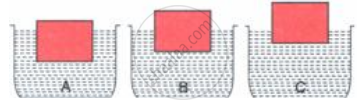
Draw a diagram to show the forces acting on a body floating in water with its some part submerged. Name the forces and show their points of application. How is the weight of water displaced by the floating body related to the weight of the body itself?
What is the centre of buoyancy? State its position for a floating body with respect to the centre of gravity of the body.
A balloon filled with helium gas floats in a big closed jar which is connected to an evacuating pump. What will be your observation, if air from the jar is pumped out? Explain your answer.
A block of wood is so loaded that it just floats in water at room temperature. What change will occur in the state of floatation, if
(a) Some salt is added to water, (b) Water is heated?
Give reasons.
A body of volume V and density ρs , floats with volume v inside a liquid of density ρL. Show that `"v"/V = ρ_s/ρ_L` .
Two identical pieces, one of ice (density = 900kg per meter cube) and other wood (density = 300kg per meter cube) float on water.
- Which of the two will have more volume submerged inside water
- Which of two will experience more upthrust due to water.
Why is the floating ice less submerged in brine than in water?
A man first swims in sea water and then in river water. (i) Compare the weights of sea water and river water displaced by him.
(ii) Where does he find it easier to swim and why?
An iron nail sinks in the water while an iron ship floats on water. Explain the reason.
What can you say about the average density of a ship floating on water in relation to the density of water?
A body is held inside water contained in a vessel by tying it with a thread to the base of the vessel. Name the three forces that keep the body in equilibrium, and state the direction in which each force acts.
A loaded cargo ship sails from sea water to river water. State and Explain your observations.
A piece of ice floating in a glass of water melts, but the level of water in the glass does not change.
Give reasons.
Hint: Ice contracts on melting.
Explain the following :
Icebergs floating in sea are dangerous for ships.
Explain the following :
An egg sinks in fresh water, but floats in a strong salt solution.
Explain the following :
Toy balloons filled with hydrogen rise to the ceiling, but if they are filled with carbon dioxide, then they sink to the floor.
Explain the following :
As a ship in harbour is being unloaded, it slowly rises higher in water.
Explain the following :
A balloon filled with hydrogen rises to a certain height and then stops rising further.
Explain the following :
A ship submerges more as it sails from sea water to river water.
Selina solutions for Concise Physics [English] Class 9 ICSE 5 Upthrust in Fluids, Archimedes’ Principle and Floatation Exercise 5 (C) [Page 124]
For a floating body, its weight W and upthrust FB on it are related as :
W > FB
W < FB
W = FB
Nothing can be said
A body of weight W is floating in a liquid. Its apparent weight will be
Equal to W
Less than W
Greater than W
Zero
A body floats in a liquid A of density ρ1 with a part of it submerged inside the liquid, while in liquid B of density ρ2 it is totally submerged inside the liquid. The densities ρ1 and ρ2 are related as :
ρ1 = ρ2
ρ1 < ρ2
ρ1 > ρ2
Nothing can be said
Selina solutions for Concise Physics [English] Class 9 ICSE 5 Upthrust in Fluids, Archimedes’ Principle and Floatation Exercise 5 (C) [Page 124]
A rubber ball floats on water with its 1/3rd volume outside water. What is the density of rubber?
A block of wood of mass 24 kg floats on water. The volume of wood is 0.032 m3. Find:
- the volume of block below the surface of water,
- the density of wood.
(Density of water = 1000 kg m−3)
A wooden cube of side 10 cm has mass 700 g. What part of it remains above the water surface while floating vertically on water surface?
A piece of wax floats on brine. What fraction of its volume is immersed?
Density of wax = 0.95 g cm-3, Density of brine = 1.1 g cm-3.
If the density of ice is 0.9 g cm-3, then what portion of an iceberg will remain below the surface of water in sea? (Density of sea water = 1.1 g cm-3)
A piece of wood of uniform cross section and height 15 cm floats vertically with its height 10 cm in water and 12 cm in spirit. Find the densities of wood and spirit.
A wooden block floats in water with two-third of its volume submerged.
(a) Calculate the density of wood.
(b) When the same block is placed in oil, three-quarters of its volume is immersed in oil. Calculate the density of oil.
The density of ice is 0.92 g cm-3 and that of sea water is 1.025 g cm-3. Find the total volume of an iceberg which floats with its volume 800 cm3 above water.
A weather forecasting plastic balloon of volume 15 m3 contains hydrogen of density 0.09 kg m-3. The volume of equipment carried by the balloon is negligible compared to its own volume. The mass of an empty balloon alone is 7.15 kg. The balloon is floating in air of density of 1.3 kg m-3. Calculate:
(i) The mass of hydrogen in the balloon,
(ii) The mass of hydrogen and balloon,
(iii) The total mass of hydrogen, balloon and equipment if the mass of equipment is x kg,
(iv) The mass of air displaced by balloon and
(v) The mass of equipment using the law of floatation.
Solutions for 5: Upthrust in Fluids, Archimedes’ Principle and Floatation
Selina solutions for Concise Physics [English] Class 9 ICSE chapter 5 - Upthrust in Fluids, Archimedes’ Principle and Floatation
Shaalaa.com has the CISCE Mathematics Concise Physics [English] Class 9 ICSE CISCE solutions in a manner that help students grasp basic concepts better and faster. The detailed, step-by-step solutions will help you understand the concepts better and clarify any confusion. Selina solutions for Mathematics Concise Physics [English] Class 9 ICSE CISCE 5 (Upthrust in Fluids, Archimedes’ Principle and Floatation) include all questions with answers and detailed explanations. This will clear students' doubts about questions and improve their application skills while preparing for board exams.
Further, we at Shaalaa.com provide such solutions so students can prepare for written exams. Selina textbook solutions can be a core help for self-study and provide excellent self-help guidance for students.
Concepts covered in Concise Physics [English] Class 9 ICSE chapter 5 Upthrust in Fluids, Archimedes’ Principle and Floatation are Buoyancy Force (Upthrust Force), Principle of Floatation (Laws of Flotation), Archimedes Principle, Characteristic Properties of Upthrust, Reason for Upthrust, Upthrust is Equal to the Weight of Displaced Liquid (Mathematical Proof), Solid Bodies with density (ρ) greater than density of liquid (ρL) sink while with density (ρ) less than density of liquid (ρL) Float, Density and It’s Unit, Relative Density and Its Unit, Relationship Between Density and Relative Density, Determination of Relative Density of a Solid Substance by Archimedes’ Principle, Determination of Relative Density of a Liquid by Archimedes’ Principle, Relation Between Volume of Submerged Part of a Floating Body, the Densities of Liquid and the Body, Application of the Principle of Floatation, Buoyancy Force (Upthrust Force), Principle of Floatation (Laws of Flotation), Archimedes Principle, Characteristic Properties of Upthrust, Reason for Upthrust, Upthrust is Equal to the Weight of Displaced Liquid (Mathematical Proof), Solid Bodies with density (ρ) greater than density of liquid (ρL) sink while with density (ρ) less than density of liquid (ρL) Float, Density and It’s Unit, Relative Density and Its Unit, Relationship Between Density and Relative Density, Determination of Relative Density of a Solid Substance by Archimedes’ Principle, Determination of Relative Density of a Liquid by Archimedes’ Principle, Relation Between Volume of Submerged Part of a Floating Body, the Densities of Liquid and the Body, Application of the Principle of Floatation.
Using Selina Concise Physics [English] Class 9 ICSE solutions Upthrust in Fluids, Archimedes’ Principle and Floatation exercise by students is an easy way to prepare for the exams, as they involve solutions arranged chapter-wise and also page-wise. The questions involved in Selina Solutions are essential questions that can be asked in the final exam. Maximum CISCE Concise Physics [English] Class 9 ICSE students prefer Selina Textbook Solutions to score more in exams.
Get the free view of Chapter 5, Upthrust in Fluids, Archimedes’ Principle and Floatation Concise Physics [English] Class 9 ICSE additional questions for Mathematics Concise Physics [English] Class 9 ICSE CISCE, and you can use Shaalaa.com to keep it handy for your exam preparation.
