Advertisements
Advertisements
Question
Complete the following sentence :
A piece of wood is held under water. The upthrust on it will be ___________ the weight of the wood piece.
Advertisements
Solution
A piece of wood is held under water. The upthrust on it will be more than the weight of the wood piece.
APPEARS IN
RELATED QUESTIONS
Define the term Density of a substance.
What is the unit of relative density?
Which of the following will sink or float on water? (Density of water = 1 g Cm-3)
(a) body A having density of 500 kg m-3
How is the unit bar related to the S.I. unit pascal?
The diagram below in Fig. 4.12 shows a device which makes the use of the principle of transmission of pressure.
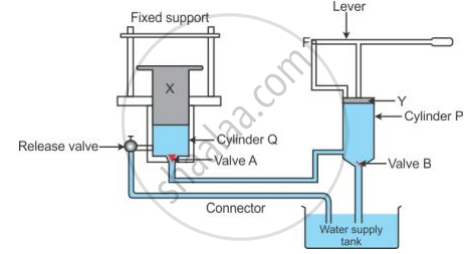
- Name the parts labelled by the letters X and Y.
- Describe what happens to valves A and B and to the quantity of water in the two cylinders when the lever arm is moved down.
- Give reasons for what happens to valves A and B in part (ii).
- What happens when the release valve is opened?
- What happens to valve B in cylinder P when the lever arm is moved up?
- Give a reason for your answer in part (v).
- State one use of the above device.
A block of wood is floating on water with its dimensions 50 cm x 50 cm x 50 cm inside water. Calculate the buoyant force acting on the block. Take g = 9.8 N kg-1.
The base of the cylindrical vessel measures 300 cm2. Water is poured into it up to a depth of 6 cm. Calculate the pressure of water on the base in the vessel.
Pressure in a water pipe on the ground floor of a building is 100,000 Pa. Calculate the pressure in the water pipe on the first floor at a height of 3 m. [Density of water = 1000 kgm−3 ; g = 10 ms−2]
Calculate the hydrostatic pressure exerted by water at the bottom of a beaker. Take the depth of water as 40 cm, the density of water 1000 kgm−3 and g = 9.8 ms−2.
Assertion (A): The buoyant force on a submerged rigid object can be considered to be acting at the center of mass of the object.
Reason (R): In rigid body, force distributed uniformly through its volume can be considered to be acting at the centre of mass of the body.
