Advertisements
Advertisements
Question
The diagram below in Fig. 4.12 shows a device which makes the use of the principle of transmission of pressure.
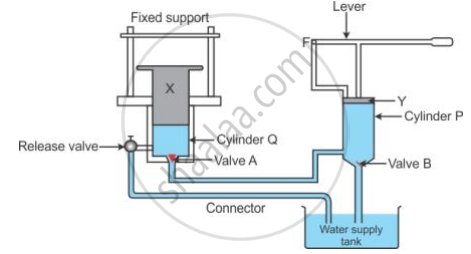
- Name the parts labelled by the letters X and Y.
- Describe what happens to valves A and B and to the quantity of water in the two cylinders when the lever arm is moved down.
- Give reasons for what happens to valves A and B in part (ii).
- What happens when the release valve is opened?
- What happens to valve B in cylinder P when the lever arm is moved up?
- Give a reason for your answer in part (v).
- State one use of the above device.
Advertisements
Solution
- X : Press Plunger; Y: Pump Plunger
- When the lever is moved down, valve B closes and valve A opens, so the water from cylinder P is forced into cylinder Q.
- Valve B closes due to an increase in pressure in cylinder P. This pressure is transmitted to the connecting pipe and when the pressure in connecting pipe becomes greater than the pressure in cylinder Q, valve A opens up.
- When the release valve is opened, the ram (or press) plunger Q gets lowered and water of cylinder Q runs out in the reservoir.
- When the lever arm is moved up valve B opens upwards.
- When the lever arm is moved up valve B opens upward because the pressure in cylinder P decreases.
- An hydraulic press is used for pressing cotton bales and goods like quilts, books, etc.
RELATED QUESTIONS
The relative density of alcohol is 0.8. Its density is
A piece of wood floats on water. The buoyant force on wood will be
What is meant by pressure? State its S.I. unit.
How does the pressure exerted by thrust depend on the area of surface on which it acts? Explain with a suitable example.
Deduce an expression for the pressure at depth inside a liquid.
A piece of wood if left under water comes to the surface. Explain the reason.
Select the correct option.
The unit Nm2 is the unit of
Pressure in a water pipe on the ground floor of a building is 100,000 Pa. Calculate the pressure in the water pipe on the first floor at a height of 3 m. [Density of water = 1000 kgm−3 ; g = 10 ms−2]
Higher Order Thinking Skill.
How does a fish manage to rise up and move down in water?
Most buoyant objects are those with relatively ______.
- high volume
- higher mass
- low density
- less viscosity
