Advertisements
Advertisements
Question
How does the pressure exerted by thrust depend on the area of surface on which it acts? Explain with a suitable example.
Advertisements
Solution
Pressure exerted by thrust is inversely proportional to area of surface on which it acts. Thus, larger the area on which the thrust acts, lesser is the pressure exerted by it.
Example: If we stand on loose sand, our feet sink into the sand, but if we lie on that sand, our body does not sink into the sand. In both the cases, the thrust exerted on the sand is equal (equal to the weight of the body). However, when we lie on sand, the thrust acts on a large area and when we stand, the same thrust acts on a small area.
RELATED QUESTIONS
The density of brass is 8.4 g cm-3. What do you mean by this statement?
The density of water is 1.0 g Cm-3. The density of iron is 7.8 × 10″3 g Cm-3. The density of mercury is 13.6 g Cm-3.
Answer the following:
Will a piece of iron float or sink in mercury?
What is meant by pressure? State its S.I. unit.
The diagram below in Fig. 4.12 shows a device which makes the use of the principle of transmission of pressure.
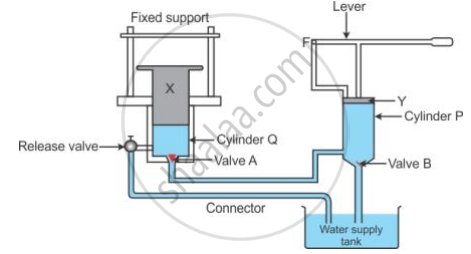
- Name the parts labelled by the letters X and Y.
- Describe what happens to valves A and B and to the quantity of water in the two cylinders when the lever arm is moved down.
- Give reasons for what happens to valves A and B in part (ii).
- What happens when the release valve is opened?
- What happens to valve B in cylinder P when the lever arm is moved up?
- Give a reason for your answer in part (v).
- State one use of the above device.
The pressure inside a liquid of density p at a depth h is :
A hammer exerts a force of 1.5 N on each of the two nails A and B. The area of cross section of tip of nail A is 2 mm2 while that of nail B is 6 mm2. Calculate pressure on each nail in pascal.
A piece of wood if left under water comes to the surface. Explain the reason.
The blood pressure reading of a patient is recorded 160/100. Express the lower pressure in SI units.
[Take density of mercury as 13.6 × 10³ kgm−3 and the value of ‘g’ as 10 ms−2]
What do you mean by buoyancy?
What do you understand by the term “Buoyancy”.
