Advertisements
Advertisements
प्रश्न
The diagram below in Fig. 4.12 shows a device which makes the use of the principle of transmission of pressure.
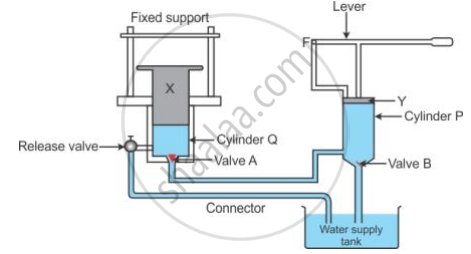
- Name the parts labelled by the letters X and Y.
- Describe what happens to valves A and B and to the quantity of water in the two cylinders when the lever arm is moved down.
- Give reasons for what happens to valves A and B in part (ii).
- What happens when the release valve is opened?
- What happens to valve B in cylinder P when the lever arm is moved up?
- Give a reason for your answer in part (v).
- State one use of the above device.
Advertisements
उत्तर
- X : Press Plunger; Y: Pump Plunger
- When the lever is moved down, valve B closes and valve A opens, so the water from cylinder P is forced into cylinder Q.
- Valve B closes due to an increase in pressure in cylinder P. This pressure is transmitted to the connecting pipe and when the pressure in connecting pipe becomes greater than the pressure in cylinder Q, valve A opens up.
- When the release valve is opened, the ram (or press) plunger Q gets lowered and water of cylinder Q runs out in the reservoir.
- When the lever arm is moved up valve B opens upwards.
- When the lever arm is moved up valve B opens upward because the pressure in cylinder P decreases.
- An hydraulic press is used for pressing cotton bales and goods like quilts, books, etc.
संबंधित प्रश्न
Relative density of a substance is expressed in g cm-3.
Name the S.I. unit of density. How is it related to g Cm-3?
Define the term relative density of a substance.
How does the density of a body and that of a liquid determine whether the body will float or sink into that liquid?
Which of the following will sink or float on water? (Density of water = 1 g Cm-3) body B having density 2520 kg m-3
Why does it happen?
A ship dips to a larger depth in fresh water as compared to marine water.
Explain the following statement:
It is easier to cut with a sharp knife than with a blunt one.
Write an expression for the pressure at a point inside a liquid. Explain the meaning of the symbols used.
Complete the following sentence :
Pressure of a liquid at a given depth is .................. To the density of the liquid.
A small block of wood is completely immersed in (i) water, (ii) glycerine and then released. In each case, What do you observe? Explain the difference in your observation in the two cases.
