Advertisements
Advertisements
Question
Prove that the loss in weight of a body when immersed wholly or partially in a liquid is equal to the buoyant force (or upthrust) and this loss is because of the difference in pressure exerted by liquid on the upper and lower surfaces of the submerged part of body.
Advertisements
Solution
Consider a cylindrical body PQRS of cross-sectional area A immersed in a liquid of density as shown in the figure above. Let the upper surface PQ of the body is at a depth h1 while its lower surface RS is at depth h2 below the free surface of liquid.
At depth h1, the pressure on the upper surface PQ,
P1 = h1 ρ g.
Therefore, the downward thrust on the upper surface PQ,
F1 = Pressure x Area = h1 ρ gA ……………….(i)
At depth h2, pressure on the lower surface RS,
P2 = h2 ρ g
Therefore, the upward thrust on the lower surface RS,
F2 = Pressure x Area = h2 ρ gA …………………(ii)
The horizontal thrust at various points on the vertical sides of body get balanced because the liquid pressure is the same at all points at the same depth.
From the above equations (i) and (ii), it is clear that F2 > F1 because h2 > h1 and therefore, body will experience a net upward force.
Resultant upward thrust or buoyant force on the body,
FB = F2 - F1
= h2 ρ gA - h1 ρgA
= A (h2 - h1) ρ g
However, A (h2 - h1) = V, the volume of the body is submerged in a liquid.
Therefore, upthrust FB = V ρ g.
Now, V ρ g = Volume of solid immersed x Density of liquid x Acceleration due to gravity
= Volume of liquid displaced x Density of liquid x Acceleration due to gravity
= Mass of liquid displaced x Acceleration due to gravity
= Weight of the liquid displaced by the submerged part of the body
Thus, Upthrust FB = weight of the liquid displaced by the submerged part of the body…..(iii)
Now, let us take a solid and suspend it by a thin thread from the hook of a spring balance and note its weight.
Then take a eureka can and fill it with water up to its spout. Arrange a measuring cylinder below the spout of the eureka can as shown. Immerse the solid gently in water. The water displaced by the solid is collected in the measuring cylinder.
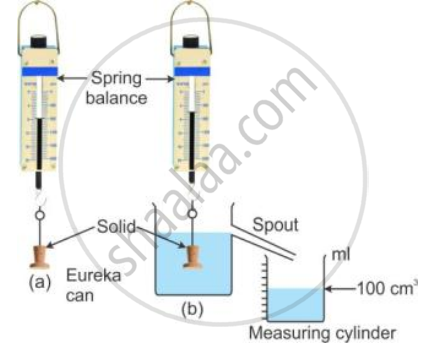
When the water stops dripping through the spout, note the weight of the solid and volume of water collected in the measuring cylinder.
From the diagram, it is clear that
Loss in weight (Weight in air - Weight in water) = Volume of water displaced.
Or, Loss in weight = Volume of water displaced x 1 gcm-3 [Because the density of water = 1 gcm-3]
Or, Loss in weight = Weight of water displaced ……………(iv)
From equations (iii) and (iv),
Loss in weight = Upthrust or buoyant force
APPEARS IN
RELATED QUESTIONS
What is meant by the term ‘buoyancy’ ?
What causes buoyant force (or upthrust) on a boat ?
When a boat is partially immersed in water, it displaces 600 kg of water. How much is the buoyant force acting on the boat in newtons ? (g = 10 m s-2)
Name the S.I. unit of density. How is it related to g Cm-3?
Explain why a gas bubble released at the bottom of a lake grows in size as it rises to the surface of the lake.
A vessel contains water up to a height of 1.5 m. Taking the density of water 103 kg m-3, acceleration due to gravity 9.8 m s-2 and area of base of vessel 100 cm2, calculate: (a) the pressure and (b) the thrust at the base of vessel.
Complete the following sentence :
A piece of wood is held under water. The upthrust on it will be ___________ the weight of the wood piece.
Salt water provides less buoyant force than freshwater.
Assertion (A): The buoyant force on a submerged rigid object can be considered to be acting at the center of mass of the object.
Reason (R): In rigid body, force distributed uniformly through its volume can be considered to be acting at the centre of mass of the body.
Complete the analogy.
Downward force : Weight :: Upward force offered by liquid : _____.
