Advertisements
Advertisements
Question
Distinguish between density and relative density.
Advertisements
Solution
| Sr. No. | Density | Relative density |
| 1. | It is the ratio of mass to volume. `D = ("Mass")/("Volume") = m/V` |
It is the ratio of the density of a substance to the density of water. |
| 2. | Units are g cm−3 or kg m−3 | It is a pure quantity. It has no units. |
| 3. | Density in kg m−3 = R.D × 1000 | R.D. = Density in g cm−3 `R.D. = ("Density in kg cm"^-3)/1000` |
APPEARS IN
RELATED QUESTIONS
Relative density of a substance is expressed in g cm-3.
Describe an experiment to determine the density of the material of a coin.
The density of water is 1.0 g Cm-3. The density of iron is 7.8 × 10″3 g Cm-3. The density of mercury is 13.6 g Cm-3.
Answer the following:
Will a piece of iron float or sink in mercury?
For a floating body, how is its weight related to the buoyant force?
What physical quantity is measured in bar?
The S.I. unit of upthrust is :
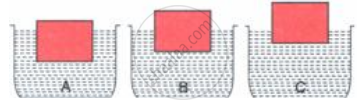
Figure shows the same block of wood floating in three different liquids A, B and C of densities ρ1, ρ2 and ρ3 respectively. Which of the liquid has the highest density? Give a reason for your answer.
A balloon filled with helium gas floats in a big closed jar which is connected to an evacuating pump. What will be your observation, if air from the jar is pumped out? Explain your answer.
Is pressure a vector quantity?
Most buoyant objects are those with relatively ______.
- high volume
- higher mass
- low density
- less viscosity
