Advertisements
Advertisements
प्रश्न
Prove that the loss in weight of a body when immersed wholly or partially in a liquid is equal to the buoyant force (or upthrust) and this loss is because of the difference in pressure exerted by liquid on the upper and lower surfaces of the submerged part of body.
Advertisements
उत्तर
Consider a cylindrical body PQRS of cross-sectional area A immersed in a liquid of density as shown in the figure above. Let the upper surface PQ of the body is at a depth h1 while its lower surface RS is at depth h2 below the free surface of liquid.
At depth h1, the pressure on the upper surface PQ,
P1 = h1 ρ g.
Therefore, the downward thrust on the upper surface PQ,
F1 = Pressure x Area = h1 ρ gA ……………….(i)
At depth h2, pressure on the lower surface RS,
P2 = h2 ρ g
Therefore, the upward thrust on the lower surface RS,
F2 = Pressure x Area = h2 ρ gA …………………(ii)
The horizontal thrust at various points on the vertical sides of body get balanced because the liquid pressure is the same at all points at the same depth.
From the above equations (i) and (ii), it is clear that F2 > F1 because h2 > h1 and therefore, body will experience a net upward force.
Resultant upward thrust or buoyant force on the body,
FB = F2 - F1
= h2 ρ gA - h1 ρgA
= A (h2 - h1) ρ g
However, A (h2 - h1) = V, the volume of the body is submerged in a liquid.
Therefore, upthrust FB = V ρ g.
Now, V ρ g = Volume of solid immersed x Density of liquid x Acceleration due to gravity
= Volume of liquid displaced x Density of liquid x Acceleration due to gravity
= Mass of liquid displaced x Acceleration due to gravity
= Weight of the liquid displaced by the submerged part of the body
Thus, Upthrust FB = weight of the liquid displaced by the submerged part of the body…..(iii)
Now, let us take a solid and suspend it by a thin thread from the hook of a spring balance and note its weight.
Then take a eureka can and fill it with water up to its spout. Arrange a measuring cylinder below the spout of the eureka can as shown. Immerse the solid gently in water. The water displaced by the solid is collected in the measuring cylinder.
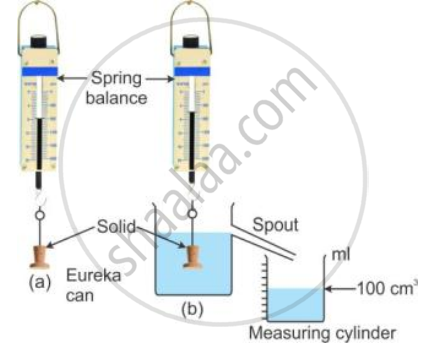
When the water stops dripping through the spout, note the weight of the solid and volume of water collected in the measuring cylinder.
From the diagram, it is clear that
Loss in weight (Weight in air - Weight in water) = Volume of water displaced.
Or, Loss in weight = Volume of water displaced x 1 gcm-3 [Because the density of water = 1 gcm-3]
Or, Loss in weight = Weight of water displaced ……………(iv)
From equations (iii) and (iv),
Loss in weight = Upthrust or buoyant force
APPEARS IN
संबंधित प्रश्न
State whether the following statement is true or false :
The buoyant force depends on the nature of object immersed in the liquid
A body experiences the same buoyant force when it floats or sinks in water.
The S.I. unit of density is ..........
The weight of a body is more than the buoyant force experienced by it, due to a liquid. The body will
Explain the meaning of the statement
‘Relative density of aluminium is 2.7’.
Explain why a gas bubble released at the bottom of a lake grows in size as it rises to the surface of the lake.
A metal solid cylinder tied to a thread is hanging from the hook of a spring balance. The cylinder is gradually immersed into the water contained in a jar. What changes do you expect in the readings of the spring balance? Explain your answer.
A body will experience minimum upthrust when it is completely immersed in :
The mass of a block made of certain material is 13.5 kg and its volume is 15 × 10-3 m3.
(a) Calculate upthrust on the block if it is held fully immersed in water.
(b) Will the block float or sink in water when released? Give a reason for your answer.
(c) What will be the upthrust on block while floating?
Take density of water = 1000 kg m-3.
In a fluid, buoyant force exists because the pressure at the ______ of an object is greater than the pressure at the top.
