Advertisements
Advertisements
प्रश्न
The area of base of a cylindrical vessel is 300 cm2. Water (density= 1000 kg m-3) is poured into it up to a depth of 6 cm. Calculate : (a) the pressure and (b) the thrust of water on the base. (g = 10m s-2.
Advertisements
उत्तर
Given Area of base of vessel , a = 300 cm2 = 300 × 10-4 m2
Density of water , ρ = 1000 kg m-3
Depth , h = 6 cm = 0.06 m
Acceleration due to gravity , g = 10 ms-2
(a) Pressure = hρg = 0.06 × 1000 × 10 = 600 pascal
(b) Thrust , T = pressure × area = 600 × 300 × 10-4 = 18 N
संबंधित प्रश्न
In what direction does the buoyant force on an object immersed in a liquid act?
A body experiences the same buoyant force while floating in water or alcohol.
Define the term Density of a substance.
Which of the following will sink or float on water? (Density of water = 1 g Cm-3)
body D having density 0.85 g m-3
The density of water is 1.0 g Cm-3. The density of iron is 7.8 × 10″3 g Cm-3. The density of mercury is 13.6 g Cm-3.
Answer the following:
Will a piece of iron float or sink in mercury?
How does the pressure exerted by thrust depend on the area of surface on which it acts? Explain with a suitable example.
The pressure P1 at the top of a dam and P2 at a depth h form the top inside water (density p) are related as :
A vessel contains water up to a height of 1.5 m. Taking the density of water 103 kg m-3, acceleration due to gravity 9.8 m s-2 and area of base of vessel 100 cm2, calculate: (a) the pressure and (b) the thrust at the base of vessel.
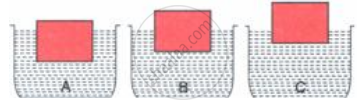
Figure shows the same block of wood floating in three different liquids A, B and C of densities ρ1, ρ2 and ρ3 respectively. Which of the liquid has the highest density? Give a reason for your answer.
Select the correct option.
Unit of thrust in the SI system is
