Advertisements
Advertisements
प्रश्न
An object of weight 200 N is floating in a liquid. What is the magnitude of buoyant force acting on it ?
Advertisements
उत्तर
According to Archimedes’ principle, buoyant force equals the weight of the liquid displaced by the object. Therefore, the buoyant force on the object would be 200 N.
APPEARS IN
संबंधित प्रश्न
State whether the following statement is true or false :
The buoyant force depends on the nature of object immersed in the liquid
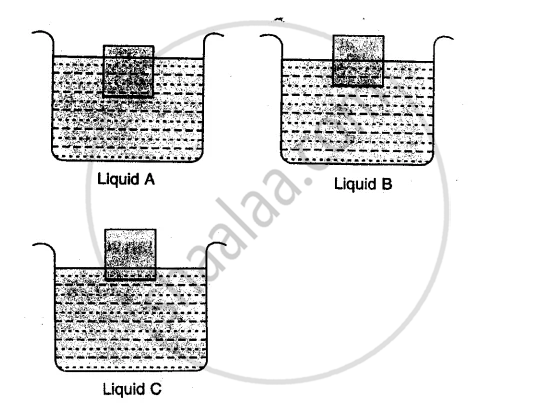
The diagram given below show a body floating in three different liquids. A, B and C at different levels.
(a) In which liquid does the body experience the greatest buoyant force?
(b) Which liquid has the least density?
(c) Which liquid has the highest density?
What physical quantity is measured in bar?
Write an expression for the pressure at a point inside a liquid. Explain the meaning of the symbols used.
Pressure at the free surface of a water lake is P1, while at a point at depth h below its free surface is P2. (a) How are P1 and P2 related? (b)Which is more P1 or P2?
A tall vertical cylinder filled with water is kept on a horizontal table top. Two small holes A and B are made on the wall of the cylinder, A near the middle and B just Below the free surface of water. State and explain your observation.
A piece of wood if left under water comes to the surface. Explain the reason.
A small block of wood is completely immersed in (i) water, (ii) glycerine and then released. In each case, What do you observe? Explain the difference in your observation in the two cases.
A homogeneous block floats on water (a) partly immersed (b) completely immersed. In each case state the position of centre of buoyancy B with respect to the centre of gravity G of the block.
Complete the analogy.
Downward force : Weight :: Upward force offered by liquid : ______
