Advertisements
Advertisements
प्रश्न
Define buoyant force. Name two factors on which buoyant force depends.
Advertisements
उत्तर
The upward force exerted by a liquid on a body when immersed in a liquid is known as buoyant force. The buoyant force depends on the following factors:
(i) Size or volume of the body immersed in a liquid.
(ii) The density of the liquid in which the body is immersed.
APPEARS IN
संबंधित प्रश्न
State whether the following statement is true or false :
The buoyant force depends on the nature of object immersed in the liquid
What is the law of floatation?
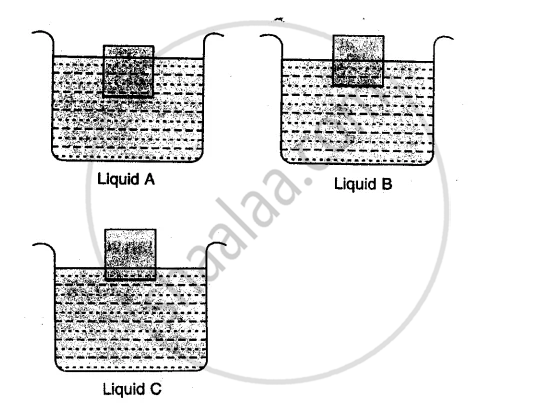
The diagram given below show a body floating in three different liquids. A, B and C at different levels.
(a) In which liquid does the body experience the greatest buoyant force?
(b) Which liquid has the least density?
(c) Which liquid has the highest density?
How is the unit bar related to the S.I. unit pascal?
Describe a simple experiment to demonstrate that a liquid enclosed in a vessel exerts pressure in all directions.
Complete the following sentence :
Pressure is .................... in all directions about a point in a liquid.
Two cylindrical vessels fitted with pistons A and B of area of cross-section 8 cm2 and 320 cm2 respectively are joined at their bottom by a tube and they are completely filled with water. When a mass of 4 kg is placed on piston A, Find:
- the pressure on piston A,
- the pressure on piston B, and
- the thrust on piston B.
Select the correct option:
When an object sinks in a liquid, its:
Write the SI units of Buoyant force
Complete the analogy.
Downward force: Weight:: Upward force offered by liquid: _____
