Advertisements
Advertisements
प्रश्न
Define buoyant force. Name two factors on which buoyant force depends.
Advertisements
उत्तर
The upward force exerted by a liquid on a body when immersed in a liquid is known as buoyant force. The buoyant force depends on the following factors:
(i) Size or volume of the body immersed in a liquid.
(ii) The density of the liquid in which the body is immersed.
APPEARS IN
संबंधित प्रश्न
In which direction does the buoyant force on an object due to a liquid act ?
Distinguish between density and relative density.
The density of water is 1.0 g Cm-3. The density of iron is 7.8 × 10″3 g Cm-3. The density of mercury is 13.6 g Cm-3.
Ans the following:
Will a piece of iron float or sink in water?
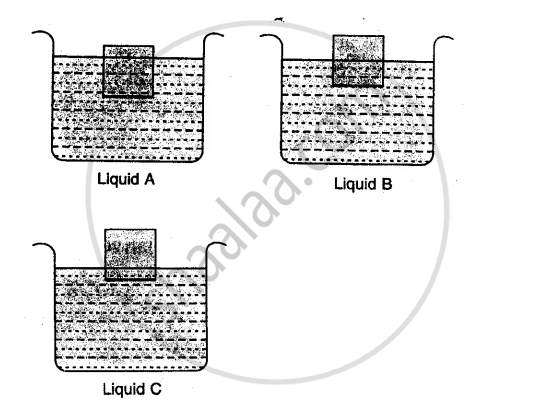
The diagram given below show a body floating in three different liquids. A, B and C at different levels.
(a) In which liquid does the body experience the greatest buoyant force?
(b) Which liquid has the least density?
(c) Which liquid has the highest density?
State the laws of liquid pressure.
How is the upthrust related to the volume of the body submerged in a liquid?
Two spheres A and B, each of volume 100 cm3 is placed on water (density = 1.0 g cm−3). The sphere A is made of wood of density 0.3 g cm−3 and sphere B is made of iron of density 8.9 g cm−3.
- Find:
- The weight of each sphere, and
- The upthrust on each sphere.
- Which sphere will float? Give reason.
A beaker contains a liquid of density ‘ρ’ up to height ‘h’ such that ‘PA’ is atmospheric pressure and ‘g’ is the acceleration due to gravity. Answer the following questions:
- What is the pressure on the free surface of the liquid?
- What is the pressure on the base of the beaker?
- What is the lateral pressure at the base on the inner walls of the beaker?
Higher Order Thinking Skill.
How does a fish manage to rise up and move down in water?
Write about buoyant force.
