Advertisements
Advertisements
प्रश्न
5 kg of material A occupy 20 cm3 whereas 20 kg of materia! B occupy 90 cm3. Which has the greater density : A or B ? Support your answer with calculations.
Advertisements
उत्तर
ρ (density of material A) = ?
V (volume of material A) = 20 cm3
m (mass of material A) = 5 kg = 5 × 1,000 = 5,000 g
`ρ = m/V`
= `5000/20`
ρ = 250 g/cm3
Ans: Density of material A = 250 g/cm3.
ρ (density of material B) = ?
V (volume of material B) = 90 cm3
m (mass of material B) = 20 kg = 20 × 1,000 = 20,000 g
`ρ = m/V`
= `(20,000)/90`
ρ = 222.222 g/cm3
Answer: Density of material B = 222.22 g/cm3.
A has greater density.
APPEARS IN
संबंधित प्रश्न
The density of gold is 19 g/cm3. Find the volume of 95 g of gold.
What is the density of a substance of mass 100 g and volume 10 cm3 ?
Calculate the density of an object of volume 3 m3 and mass 9 kg. State whether this object will float or sink in water. Give reason for your answer.
The density of turpentine is 840 kg/m3. What will be its relative density ? (Density of water = 1000 kg/m3)
A body floats in kerosene of density 0.8 x 10³ kg/m3 up to a certain mark. If the same body is placed in water of density 1.0 x 10³ kg/m3, will it sink more or less ? Give reason for your answer.
A piece of steel has a volume of 12 cm3, and a mass of 96 g. What is its density in kg/m3 ?
A solid of density 900 kg/m3 floats in oil as shown in the given diagram. The oil floats on water of density 1000 kg/m3 as shown. The density of oil kg/m3 could be :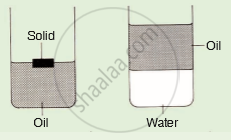
The density of water is 1000 kg/m3 and the density of copper is 8900 kg/m3. Which of the following statements is incorrect?
Numerical Problem.
Density of mercury is 13600 kg m–3. Calculate the relative density.
A cube of side 5 cm is immersed in water and then in a saturated salt solution. In which case will it experience a greater buoyant force. If each side of the cube is reduced to 4 cm and then immersed in water, what will be the effect on the buoyant force experienced by the cube as compared to the first case for water. Give a reason for each case.
