Advertisements
Advertisements
प्रश्न
Calculate the density of an object of volume 3 m3 and mass 9 kg. State whether this object will float or sink in water. Give reason for your answer.
Advertisements
उत्तर
ρ (density) = ?
V (volume) = 3 m3
m (mass) = 9 kg
`ρ = m/V`
= `9/3`
ρ = 3 kg/m3
Answer: Density = 3 kg/m3.
It will float in water because the density of this object (3 kg/m3) is less than the density of water (1,000 kg/m3).
APPEARS IN
संबंधित प्रश्न
The density of gold is 19 g/cm3. Find the volume of 95 g of gold.
What is the mass of 5 m3 of cement of density 3000 kg/m3 ?
Write down an equation that defines density.
A piece of steel has a volume of 12 cm3, and a mass of 96 g. What is its density in kg/m3 ?
A metal in which even iron can float is :
A solid of density 900 kg/m3 floats in oil as shown in the given diagram. The oil floats on water of density 1000 kg/m3 as shown. The density of oil kg/m3 could be :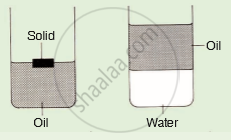
Why is it easier to swim in seawater than in river water?
A cube of side 5 cm is immersed in water and then in a saturated salt solution. In which case will it experience a greater buoyant force. If each side of the cube is reduced to 4 cm and then immersed in water, what will be the effect on the buoyant force experienced by the cube as compared to the first case for water. Give a reason for each case.
The density Bottle is also called ______.
Describe the construction and working of the Pycnometer.
