Advertisements
Advertisements
प्रश्न
What is the mass of 5 m3 of cement of density 3000 kg/m3 ?
Advertisements
उत्तर
ρ (density) = 3,000 kg/m3
V (volume) = 5 m3
m (mass) = ?
`ρ = m/V`
ρ×V=m
3,000 × 5 = m
15,000 = m
Answer: Mass of cement = 15,000 kg.
APPEARS IN
संबंधित प्रश्न
What is the density of a substance of mass 100 g and volume 10 cm3 ?
Write down an equation that defines density.
Define relative density. What is the SI unit of relative density ?
When a golf ball is lowered into a measuring cylinder containing water, the water level rises by 30 cm3 when the ball is completely submerged. If the mass of ball in air is 33 g, find its density.
A metal in which even iron can float is :
A solid of density 900 kg/m3 floats in oil as shown in the given diagram. The oil floats on water of density 1000 kg/m3 as shown. The density of oil kg/m3 could be :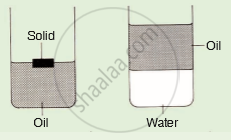
The density of water is 1000 kg/m3 and the density of copper is 8900 kg/m3. Which of the following statements is incorrect?
Why is it easier to swim in seawater than in river water?
A ball weighing 4 kg of density 4000 kg m–3 is completely immersed in water of density 103 kg m–3 Find the force of buoyancy on it. (Given g = 10 m s–2)
The density Bottle is also called ______.
