Advertisements
Advertisements
प्रश्न
A body experiences the same buoyant force when it floats or sinks in water.
पर्याय
Ture
False
Advertisements
उत्तर
False.
APPEARS IN
संबंधित प्रश्न
What is the scientific name of the 'upward force' acting on an object immersed in a liquid?
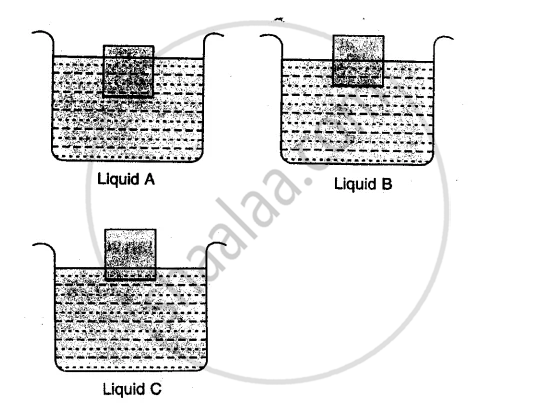
The diagram given below show a body floating in three different liquids. A, B and C at different levels.
(a) In which liquid does the body experience the greatest buoyant force?
(b) Which liquid has the least density?
(c) Which liquid has the highest density?
What physical quantity is measured in bar?
How does the pressure exerted by a solid and fluid differ?
Complete the following sentence :
Pressure at a depth h in a liquid of density p is ......................
- Calculate the height of a water column which will exert on its base the same pressure as the 70 cm column of mercury. Density of mercury is 13.6 g cm-3.
- Will the height of the water column in part (a) change if the cross-section of the water column is made wider?
What is meant by the term buoyancy?
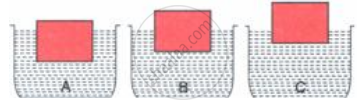
Figure shows the same block of wood floating in three different liquids A, B and C of densities ρ1, ρ2 and ρ3 respectively. Which of the liquid has the highest density? Give a reason for your answer.
Pressure in a water pipe on the ground floor of a building is 100,000 Pa. Calculate the pressure in the water pipe on the first floor at a height of 3 m. [Density of water = 1000 kgm−3 ; g = 10 ms−2]
Select the correct option:
When a body is wholly or partially immersed in a liquid, it experiences a buoyant force which is equal to:
