Advertisements
Advertisements
प्रश्न
Describe a simple experiment to demonstrate that a liquid enclosed in a vessel exerts pressure in all directions.
Advertisements
उत्तर
Take a can or large plastic bottle filled with water. Place it on a horizontal surface. Make a series of holes in the wall of the vessel anywhere below the free surface of the liquid. The water spurts out through each hole. This shows that the liquid exerts pressure at each point on the wall of the bottle.
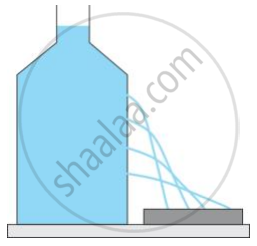
Liquid exerts pressure at all points in all directions
संबंधित प्रश्न
In what direction does the buoyant force on an object immersed in a liquid act?
What is meant by the term ‘buoyancy’ ?
Name the S.I. unit of density. How is it related to g Cm-3?
How does the density of a body and that of a liquid determine whether the body will float or sink into that liquid?
Why does it happen?
A ship dips to a larger depth in fresh water as compared to marine water.
Explain the following statement:
It is easier to cut with a sharp knife than with a blunt one.
State the laws of liquid pressure.
(i) The diameter of neck and bottom of a bottle are 2 cm and 10 cm, respectively. The bottle is completely filled with oil. If the cork in the neck is pressed in with a force of 1.2 kgf, what force is exerted on the bottom of the bottle?
(ii) Name the law/principle you have used to find the force in part (a).
How is the upthrust related to the volume of the body submerged in a liquid?
What do you understand by the term “Buoyancy”.
