Advertisements
Advertisements
प्रश्न
Name the S.I. unit of density. How is it related to g Cm-3?
Advertisements
उत्तर
S.I. unit of density is kg M-3 In C.GS. system unit of mass is g and unit of volume is Cm3, so CGS unit of density is g Cm-3 (gram per cubic centimetre)
Relationship between S.I. and C.GS. units
1kg `m^-3`=`(1 kg)/(1m^3`=`(1000g)/(100 cm)^3`
=`1/1000` g `cm^-3`
thus,
1 kg `m^-3`=`10^-3`g_`cm^-3`
or 1 g `cm^-3`= 1000kg `m^-3`
APPEARS IN
संबंधित प्रश्न
What do you mean by buoyancy?
A body floats in a liquid when its weight becomes equal to the weight of the liquid displaced by its submerged part.
When does an object float or sink when placed on the surface of a liquid ?
The density of water is 1.0 g Cm-3. The density of iron is 7.8 × 10″3 g Cm-3. The density of mercury is 13.6 g Cm-3.
Answer the following:
Will a piece of iron float or sink in mercury?
How does the pressure exerted by thrust depend on the area of surface on which it acts? Explain with a suitable example.
Pressure at the free surface of a water lake is P1, while at a point at depth h below its free surface is P2. (a) How are P1 and P2 related? (b)Which is more P1 or P2?
The diagram below in Fig. 4.12 shows a device which makes the use of the principle of transmission of pressure.
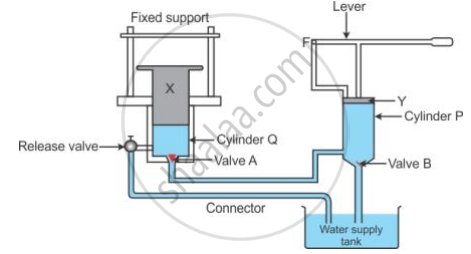
- Name the parts labelled by the letters X and Y.
- Describe what happens to valves A and B and to the quantity of water in the two cylinders when the lever arm is moved down.
- Give reasons for what happens to valves A and B in part (ii).
- What happens when the release valve is opened?
- What happens to valve B in cylinder P when the lever arm is moved up?
- Give a reason for your answer in part (v).
- State one use of the above device.
The pressure of water on the ground floor is 40,000 Pa and on the first floor is 10,000 Pa. Find the height of the first floor. (Take : density of water = 1000 kg m-3, g = 10 m s-2)
A metal solid cylinder tied to a thread is hanging from the hook of a spring balance. The cylinder is gradually immersed into the water contained in a jar. What changes do you expect in the readings of the spring balance? Explain your answer.
The point at which the force of buoyancy is supposed to act is known as ______.
