Advertisements
Advertisements
प्रश्न
The density of brass is 8.4 g cm-3. What do you mean by this statement?
Advertisements
उत्तर
This statement means one cubic centimetre volume of brass has mass of 8.4 g.
APPEARS IN
संबंधित प्रश्न
A body sinks in a liquid A but floats in a liquid B. The density of liquid A is ....... than the density of liquid B.
The buoyant force experienced by a body when floating in saltwater is ....... to or same that of when floating in pure water.
The weight of a body is more than the buoyant force experienced by it, due to a liquid. The body will
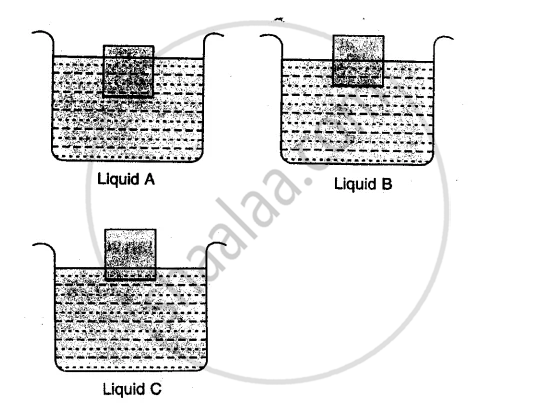
The diagram given below show a body floating in three different liquids. A, B and C at different levels.
(a) In which liquid does the body experience the greatest buoyant force?
(b) Which liquid has the least density?
(c) Which liquid has the highest density?
Why is the tip of an allpin made sharp?
The pressure inside a liquid of density p at a depth h is :
A vessel contains water up to a height of 1.5 m. Taking the density of water 103 kg m-3, acceleration due to gravity 9.8 m s-2 and area of base of vessel 100 cm2, calculate: (a) the pressure and (b) the thrust at the base of vessel.
Why is a force needed to keep a block of wood inside water?
Select the correct option:
When a body is wholly or partially immersed in a liquid, it experiences a buoyant force which is equal to:
Salt water provides less buoyant force than freshwater.
