Advertisements
Advertisements
Question
Describe a simple experiment to demonstrate that a liquid enclosed in a vessel exerts pressure in all directions.
Advertisements
Solution
Take a can or large plastic bottle filled with water. Place it on a horizontal surface. Make a series of holes in the wall of the vessel anywhere below the free surface of the liquid. The water spurts out through each hole. This shows that the liquid exerts pressure at each point on the wall of the bottle.
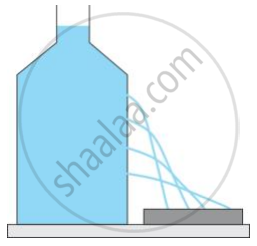
Liquid exerts pressure at all points in all directions
RELATED QUESTIONS
A body experiences the same buoyant force while floating in water or alcohol.
The weight of a body floating in a liquid is ........
Which of the following will sink or float on water? (Density of water = 1 g Cm-3) body B having density 2520 kg m-3
The area of base of a cylindrical vessel is 300 cm2. Water (density= 1000 kg m-3) is poured into it up to a depth of 6 cm. Calculate : (a) the pressure and (b) the thrust of water on the base. (g = 10m s-2.
Why is a force needed to keep a block of wood inside water?
Select the correct option.
Unit of thrust in the SI system is
Calculate the hydrostatic pressure exerted by water at the bottom of a beaker. Take the depth of water as 40 cm, the density of water 1000 kgm−3 and g = 9.8 ms−2.
Define atmospheric pressure diving suits. Does a diving suit create buoyancy?
Consider the statement given below and choose the correct option.
Assertion: Water strider slides easily on the surface of the water.
Reason: Water strider experiences less buoyant force.
The upward force that is caused due to the pressure difference in liquid (or fluid) is called ______.
