Advertisements
Advertisements
Question
A simple U tube contains mercury to the same level in both of its arms. If water is poured to a height of 13.6 cm in one arm, how much will be the rise in mercury level in the other arm?
Given : density of mercury = 13.6 x 10³ kg m-3 and density of water = 103 kg m-3.
Advertisements
Solution
Given, ρm = 13.6 × 10³ kg m -3, ρw = 103 kg m -3
Height to which water is poured in one arm, hw = 13.6 cm
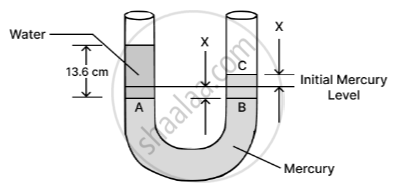
By pouring 13.6 cm of water, the mercury level in the left arm goes down to point A by x cm, while in the right arm, it rises to point C by x cm. Therefore, BC = hm = 2x cm
By Pascal's law,
Pressure in the water column = pressure in the mercury column
Therefore, PA = PB
⇒ hw ρw g = hm ρm g
⇒ 13.6 × 10³ × g = 2𝑥 × 13.6 × 103 × g
⇒ 1 = 2𝑥
⇒ 𝑥 = `1/2` = 0.5 cm
Hence, the rise in mercury level = 0.5 cm
RELATED QUESTIONS
In what direction does the buoyant force on an object immersed in a liquid act?
What is upthrust ?
The weight of a body is more than the buoyant force experienced by it, due to a liquid. The body will
A tall vertical cylinder filled with water is kept on a horizontal table top. Two small holes A and B are made on the wall of the cylinder, A near the middle and B just Below the free surface of water. State and explain your observation.
The diagram below in Fig. 4.12 shows a device which makes the use of the principle of transmission of pressure.
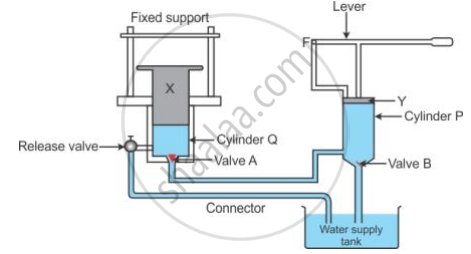
- Name the parts labelled by the letters X and Y.
- Describe what happens to valves A and B and to the quantity of water in the two cylinders when the lever arm is moved down.
- Give reasons for what happens to valves A and B in part (ii).
- What happens when the release valve is opened?
- What happens to valve B in cylinder P when the lever arm is moved up?
- Give a reason for your answer in part (v).
- State one use of the above device.
Complete the following sentence :
Pressure at a point inside the liquid is ...................... To its depth.
Complete the following sentence :
Pressure of a liquid at a given depth is .................. To the density of the liquid.
The pressure P1 at the top of a dam and P2 at a depth h form the top inside water (density p) are related as :
What do you understand by the term upthrust of a fluid? Describe an experiment to show its existence.
The magnitude of buoyant force acting on an object immersed in a liquid depends on ______ of the liquid.
