Advertisements
Advertisements
प्रश्न
A simple U tube contains mercury to the same level in both of its arms. If water is poured to a height of 13.6 cm in one arm, how much will be the rise in mercury level in the other arm?
Given : density of mercury = 13.6 x 10³ kg m-3 and density of water = 103 kg m-3.
Advertisements
उत्तर
Given, ρm = 13.6 × 10³ kg m -3, ρw = 103 kg m -3
Height to which water is poured in one arm, hw = 13.6 cm
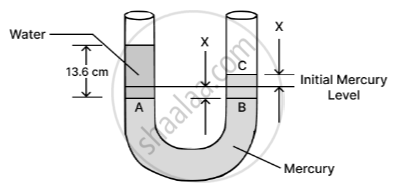
By pouring 13.6 cm of water, the mercury level in the left arm goes down to point A by x cm, while in the right arm, it rises to point C by x cm. Therefore, BC = hm = 2x cm
By Pascal's law,
Pressure in the water column = pressure in the mercury column
Therefore, PA = PB
⇒ hw ρw g = hm ρm g
⇒ 13.6 × 10³ × g = 2𝑥 × 13.6 × 103 × g
⇒ 1 = 2𝑥
⇒ 𝑥 = `1/2` = 0.5 cm
Hence, the rise in mercury level = 0.5 cm
संबंधित प्रश्न
The density of aluminium is 2.7 g cm-3 and that of brass 8.4 g cm’3. The correct statement is
What is a density bottle? How is it used to find the density of a liquid?
State three factors on which the pressure at a point in a liquid depends.
- Calculate the height of a water column which will exert on its base the same pressure as the 70 cm column of mercury. Density of mercury is 13.6 g cm-3.
- Will the height of the water column in part (a) change if the cross-section of the water column is made wider?
In what direction and at what point does the buoyant force on a body due to a liquid act?
What is meant by the term buoyancy?
Describe an experiment to show that a body immersed in a liquid appears lighter than it really is.
How is thrust different from pressure?
Define atmospheric pressure diving suits. Does a diving suit create buoyancy?
Most buoyant objects are those with relatively ______.
- high volume
- higher mass
- low density
- less viscosity
