Advertisements
Advertisements
प्रश्न
A simple U tube contains mercury to the same level in both of its arms. If water is poured to a height of 13.6 cm in one arm, how much will be the rise in mercury level in the other arm?
Given : density of mercury = 13.6 x 10³ kg m-3 and density of water = 103 kg m-3.
Advertisements
उत्तर
Given, ρm = 13.6 × 10³ kg m -3, ρw = 103 kg m -3
Height to which water is poured in one arm, hw = 13.6 cm
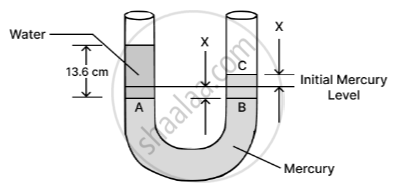
By pouring 13.6 cm of water, the mercury level in the left arm goes down to point A by x cm, while in the right arm, it rises to point C by x cm. Therefore, BC = hm = 2x cm
By Pascal's law,
Pressure in the water column = pressure in the mercury column
Therefore, PA = PB
⇒ hw ρw g = hm ρm g
⇒ 13.6 × 10³ × g = 2𝑥 × 13.6 × 103 × g
⇒ 1 = 2𝑥
⇒ 𝑥 = `1/2` = 0.5 cm
Hence, the rise in mercury level = 0.5 cm
संबंधित प्रश्न
What is the other name of buoyant force ?
The relative density of alcohol is 0.8. Its density is
What is the cause of buoyant force ?
Which of the following will sink or float on water? (Density of water = 1 g Cm-3) body B having density 2520 kg m-3
How is the unit bar related to the S.I. unit pascal?
How does the liquid pressure on a diver change if:
the diver moves to the greater depth
What is the cause of upthrust? At which point can it be considered to act?
A body of mass 3.5 kg displaces 1000 cm3 of water when fully immersed inside it. Calculate:
- the volume of body,
- the upthrust on body and
- the apparent weight of body in water.
Calculate the hydrostatic pressure exerted by water at the bottom of a beaker. Take the depth of water as 40 cm, the density of water 1000 kgm−3 and g = 9.8 ms−2.
State whether true or false. If false, correct the statement.
The weight of fluid displaced determines the buoyant force on an object.
