Advertisements
Advertisements
प्रश्न
A beaker contains a liquid of density ‘ρ’ up to height ‘h’ such that ‘PA’ is atmospheric pressure and ‘g’ is the acceleration due to gravity. Answer the following questions:
- What is the pressure on the free surface of the liquid?
- What is the pressure on the base of the beaker?
- What is the lateral pressure at the base on the inner walls of the beaker?
Advertisements
उत्तर
a. Pressure on the free surface of the liquid is equal to the atmospheric pressure (Pa).
b. Consider a liquid contained in a beaker, such that ‘ p’ is the density of the liquid.
Consider a point B at the base of liquid and the liquid column of the area of cross-section ‘a’ around it, such that ‘h’ is the height of the liquid column as shown in the figure
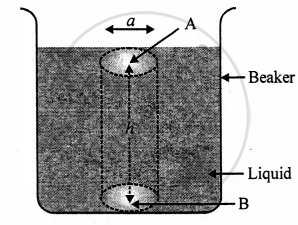
∴ Volume of the imaginary column of liquids = area of cross-section × length = ah
∴ Mass of liquid column = Volume × density
= V × ρ = a.h.ρ
∴ Weight of liquid column =mass × g = mg
= a.h.ρ.g.
∴Thrust exerted by liquid column on the base of the breaker
= a.h.ρ.g.
∴ Pressure due to the liquid column
P = `"Force"/"Area"="F"/"a"="ahρg"/"a"`
P = h.ρ.g.
So, pressure on the base of beaker = hρg
∴ Total pressure at the base of beaker = Atmospheric pressure + hρg
= Pa + hρg
c. Also lateral pressure at the base on the inner walls of beaker = Pa + hρg
APPEARS IN
संबंधित प्रश्न
The density of a body which sinks in water is ......... than 1000 Kg m-3.
The density of aluminium is 2.7 g cm-3 and that of brass 8.4 g cm’3. The correct statement is
A piece of wood floats on water. The buoyant force on wood will be
Explain why an iron needle sinks in water, but a ship made of iron floats on water.
A tall vertical cylinder filled with water is kept on a horizontal table top. Two small holes A and B are made on the wall of the cylinder, A near the middle and B just Below the free surface of water. State and explain your observation.
Complete the following sentence :
Pressure at a point inside the liquid is ...................... To its depth.
In what direction and at what point does the buoyant force on a body due to a liquid act?
How is thrust different from pressure?
Complete the analogy.
Downward force: Weight:: Upward force offered by liquid: _____
If the buoyant force is less, the object will float.
