Advertisements
Advertisements
Question
A beaker contains a liquid of density ‘ρ’ up to height ‘h’ such that ‘PA’ is atmospheric pressure and ‘g’ is the acceleration due to gravity. Answer the following questions:
- What is the pressure on the free surface of the liquid?
- What is the pressure on the base of the beaker?
- What is the lateral pressure at the base on the inner walls of the beaker?
Advertisements
Solution
a. Pressure on the free surface of the liquid is equal to the atmospheric pressure (Pa).
b. Consider a liquid contained in a beaker, such that ‘ p’ is the density of the liquid.
Consider a point B at the base of liquid and the liquid column of the area of cross-section ‘a’ around it, such that ‘h’ is the height of the liquid column as shown in the figure
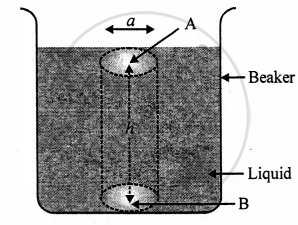
∴ Volume of the imaginary column of liquids = area of cross-section × length = ah
∴ Mass of liquid column = Volume × density
= V × ρ = a.h.ρ
∴ Weight of liquid column =mass × g = mg
= a.h.ρ.g.
∴Thrust exerted by liquid column on the base of the breaker
= a.h.ρ.g.
∴ Pressure due to the liquid column
P = `"Force"/"Area"="F"/"a"="ahρg"/"a"`
P = h.ρ.g.
So, pressure on the base of beaker = hρg
∴ Total pressure at the base of beaker = Atmospheric pressure + hρg
= Pa + hρg
c. Also lateral pressure at the base on the inner walls of beaker = Pa + hρg
APPEARS IN
RELATED QUESTIONS
When a boat is partially immersed in water, it displaces 600 kg of water. How much is the buoyant force acting on the boat in newtons ? (g = 10 m s-2)
When does an object float or sink when placed on the surface of a liquid ?
Name the S.I. unit of density. How is it related to g Cm-3?
Which of the following will sink or float on water? (Density of water = 1 g Cm-3)
body D having density 0.85 g m-3
Why does it happen?
A ship dips to a larger depth in fresh water as compared to marine water.
Explain why a gas bubble released at the bottom of a lake grows in size as it rises to the surface of the lake.
Complete the following sentence :
Pressure at a point inside the liquid is ...................... To its depth.
It is easier to lift a heavy stone under water than in air. Explain.
Figure shows the same block of wood floating in three different liquids A, B and C of densities ρ1, ρ2 and ρ3 respectively. Which of the liquid has the highest density? Give a reason for your answer.
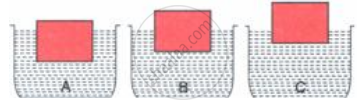
Select the correct option:
When an object sinks in a liquid, its:
