Advertisements
Online Mock Tests
Chapters
1: Goods and Services Tax (G.S.T.)
2: Banking
3: Shares and Dividends
UNIT 2: ALGEBRA
4: Linear Inequations
5: Quadratic Equation
6: Problems on Quadratic Equations
7: Ratio and Proportion
8: Remainder Theorem and Factor Theorem
9: Matrices
▶ 10: Arithmetic Progression
11: Geometric Progression
12: Reflection
Chapter 13: Section and Mid-point Formulae
Chapter 14: Equation of a Straight Line
UNIT 3: GEOMETRY
Chapter 15: Similarity (As a Size Transformation)
Chapter 16: Similarity of Triangles
17: Loci
Chapter 18: Angle and Cyclic Properties of a Circle
Chapter 19: Tangent Properties of Circles
20: Constructions
UNIT 4: MENSURATION
Chapter 21: Volume and Surface Area of Solids (Cylinder, Cone and Sphere)
UNIT 5: TRIGONOMETRY
Chapter 22: Trigonometrical Identities
Chapter 23: Heights and Distances
UNIT 6: STATISTICS
Chapter 24: Graphical Representation of Statistical Data
Chapter 25: Measures of Central Tendency (Mean)
Chapter 26: Median, Quartiles and Mode
UNIT 7: PROBABILITY
Chapter 27: Probability
Advertisements
Solutions for Chapter 10: Arithmetic Progression
Below listed, you can find solutions for Chapter 10 of CISCE R.S. Aggarwal for Mathematics [English] Class 10 ICSE.
R.S. Aggarwal solutions for Mathematics [English] Class 10 ICSE 10 Arithmetic Progression EXERCISE 10A [Page 164]
Show that the progression 11, 13, 15, 17, 19, ......... is an A.P. Write down its (i) first term (ii) common difference (iii) 20th term.
Show that the progression 13, 20, 27, 34, ......... is an A.P. Write down its (i) first term (ii) common difference (iii) 16th term.
Show that the progression 10, 6, 2, –2, –6, ......... is an A.P. Write down its (i) first term (ii) common difference (iii) 10th term.
Show that the progression 11, 5, –1, –7, –13, ......... is an A.P. Write down its (i) first term (ii) common difference (iii) 12th term.
Show that the progression `6, 7 3/4, 9 1/2, 11 1/4`, ......... is an A.P. Write down its (i) first term (ii) common difference (iii) 17th term.
Show that the progression `6, 5 1/2, 5, 4 1/2, 4`, ......... is an A.P. Write down its (i) first term (ii) common difference (iii) 9th term.
Find the nth term of the A.P. 5, 11, 17, 23, ......... . Using it, find its (i) 11th term (ii) 21st term.
Find the nth term of the A.P. 13, 7, 1, –5, –11, ......... . Using it, find its (i) 9th term (ii) 16th term.
How many terms are there in the AP 6, 10, 14, 18, ..., 174?
How many terms are there in the A.P. 41, 38, 35, ......, –1?
Which term of the A.P. 3, 8, 13, 18, 23 ......, is 98?
Which term of AP 72, 68, 64, 60, ... is 0?
Which term of the A.P. `1, 1 1/6, 1 1/3`, ......, is 3?
The 4th and 10th terms of an A.P. are 13 and 25 respectively. Find its (i) first term (ii) common difference (iii) 17th term.
The 7th term of an A.P. is – 4 and its 13th term is –16. Find its (i) first term (ii) common difference (iii) nth term.
Find the 8th term from the end of the AP 7, 10, 13, ..., 184.
Find the 6th term form the end of the AP 17, 14, 11, ..., (–40).
Find the value of x for which the numbers (5x + 2), (4x – 1) and (x + 2) are in AP.
If (k – 3), (2k + l) and (4k + 3) are three consecutive terms of an A.P., find the value of k.
Find the three numbers in AP whose sum is 15 and product is 80.
The angles of a quadrilateral are in A.P. whose common difference is 10°. Find the angles.
The angles of a triangle are in A.P. whose common difference is 20°. Find the angles.
–11, –7, –3, ............., 49, 53 are the terms of a progression.
Answer the following:
- What is the type of progression?
- How many terms are there in all?
- Calculate the value of middle most term.
R.S. Aggarwal solutions for Mathematics [English] Class 10 ICSE 10 Arithmetic Progression EXERCISE 10B [Pages 167 - 168]
Find the sum 2 + 7 + 12 + 17 + ...... to 19 terms.
Find the sum 9 + 7 + 5 + 3 ...... to 14 terms.
Find the sum (–11) + (–7) + (–3) + 1 + ........ to 12 terms.
Find the sum `1/15, 1/12, 1/10`, ............... to 11 terms.
Find the sum 0.6 + 1.7 + 2.8 + .................... to 100 terms.
Find the sum 7 + `10 1/2` + 14 + .................... + 84.
Find the sum 32 + 30 + 28 + .................... + 10.
Find the sum (–5) + (–8) + (–11) + .................... + (–62).
Find the sum of all 2-digit natural numbers divisible by 5.
Find the sum of all even numbers between 10 and 100.
Find the sum of all odd numbers between 100 and 150.
Find the sum of first fifteen multiples of 8.
The nth term of an Arithmetic Progression (A.P.) is given by the relation Tn = 6(7 − n). Find:
- its first term and the common difference
- sum of its first 25 terms
The 4th term of an A.P. is 22, and the 15th term is 66. Find the first term and the common difference. Hence, find the sum of the series to 8 terms.
In an Arithmetic Progression (A.P.), the fourth and sixth terms are 8 and 14 respectively. Find the:
- first term
- common difference
- sum of the first 20 terms.
The sum of the first three terms of an Arithmetic Progression (A.P.) is 42 and the product of the first and third term is 52. Find the first term and the common difference.
The 6th term of an A.P. is equal to 4 times its first term, and the sum of the first 6 terms is 75. Find the first term and the common difference.
The 5th term and the 9th term of an Arithmetic Progression are 4 and – 12 respectively.
Find:
- the first term
- common difference
- sum of 16 terms of the AP.
Which term of the Arithmetic Progression (A.P.) 15, 30, 45, 60...... is 300?
Hence find the sum of all the terms of the Arithmetic Progression (A.P.)
164, 160, 156, 152, ...... are in Arithmetic Progression (A.P.). Find:
- which term is equal to 0.
- the sum of its first 20 terms.
An Arithmetic Progression (A.P.) has 3 as its first term. The sum of the first 8 terms is twice the sum of the first 5 terms. Find the common difference of the A.P.
A sum of ₹ 2800 is to be used to award four prizes. If each prize after the first is ₹ 200 less than the preceding prize, find the value of each of the prizes.
The production of TV sets in a factory increases uniformly by a fixed number every year. It produced 8000 sets in 6th year, and 11300 in 9th year. Find the production in (i) first year (ii) 8th year (iii) 6 years.
[Hint: a + 5d = 8000 and a + 8d = 11300.
Production in 8th year = (a + 7d)
Production in 6 years = `6/2 xx [2a + 5d]`.]
200 logs are stacked in such a way that there are 20 logs in the bottom row, 19 logs in the next row, 18 logs in the next row and so on. How many rows are formed and how many logs are there in the top row?
[Hint: 20 + 19 + 18 + ......... to n terms = 200. Find n and Tn]
In a flower bed there are 43 rose plants in the first row, 41 in the second row, 39 in the third row and so on. There are 11 rose plants in the last row. How many rows are there in the flower bed? How many rose plants are there in the flower bed?
[Hint: Take a = 43, d = –2 and `l` = 11.
a + (n – 1)d = l ⇒ 43 + (n – 1) × (–2) = 11 ⇒ 2n = 34 ⇒ n = 17.
Sun = `17/2(43 + 11) = (17 xx 27) = 459.`]
A man saved ₹ 33000 in 10 months. In each month after the first, he saved ₹ 100 more than he did in the preceding month. How much did he save in the first month?
R.S. Aggarwal solutions for Mathematics [English] Class 10 ICSE 10 Arithmetic Progression COMPETENCY-FOCUSED QUESTIONS [Pages 169 - 172]
I. Multiple Choice Questions Choose the correct alternative:
The 7th term of the given Arithmetic Progression (A.P.) `1/a, (1/a + 1), (1/a + 2)`... is ______.
`(1/a + 6)`
`(1/a + 7)`
`(1/a + 8)`
`(1/a + 7^7)`
The $$n$$th term from the end of an A.P. whose first term, last term and common difference are $$a$$, $$l$$ and $$d$$ respectively, is given by:
$$l + (n + 1)d$$
$$l - (n - 1)d$$
$$l + (n - 1)d$$
$$l - (n + 1)d$$
The sum of first $$n$$ natural numbers is ______.
$$\frac{n(n - 1)}{2}$$
$$\frac{n(n + 1)}{2}$$
$$\frac{n(n + 2)}{2}$$
$$\frac{n(n - 2)}{2}$$
The sum of first 50 natural numbers is ______.
$$1050$$
$$1175$$
$$1225$$
$$1275$$
The nth term of an Arithmetic Progression (A.P.) is 2n + 5. The 10th term is ______.
7
15
25
45
The first term of an A.P. is $$7$$ and the common difference is $$3$$. The general term of the A.P. is ______.
$$\mathrm{T}_{n}=3n-4$$
$$\mathrm{T}_{n}=2n+5$$
$$\mathrm{T}_{n}=3n+4$$
none of these
The 24th term of the A.P. $$-1, 3, 7, 11, .....$$ is ______.
$$83$$
$$87$$
$$91$$
$$95$$
If $$70, 75, 80, 85$$ are the first four terms of an arithmetic progression, then the 10th term is ______.
$$35$$
$$25$$
$$115$$
$$105$$
The A.P. $$6, 13, 20, ......., 216$$ has 31 terms. The middle term of the A.P. is ______.
$$91$$
$$97$$
$$107$$
$$111$$
Which term of the A.P. $$7, 13, 19, 25, ......$$ is $$241$$?
40th
36th
44th
45th
Which term of the A.P. $$11, 8, 5, 2, ......$$ is $$-148$$?
52th
54th
55th
57th
How many three digit numbers are divisible by $$7$$?
$$128$$
$$124$$
$$136$$
$$132$$
How many numbers lying between $$20$$ and $$200$$ are divisible by $$4$$?
$$43$$
$$44$$
$$45$$
$$46$$
The common difference of the A.P. $$\frac{1}{k}, \frac{1 - k}{k}, \frac{1 - 2k}{k}, .......$$ is ______.
$$-k$$
$$k$$
$$1$$
$$-1$$
If the $$n$$th term of an A.P. is given by $$(3n + 2)$$, then the sum of its first three terms is ______.
$$21$$
$$24$$
$$27$$
$$32$$
The last term of the A.P. $$5, 12, 19, ........,$$ having $$60$$ terms is ______.
$$406$$
$$412$$
$$416$$
$$418$$
The common difference of the A.P. $$\frac{1}{3}, \frac{1 - 3p}{3}, \frac{1 - 6p}{3}, ....$$ is ______.
$$p$$
$$-p$$
$$\frac{1}{3}$$
$$-\frac{1}{3}$$
The next term of the A.P. $$\sqrt{3}, \sqrt{12}, \sqrt{27}, \sqrt{48}, ......$$ is ______.
$$\sqrt{72}$$
$$\sqrt{68}$$
$$\sqrt{75}$$
$$\sqrt{56}$$
The first term of an A.P. is $$p$$ and its common difference is $$q$$. The 10th term of the A.P. is ______.
$$p - 9q$$
$$p + 10q$$
$$p - 10q$$
$$p + 9q$$
The $$n$$th term of the A.P. $$\frac{1}{m}, \frac{1 + m}{m}, \frac{1 + 2m}{m}, .........$$ is ______.
$$\frac{m(n - 1) + 1}{m}$$
$$\frac{m(n + 1) - 1}{m}$$
$$\frac{m(n - 1) - 1}{m}$$
none of these
For what value of $$p$$ are $$2p + 1, 13, 5p - 3$$ three consecutive terms of an A.P.?
$$0$$
$$1$$
$$2$$
$$4$$
For what value of $$k$$ will $$2k + 1, 3k + 3$$ and $$5k - 1$$ be three consecutive terms of an A.P.?
$$1$$
$$2$$
$$4$$
$$6$$
If the sum of first $$n$$ terms of an A.P. is, $$\mathrm{S}_{n} = 5n^{2} + 3n$$, then its common difference is ______.
$$8$$
$$10$$
$$18$$
$$26$$
The first and the last terms of an A.P. are $$1$$ and $$11$$ respectively. If the sum of its terms is $$36$$, then the number of terms is ______.
$$6$$
$$7$$
$$8$$
$$9$$
The sum of first 40 positive integers divisible by 6 is ______.
2460
3640
4920
4860
The sum of first $$30$$ odd natural numbers is ______.
$$800$$
$$900$$
$$729$$
$$1249$$
The 7th term of an A.P. is $$4$$ and its common difference is $$-4$$. The first term of the A.P. is ______.
$$32$$
$$28$$
$$24$$
$$36$$
The sum of first $$n$$ terms of an A.P. is $$\left(4n^{2} + 2n\right)$$. The $$n$$th term of the A.P. is ______.
$$(6n - 2)$$
$$(8n - 2)$$
$$(6n + 2)$$
$$(8n - 2)$$
The first term of an A.P. is $$7$$ and its 13th term is $$35$$. The common difference of the A.P. is ______.
$$\frac{5}{3}$$
$$\frac{7}{2}$$
$$\frac{8}{3}$$
$$\frac{7}{3}$$
There are total $$9$$ terms in an A.P. If the last term and the sum of all the terms are $$28$$ and $$144$$ respectively, then the first term is ______.
$$1$$
$$7$$
$$4$$
$$5$$
The 5th term of an A.P. is $$-3$$ and its common difference is $$-4$$. The sum of its first $$10$$ terms is ______.
$$-50$$
$$-40$$
$$-60$$
$$-30$$
The 7th term of an A.P. is $$-1$$ and its 16th term is $$17$$. The nth term of the A.P. is ______.
$$(3n + 12)$$
$$(2n - 5)$$
$$(3n + 5)$$
$$(2n - 15)$$
If the sum of first $$p$$ terms of an A.P. is $$ap^{2} + bp$$, then its common difference is ______.
$$a$$
$$3a + b$$
$$a + b$$
$$2a$$
The first term of an A.P. is $$a$$ and $$n$$th term is $$b$$, then the common difference of the A.P. is ______.
$$\frac{b - a}{n}$$
$$\frac{b - a}{n - 1}$$
$$\frac{b + a}{n - 1}$$
$$\frac{b - a}{n + 1}$$
The first three terms of an A.P. are $$3y - 1, 3y + 5$$ and $$5y + 1$$ respectively. Then, the value of $$y$$ is ______.
$$1$$
$$5$$
$$8$$
$$3$$
The 8th term from the end of the A.P. $$7, 10, 13, ......., 184$$ is ______.
$$157$$
$$160$$
$$163$$
$$166$$
If $$a = 3, n = 8$$ and $$\mathrm{S}_{n} = 192$$, then the common difference of the A.P. is ______.
$$4$$
$$5$$
$$6$$
$$7$$
If the sum of $$n$$ terms of an arithmetic progression $$\mathrm{S}_{n} = n^{2} - n$$, then the third term of the series is ______.
$$2$$
$$4$$
$$6$$
$$9$$
II. Assertion-Reason Type Questions Directions: In each question below, there are two statements labelled as Assertion (A) and Reason (R). Choose the correct answer as per the options given below:
Assertion (A): The sum of first n terms of the A.P. –1, 5, 11 .... is \(3n^{2} - 4n\).
Reason (R): The sum of first n terms of an A.P. is given by \(\mathrm{S}_{n} = \frac{n}{2}[2a + (n - 1)d]\).
Both A and R are true, and R is the correct explanation of A.
Both A and R are true, but R is not the correct explanation of A.
A is true, but R is false.
A is false, but R is true.
Assertion (A): The 10th term from the end of the A.P. 17, 14, 11, ....... –40 is –11.
Reason (R): nth term of an A.P. is given by \(t_{n} = a + (n - 1)d\).
Both A and R are true, and R is the correct explanation of A.
Both A and R are true, but R is not the correct explanation of A.
A is true, but R is false.
A is false, but R is true.
Assertion (A): For an A.P., \(\mathrm{T}_{22} = 149\) and \(d = 7\). Then \(\mathrm{S}_{22}\) is 1661.
Reason (R): The sum of first n terms of an A.P. is given by \(\mathrm{S}_{n} = \frac{n}{2}[2a - (n - 1)d]\).
Both A and R are true, and R is the correct explanation of A.
Both A and R are true, but R is not the correct explanation of A.
A is true, but R is false.
A is false, but R is true.
Assertion (A): If the sum of first n terms of an A.P. is given \(\mathrm{S}_{n} = 2n^{2} - n\), then, its nth term is \(4n - 3\).
Reason (R): The nth term of an AP from the end is \(l - (n - 1)d\).
Both A and R are true, and R is the correct explanation of A.
Both A and R are true, but R is not the correct explanation of A.
A is true, but R is false.
A is false, but R is true.
III. Analytical and Application Based Questions
(a) Write the nth term (Tn) of an Arithmetic Progression (A.P.) consisting of all whole numbers which are divisible by 3 and 7.
(b) How many of these are two-digit numbers? Write them.
(c) Find the sum of first 10 terms of this A.P.
The sum of a certain number of terms of the Arithmetic Progression (A.P.) 20, 17, 14, .... is 65. Find the:
- number of terms.
- last term.
The sequence 2, 9, 16, ...... is given.
- Identify if the given sequence is an AP or a GP. Give reasons to support your answer.
- Find the 20th term of the sequence.
- Find the difference between the sum of its first 22 and 25 terms.
- Is the term 102 belong to this sequencе?
- If ‘k’ is added to each of the above terms, will the new sequence be in A.P. or G.P.?
IV. Case Study Based Questions Read the following case studies carefully and answer the questions based on them:
|
A spiral is made up of successive semicircles, with centres alternately at A and B, starting with centre at A, of raddi 0.5 cm, 1 cm, 1.5 cm, 2 cm, ....... as shown in the given figure. `("Take" pi = 22/7)` |
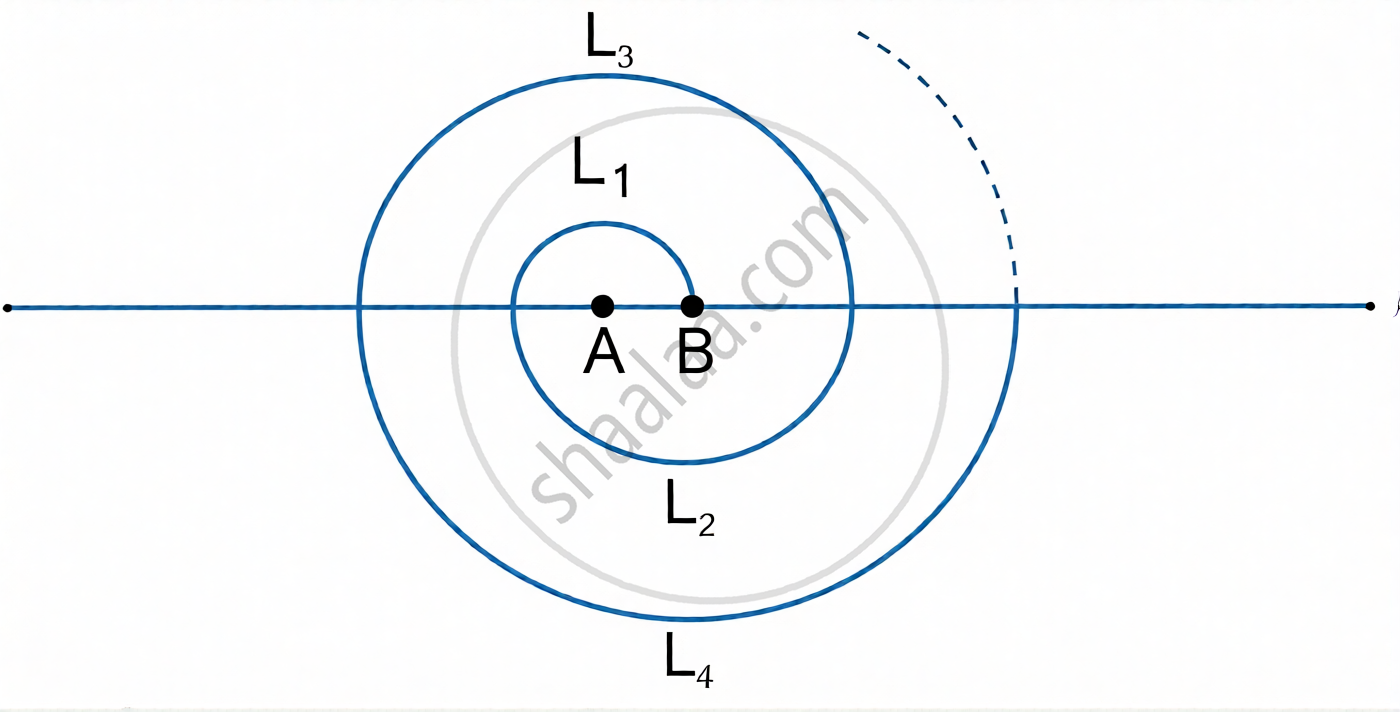
1. What is the radius of the 9th semicircle?
(a) 4 cm
(b) 4.5 cm
(c) 3.5 cm
(d) 5 cm
2. The length of 15th semicircle is:
(a) 8π cm
(b) 7π cm
(c) 7.5π cm
(d) 6.5π cm
3. The difference of lengths of 19th and 12th semicircle is :
(a) 3.5π cm
(b) 3 cm
(с) 4π cm
(d) 4.5π cm
4. The total length of the spiral made up of first 7 consecutive semicircles is :
(a) 38 cm
(b) 42 cm
(с) 44 cm
(d) 46 cm
5. The lengths of the semicircles form as A.P. What is the common difference of this A.Р.?
(a) 0.5π cm
(b) π cm
(c) 0.25π cm
(d) 1.25π cm
| The production of TV sets in a factory increases uniformly by a fixed number every year. It produced 16000 sets in 6th year and 22600 in 9th year. |
1. The production of the TV sets during the first year was:
(a) 4000
(b) 4500
(c) 5000
(d) 5500
2. What was the uniform increase in the production of TV sets every year?
(a) 1800
(b) 2400
(c) 1600
(d) 2200
3. The production of the TV sets during the 8th year was:
(a) 20000
(b) 20400
(c) 21200
(d) 22800
4. The total production of the TV sets during first 6 years was:
(a) 56000
(b) 72000
(c) 66000
(d) 63000
5. The average production of the TV sets during first 6 years was:
(a) 10500
(b) 11000
(c) 11500
(d) 12000
| 200 logs are stacked in the following manner: 20 logs in the bottom row, 19 in the next row, 18 in the next row and so on. |
Based on the above information, answer the following questions:
1. In how many rows these 200 logs are placed?
(a) 25
(b) 20
(c) 16
(d) 14
2. The number of logs in the top row is:
(a) 1
(b) 5
(c) 3
(d) 8
3. The number of logs in the 8th row from the bottom is:
(a) 14
(b) 11
(c) 12
(d) 13
4. Total number of logs in the first six rows from the bottom is:
(a) 105
(b) 95
(c) 85
(d) 75
5. The number of logs in the 5th row from the top is:
(a) 8
(b) 9
(c) 7
(d) 10
Solutions for 10: Arithmetic Progression
R.S. Aggarwal solutions for Mathematics [English] Class 10 ICSE chapter 10 - Arithmetic Progression
Shaalaa.com has the CISCE Mathematics Mathematics [English] Class 10 ICSE CISCE solutions in a manner that help students grasp basic concepts better and faster. The detailed, step-by-step solutions will help you understand the concepts better and clarify any confusion. R.S. Aggarwal solutions for Mathematics Mathematics [English] Class 10 ICSE CISCE 10 (Arithmetic Progression) include all questions with answers and detailed explanations. This will clear students' doubts about questions and improve their application skills while preparing for board exams.
Further, we at Shaalaa.com provide such solutions so students can prepare for written exams. R.S. Aggarwal textbook solutions can be a core help for self-study and provide excellent self-help guidance for students.
Concepts covered in Mathematics [English] Class 10 ICSE chapter 10 Arithmetic Progression are Arithmetic Mean in A.P., Sequence, Series, and Progression, Concept of Arithmetic Progression (A.P.), General Term (nth) of an Arithmetic Progression, Sum of First ‘n’ Terms of an Arithmetic Progressions, Three or More Terms in Arithmetic Progression (A.P.), Properties of an Arithmetic Progression.
Using R.S. Aggarwal Mathematics [English] Class 10 ICSE solutions Arithmetic Progression exercise by students is an easy way to prepare for the exams, as they involve solutions arranged chapter-wise and also page-wise. The questions involved in R.S. Aggarwal Solutions are essential questions that can be asked in the final exam. Maximum CISCE Mathematics [English] Class 10 ICSE students prefer R.S. Aggarwal Textbook Solutions to score more in exams.
Get the free view of Chapter 10, Arithmetic Progression Mathematics [English] Class 10 ICSE additional questions for Mathematics Mathematics [English] Class 10 ICSE CISCE, and you can use Shaalaa.com to keep it handy for your exam preparation.
