Advertisements
Advertisements
Question
|
A spiral is made up of successive semicircles, with centres alternately at A and B, starting with centre at A, of raddi 0.5 cm, 1 cm, 1.5 cm, 2 cm, ....... as shown in the given figure. `("Take" pi = 22/7)` |
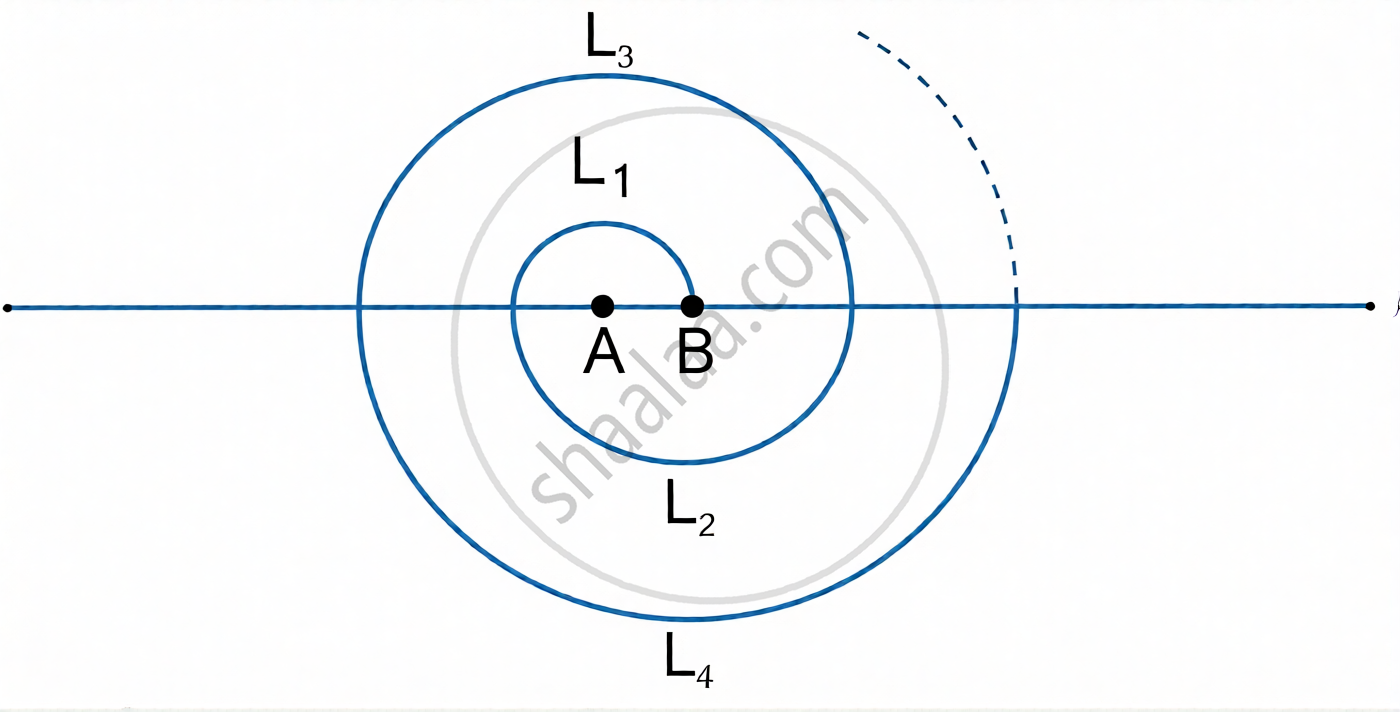
1. What is the radius of the 9th semicircle?
(a) 4 cm
(b) 4.5 cm
(c) 3.5 cm
(d) 5 cm
2. The length of 15th semicircle is:
(a) 8π cm
(b) 7π cm
(c) 7.5π cm
(d) 6.5π cm
3. The difference of lengths of 19th and 12th semicircle is :
(a) 3.5π cm
(b) 3 cm
(с) 4π cm
(d) 4.5π cm
4. The total length of the spiral made up of first 7 consecutive semicircles is :
(a) 38 cm
(b) 42 cm
(с) 44 cm
(d) 46 cm
5. The lengths of the semicircles form as A.P. What is the common difference of this A.Р.?
(a) 0.5π cm
(b) π cm
(c) 0.25π cm
(d) 1.25π cm
Advertisements
Solution
1. The correct option is (b).
Reasoning:
The radii of the successive semicircles form an Arithmetic Progression: \[r_1 = 0.5\text{ cm}, r_2 = 1.0\text{ cm}, r_3 = 1.5\text{ cm}, \dots\] where the first term is \[a = 0.5\text{ cm}\] and the common difference is \[d = 0.5\text{ cm}\].
The radius of the 9th semicircle is given by \[r_9 = a + (9 - 1)d = 0.5 + 8 \times 0.5 = 0.5 + 4 = 4.5\text{ cm}\].
Options (a), (c) and (d) are incorrect because they correspond to the 8th (4 cm), 7th (3.5 cm) and 10th (5 cm) semicircles respectively.
2. The correct option is (c).
Reasoning:
The length of a semicircle of radius r is \[L = \pi r\].
For the 15th semicircle, the radius is \[r_{15} = 0.5 + (15 - 1) \times 0.5 = 7.5\text{ cm}\].
Thus, the length is \[L_{15} = \pi r_{15} = 7.5\pi\text{ cm}\].
Options (a), (b) and (d) are incorrect because they correspond to semicircles of radii 8 cm, 7 cm and 6.5 cm respectively.
3. The correct option is (a).
Reasoning:
The difference between the 19th and 12th terms of this A.P. of lengths is \[L_{19} - L_{12} = (19 - 12)d\].
Here, the common difference between consecutive semicircle lengths is \[d = 0.5\pi\text{ cm}\].
Therefore, \[L_{19} - L_{12} = 7 \times 0.5\pi = 3.5\pi\text{ cm}\].
Options (b), (c) and (d) are incorrect due to miscalculating the term difference or omitting the factor of \[\pi\].
4. The correct option is (c).
Reasoning:
The total length of n semicircles is \[S_n = \pi (r_1 + r_2 + \dots + r_n) = \pi \left[\frac{n}{2}(2a + (n-1)d)\right]\].
For \[n = 7\], \[a = 0.5\] and \[d = 0.5\]:
\[S_7 = \frac{22}{7} \times \left[\frac{7}{2}(2(0.5) + (7 - 1)(0.5))\right] = \frac{22}{7} \times \frac{7}{2} \times [1 + 3] = 11 \times 4 = 44\text{ cm}\]
Options (a), (b), and (d) result from common arithmetic errors or incorrect values of \[\pi\].
5. The correct option is (a).
Reasoning:
The lengths of the consecutive semicircles are \[L_1 = 0.5\pi\text{ cm}\], \[L_2 = 1.0\pi\text{ cm}\], \[L_3 = 1.5\pi\text{ cm}\] and so on.
Common difference \[d = L_2 - L_1 = 1.0\pi - 0.5\pi = 0.5\pi\text{ cm}\].
Options (b), (c) and (d) are incorrect values that do not equal the constant increment of \[0.5\pi\text{ cm}\].
