Advertisements
Online Mock Tests
Chapters
2: Polynomials
3: Pair of Linear Equations in Two Variables
▶ 4: Quadratic Equations
5: Arithmetic Progressions
6: Co-ordinate Geometry
7: Triangles
8: Circles
9: Constructions
10: Trigonometric Ratios
11: Trigonometric Identities
12: Heights and Distances
13: Areas Related to Circles
14: Surface Areas and Volumes
15: Statistics
16: Probability
![R.D. Sharma solutions for Mathematics [English] Class 10 chapter 4 - Quadratic Equations - Shaalaa.com](/images/mathematics-english-class-10_6:df8cedf76b7f4149972b35ec991c0c9d.jpg "R.D. Sharma solutions for Mathematics [English] Class 10 chapter 4 - Quadratic Equations")
Advertisements
Solutions for Chapter 4: Quadratic Equations
Below listed, you can find solutions for Chapter 4 of CBSE, Karnataka Board R.D. Sharma for Mathematics [English] Class 10.
R.D. Sharma solutions for Mathematics [English] Class 10 4 Quadratic Equations EXERCISE 4.1 [Pages 4.3 - 4.4]
BASIC
Check whether the following is quadratic equation or not.
16x2 – 3 = (2x + 5) (5x – 3)
Check whether the following is quadratic equation or not.
`sqrt(3x^2) - 2x + 1/2 = 0`
Check whether the following is quadratic equation or not.
`x^2 + 1/x^2 = 5`
Check whether the following is quadratic equation or not.
`x - 3/x = x^2`
Check whether the following is quadratic equation or not.
`2x^2 - sqrt(3x) + 9 = 0`
Check whether the following is quadratic equation or not.
`x^2 - 2x - sqrtx - 5 = 0`
Check whether the following is quadratic equation or not.
(x + 2)3 = x3 – 4
Check whether the following is quadratic equation or not.
`x + 1/x = 1`
Check whether the following is quadratic equation or not.
`x + 1/x = x^2`, x ≠ 0
Check whether the following is quadratic equation or not.
`(x + 1/x)^2 = 3(x + 1/x) + 4`
In the following, determine whether the given values are solutions of the given equation or not:
`x^2 - 3sqrt3x + 6 = 0, x = sqrt3, x = -2sqrt3`
In the following, determine whether the given values are solutions of the given equation or not:
`x + 1/x = 13/6, x = 5/6, x = 4/3`
In the following, determine whether the given values are solutions of the given equation or not:
2x2 – x + 9 = x2 + 4x + 3, x = 2, x = 3
In the following, determine whether the given values are solutions of the given equation or not:
`x^2 - sqrt2x - 4 = 0, x = -sqrt2, x = -2sqrt2`
In the following, determine whether the given values are solutions of the given equation or not:
`a^2x^2 - 3abx + 2b^2 = 0, x = a/b, x = b/a`
In the following, determine whether the given values are solutions of the given equation or not:
`sqrt(x^2 - 4x + 3) + sqrt(x^2 - 9) = sqrt(4x^2 - 14x + 16), x = 3`
In the following, find the value of k for which the given value is a solution of the given equation:
`7x^2 + kx - 3 = 0, x = 2/3`
In the following, find the value of k for which the given value is a solution of the given equation:
x2 – x(a + b) + k = 0, x = a
In the following, find the value of k for which the given value is a solution of the given equation:
`kx^2 + sqrt2x - 4 = 0, x = sqrt2`
In the following, find the value of k for which the given value is a solution of the given equation:
x2 + 3ax + k = 0, x = –a
BASED ON LOTS
If `x = 2/3` and x = –3 are the roots of the equation ax2 + 7x + b = 0, find the values of a and b.
R.D. Sharma solutions for Mathematics [English] Class 10 4 Quadratic Equations EXERCISE 4.2 [Pages 4.6 - 4.7]
BASIC
The product of two consecutive positive integers is 306. Form the quadratic equation to find the integers, if x denotes the smaller integer.
John and Jivanti together have 45 marbles. Both of them lost 5 marbles each, and the product of the number of marbles they now have is 124. Form the quadratic equation to find how many marbles they had to start with, if John had x marbles.
The height of a right triangle is 7 cm less than its base. If the hypotenuse is 13 cm, form the quadratic equation to find the base of the triangle.
BASED ON LOTS
A cottage industry produces a certain number of toys in a day. The cost of production of each toy (in rupees) was found to be 55 minus the number of articles produced in a day. On a particular day, the total cost of production was Rs. 750. If x denotes the number of toys produced that day, form the quadratic equation of find x.
An express train takes 1 hour less than a passenger train to travel 132 km between Mysore and Bangalore. If the average speed of the express train is 11 km/hr more than that of the passenger train, form the quadratic equation to find the average speed of express train.
A train travels 360 km at a uniform speed. If the speed had been 5 km/h more, it would have taken 1 hour less for the same journey. Find the speed of the train.
R.D. Sharma solutions for Mathematics [English] Class 10 4 Quadratic Equations EXERCISE 4.3 [Page 4.16]
BASIC
Solve the following quadratic equations by factorization:
25x(x + 1) = – 4
Solve the following quadratic equations by factorization:
\[16x - \frac{10}{x} = 27\]
Solve the following quadratic equations by factorization:
6x2 + 11x + 3 = 0
Solve the following quadratic equations by factorization:
\[2x^2 + ax - a^2 = 0\]
Solve the following quadratic equations by factorization:
`1/(x - 1) - 1/(x + 5) = 6/7, x ≠ 1, -5`
Solve the following quadratic equations by factorization:
`1/(x + 4) - 1/(x - 7) = 11/30, x ≠ 4, 7`
Solve the following quadratic equations by factorization:
\[\frac{1}{x - 3} + \frac{2}{x - 2} = \frac{8}{x}; x \neq 0, 2, 3\]
Solve the following quadratic equations by factorization:
\[\frac{16}{x} - 1 = \frac{15}{x + 1}; x \neq 0, - 1\]
Solve the following quadratic equations by factorization:
`(x + 3)/(x + 2) = (3x - 7)/(2x - 3); x ≠ -2, 3/2`
Solve the following quadratic equations by factorization:
`(x + 3)/(x - 2) - (1 - x)/x = 17/4; x ≠ 0, 2`
Solve the following quadratic equations by factorization:
`(x - 3)/(x + 3) - (x + 3)/(x - 3) = 48/7; x ≠ 3, -3`
Solve the following quadratic equations by factorization:
\[\frac{4}{x} - 3 = \frac{5}{2x + 3}, x \neq 0, - \frac{3}{2}\]
Solve the following quadratic equations by factorization:
\[\frac{3}{x + 1} - \frac{1}{2} = \frac{2}{3x - 1}, x \neq - 1, \frac{1}{3}\]
Solve the following quadratic equations by factorization:
\[\frac{3}{x + 1} + \frac{4}{x - 1} = \frac{29}{4x - 1}; x \neq 1, -1, \frac{1}{4}\]
Solve the following quadratic equations by factorization:
\[\frac{2}{x + 1} + \frac{3}{2(x - 2)} = \frac{23}{5x}; x \neq 0, -1, 2\]
BASED ON LOTS
Solve the following quadratic equations by factorization:
a2x2 – 3abx + 2b2 = 0
Solve the following quadratic equations by factorization:
\[9x^2 - 6 b^2 x - \left(a^4 - b^4 \right) = 0\]
Solve the following quadratic equations by factorization:
4x2 + 4bx – (a2 – b2) = 0
Solve the following quadratic equations by factorization:
`x^2 + (a + 1/a)x + 1 = 0`
Solve the following quadratic equations by factorization:
abx2 + (b2 – ac)x – bc = 0
Solve the following quadratic equations by factorization:
`3sqrt(5)x^2 + 25x - 10sqrt(5) = 0`
Solve the following quadratic equations by factorization:
\[\sqrt{3}x^2 - 2\sqrt{2}x - 2\sqrt{3} = 0\]
Solve the following quadratic equations by factorization:
`3x^2 - 2sqrt6x + 2 = 0`
Find the roots of the quadratic equation \[\sqrt{2}x^2 + 7x + 5\sqrt{2} = 0\].
Solve the following quadratic equations by factorization:
\[3\left( \frac{7x + 1}{5x - 3} \right) - 4\left( \frac{5x - 3}{7x + 1} \right) = 11; x \neq \frac{3}{5}, - \frac{1}{7}\]
Solve the following quadratic equations by factorization:
\[\frac{x + 1}{x - 1} + \frac{x - 2}{x + 2} = 4 - \frac{2x + 3}{x - 2}; x \neq 1, -2, 2\]
BASED ON HOTS
Solve the following quadratic equation:
`a/((x - b)) + b/((x - a)) = 2, x ≠ b, a`
Solve the following quadratic equations by factorization:
`a/(x - a) + b/(x - b) = (2c)/(x - c)`
Solve the following quadratic equations by factorization:
\[\frac{1}{2a + b + 2x} = \frac{1}{2a} + \frac{1}{b} + \frac{1}{2x}\]
Solve the following quadratic equations by factorization:
`(x - 5)(x - 6) = 25/(24)^2`
Solve the following quadratic equations by factorization:
`7x + 3/x = 35 3/5`
R.D. Sharma solutions for Mathematics [English] Class 10 4 Quadratic Equations EXERCISE 4.4 [Page 4.21]
BASIC
Write the discriminant of the following quadratic equations:
(x – 1) (2x – 1) = 0
Write the discriminant of the following quadratic equations:
x2 – 2x + k = 0, k ∈ R
Write the discriminant of the following quadratic equations:
`sqrt3x^2 + 2sqrt2x - 2sqrt3 = 0`
Write the discriminant of the quadratic equation (x + 5)2 = 2 (5x − 3).
In the following, determine whether the given quadratic equation have real roots and if so, find the roots:
`3x^2 + 2sqrt5x - 5 = 0`
In the following, determine whether the given quadratic equation have real roots and if so, find the roots:
`2x^2 + 5sqrt3x + 6 = 0`
In the following, determine whether the given quadratic equation have real roots and if so, find the roots:
`sqrt2x^2 + 7x + 5sqrt2 = 0`
In the following, determine whether the given quadratic equation have real roots and if so, find the roots:
`2x^2 - 2sqrt2x + 1 = 0`
Solve for x:
`(x - 1)/(x - 2) + (x - 3)/(x - 4) = 3 1/3; x ≠ 2, 4`
Solve for x:
\[\frac{1}{x - 3} - \frac{1}{x + 5} = \frac{1}{6}, x \neq 3, - 5\]
R.D. Sharma solutions for Mathematics [English] Class 10 4 Quadratic Equations EXERCISE 4.5 [Pages 4.28 - 4.30]
BASIC
Find the nature of the roots of the following quadratic equation. If the real roots exist, find them:
2x2 – 3x + 5 = 0
Find the nature of the roots of the following quadratic equation. If the real roots exist, find them:
2x2 – 6x + 3 = 0
Find the nature of the roots of the following quadratic equation. If the real roots exist, find them:
`3x^2 - 4sqrt3x + 4 = 0`
Determine the nature of the roots of the following quadratic equation:
`4x^2 + 4sqrt(3)x + 3 = 0`
Find the values of k for which the roots are real and equal in the following quadratic equation:
4x2 – 2(k + 1)x + (k + 4) = 0
Find the values of k for which the roots are real and equal in the following quadratic equation:
4x2 – 2(k + 1)x + (k + 1) = 0
Find the value of k for which the following equations have real and equal roots:
\[x^2 - 2\left( k + 1 \right)x + k^2 = 0\]
Find the values of k for which the roots are real and equal in the following quadratic equation:
k2x2 – 2(2k – 1)x + 4 = 0
Find the value of k for which the following equations have real and equal roots:
\[\left( k + 1 \right) x^2 - 2\left( k - 1 \right)x + 1 = 0\]
Find the value of k for which the following equations have real and equal roots:
\[x^2 + k\left(2x + k - 1 \right) + 2 = 0\]
Find the values of k for which the roots are real and equal in the following equation:
2x2 + kx + 3 = 0
Find the values of k for which the roots are real and equal in the following equation:
kx(x – 2) + 6 = 0
Find the values of k for which the roots are real and equal in the following equation:
x2 – 4kx + k = 0
Find the values of k for which the roots are real and equal in the following equation:
\[kx\left( x - 2\sqrt{5} \right) + 10 = 0\]
Find the values of k for which the roots are real and equal in the following equation:
\[kx(x - 3) + 9 = 0\]
Find the values of k for which the roots are real and equal in the following equation:
\[4x^2 + kx + 3 = 0\]
Find the values of k for which the given quadratic equation has real and distinct roots:
kx2 + 2x + 1 = 0
Find the values of k for which the given quadratic equation has real and distinct roots:
kx2 + 6x + 1 = 0
For what value of k, (4 – k)x2 + (2k + 4)x + (8k + 1) = 0, is a perfect square.
Find the values of k for which the quadratic equation \[\left( 3k + 1 \right) x^2 + 2\left( k + 1 \right)x + 1 = 0\] has equal roots. Also, find the roots.
Write all the values of k for which the quadratic equation x2 + kx + 16 = 0 has equal roots. Find the roots of the equation so obtained.
Find the value of 'p' for which the equation px (x – 2) + 6 = 0 has two equal roots. Also, find the roots.
Find the values of p for which the quadratic equation \[\left( 2p + 1 \right) x^2 - \left( 7p + 2 \right)x + \left( 7p - 3 \right) = 0\] has equal roots. Also, find these roots.
Find that value of p for which the quadratic equation (p + 1)x2 – 6(p + 1)x + 3(p + 9) = 0, p ≠ –1 has equal roots. Hence, find the roots of the equation.
Find the value(s) of p for which the quadratic equation given as (p + 4) x2 – (p + 1) x + 1 = 0 has real and equal roots. Also, find the roots of the equation(s) so obtained.
Find the smallest value of p for which the quadratic equation x2 − 2(p + 1)x + p2 = 0 has real roots. Hence, find the roots of the equation so obtained.
BASED ON LOTS
Find the least positive value of k for which the equation x2 + kx + 4 = 0 has real roots.
If the roots of the equation (b – c) x2 + (c – a) x + (a – b) = 0 are equal, then prove that 2b = a + c.
If the roots of the equation (a2 + b2)x2 – 2(ac + bd)x + (c2 + d2) = 0 are equal, prove that `a/b = c/d`.
If the equation \[\left(1 + m^2 \right) x^2 + 2mcx + \left(c^2 - a^2 \right) = 0\] has equal roots, prove that c2 = a2(1 + m2).
BASED ON HOTS
Determine the nature of the roots of the following quadratic equation:
(x – 2a)(x – 2b) = 4ab
Determine the nature of the roots of the following quadratic equation:
9a2b2x2 – 24abcdx + 16c2d2 = 0, a ≠ 0, b ≠ 0
Determine the nature of the roots of the following quadratic equation:
2(a2 + b2)x2 + 2(a + b)x + 1 = 0
Determine the nature of the roots of the following quadratic equation:
(b + c)x2 – (a + b + c)x + a = 0
If the roots of the equations ax2 + 2bx + c = 0 and `bx^2 - 2sqrt(ac)x + b = 0` are simultaneously real, then prove that b2 = ac.
If p, q are real and p ≠ q, then show that the roots of the equation (p – q) x2 + 5(p + q) x – 2(p – q) = 0 are real and unequal.
If the roots of the equation (c2 – ab)x2 – 2(a2 – bc)x + b2 – ac = 0 are real and equal, prove that either a = 0 or a3 + b3 + c3 = 3abc.
Show that the equation 2(a2 + b2)x2 + 2(a + b)x + 1 = 0 has no real roots, when a ≠ b.
Prove that both the roots of the equation (x – a)(x – b) + (x – b)(x – c) + (x – c)(x – a) = 0 are real but they are equal only when a = b = c.
If a, b, c are real numbers such that ac ≠ 0, then show that at least one of the equations ax2 + bx + c = 0 and –ax2 + bx + c = 0 has real roots.
R.D. Sharma solutions for Mathematics [English] Class 10 4 Quadratic Equations EXERCISE 4.6 [Pages 4.36 - 4.37]
BASIC
The sum of the squares of two consecutive odd numbers is 394. Find the numbers.
The sum of two numbers is 8 and 15 times the sum of their reciprocals is also 8. Find the numbers.
Two numbers differ by 3 and their product is 504. Find the numbers.
The sum of two numbers a and b is 15, and the sum of their reciprocals `1/a` and `1/b` is `3/10`. Find the numbers a and b.
The sum of two numbers is 9. The sum of their reciprocals is `1/2`. Find the numbers.
Three consecutive positive integers are such that the sum of the square of the first and the product of other two is 46, find the integers.
The difference of squares of two numbers is 88. If the larger number is 5 less than twice the smaller number, then find the two numbers.
The sum of the squares of two consecutive odd numbers is 394. Find the numbers.
The sum of the squares of two consecutive multiples of 7 is 637. Find the multiples.
The sum of the squares of two consecutive even numbers is 340. Find the numbers.
BASED ON LOTS
The sum of a numbers and its positive square root is `6/25`. Find the numbers.
The difference of two numbers is 4. If the difference of their reciprocals is `4/21`, find the numbers.
A two digit number is 4 times the sum of its digits and twice the product of its digits. Find the number.
The difference of squares of two numbers is 180. The square of the smaller number is 8 times the larger number. Find two numbers.
The difference of two natural numbers is 3 and the difference of their reciprocals is \[\frac{3}{28}\]. Find the numbers.
The numerator of a fraction is 3 less than the denominator. If 2 is added to both the numerator and the denominator, then the sum of the new fraction and the original fraction is \[\frac{29}{20}\]. Find the original fraction.
Find a natural number whose square diminished by 84 is equal to thrice of 8 more than the given number.
A natural number, when increased by 12, equals 160 times its reciprocal. Find the number.
A 2-digit number is such that the product of its digits is 24. If 18 is subtracted from the number, the digits interchange their places. Find the number.
In a 2-digit number, the digit at the unit's place is 5 less than the digit at the ten's place. The product of the digits is 36. Find the number.
The difference of squares of two positive integers is 400. Find the integers if twice of the smaller integer is 5 more than the greater integer.
A two digit number is such that the product of the digit is 12. When 36 is added to the number, the digits interchange their places. Find the numbers.
A 2 digit number is seven times the sum of its digits and two 2 more then 5 times the product of its digits. Find the number.
R.D. Sharma solutions for Mathematics [English] Class 10 4 Quadratic Equations EXERCISE 4.7 [Pages 4.41 - 4.42]
BASIC
A train covers a distance of 90 km at a uniform speed. Had the speed been 15 km/hour more, it would have taken 30 minutes less for a journey. Find the original speed of the train.
A train travels 360 km at a uniform speed. If the speed had been 5 km/h more, it would have taken 1 hour less for the same journey. Find the speed of the train.
Represent the following situation in the form of a quadratic equation.
A train travels a distance of 480 km at a uniform speed. If the speed had been 8 km/h less, then it would have taken 3 hours more to cover the same distance. We need to find the speed of the train.
An express train takes 1 hour less than a passenger train to travel 132 km between Mysore and Bangalore (without taking into consideration the time they stop at intermediate stations). If the average speed of the express train is 11 km/h more than that of the passenger train, find the average speed of the two trains.
A motor boat whose speed in still water is 18 km/hr takes 1 hour more to go 24 km upstream than to return downstream to the same spot. Find the speed of the stream.
A motorboat whose speed is 9 km/hr in still water, goes 15 km downstream and comes back in a total time of 3 hours 45 minutes. Find the speed of the stream.
A train, travelling at a uniform speed for 360 km, would have taken 48 minutes less to travel the same distance if its speed were 5 km/h more. Find the original speed of the train.
BASED ON LOTS
A plane left 40 minutes late due to bad weather and in order to reach its destination, 1600 km away in time, it had to increase its speed by 400 km/hr from its usual speed. Find the usual speed of the plane.
A train travels at a certain average speed for a distance 63 km and then travels a distance of 72 km at an average speed of 6 km/hr more than the original speed, If it takes 3 hours to complete total journey, what is its original average speed?
An aeroplane left 50 minutes later than its scheduled time, and in order to reach the destination, 1250 km away, in time, it had to increase its speed by 250 km/hr from its usual speed. Find its usual speed.
While boarding an aeroplane, a passenger got hurt. The pilot showing promptness and concern, made arrangements to hospitalise the injured and so the plane started late by 30 minutes. To reach the destination, 1500 km away, in time, the pilot increased the speed by 100 km/hour. Find the original speed of the plane.
A car moves a distance of 2592 km with uniform speed. The number of hours taken for the journey is one-half the number representing the speed, in km/hour. Find the time taken to cover the distance.
A train travels at a certain average speed for a distanced of 54 km and then travels a distance of 63 km at an average speed of 6 km/hr more than the first speed. If it takes 3 hours to complete the total journey, what is its first speed?
The time taken by a person to travel an upward distance of 150 km was `2 1/2` hours more than the time taken in the downward return journey. If he returned at a speed of 10 km/h more than the speed while going up, find the speeds in each direction.
R.D. Sharma solutions for Mathematics [English] Class 10 4 Quadratic Equations EXERCISE 4.8 [Page 4.44]
BASIC
Ashu is x years old while his mother Mrs Veena is x2 years old. Five years hence Mrs Veena will be three times old as Ashu. Find their present ages.
The sum of the ages of a man and his son is 45 years. Five years ago, the product of their ages was four times the man’s age at the time. Find their present ages.
The product of Shikha’s age five years ago and her age 8 years later is 30, her age at both times being given in years. Find her present age.
The product of Ramu’s age (in years) five years ago and his age (in years) nice years later is 15. Determine Ramu’s present age.
Is the following situation possible? If so, determine their present ages. The sum of the ages of two friends is 20 years. Four years ago, the product of their ages in years was 48.
A girls is twice as old as her sister. Four years hence, the product of their ages (in years) will be 160. Find their present ages.
The sum of the reciprocals of Rehman’s ages, (in years) 3 years ago and 5 years from now is `1/3`. Find his present age.
BASED ON LOTS
If Zeba were younger by 5 years than what she really is, then the square of her age (in years) would have been 11 more than five times her actual age. What is her age now?
At present Asha’s age (in years) is 2 more than the square of her daughter Nisha’s age. When Nisha grows to her mother’s present age, Asha’s age would be one year less than 10 times the present age of Nisha. Find the present ages of both Asha and Nisha.
The age of a man is twice the square of the age of his son. Eight years hence, the age of the man will be 4 years more than three times the age of his son. Find the present age.
R.D. Sharma solutions for Mathematics [English] Class 10 4 Quadratic Equations EXERCISE 4.9 [Page 4.46]
BASIC
The hypotenuse of a right triangle is 25 cm. The difference between the lengths of the other two sides of the triangle is 5 cm. Find the lengths of these sides.
The diagonal of a rectangular field is 60 metres more than the shorter side. If the longer side is 30 metres more than the shorter side, find the sides of the field.
BASED ON LOTS
The hypotenuse of a right triangle is `3sqrt10` cm. If the smaller leg is tripled and the longer leg doubled, new hypotenuse wll be `9sqrt5` cm. How long are the legs of the triangle?
A pole has to be erected at a point on the boundary of a circular park of diameter 13 meters in such a way that the difference of its distances from two diametrically opposite fixed gates A and B on the boundary is 7 meters. Is it the possible to do so? If yes, at what distances from the two gates should the pole be erected?
R.D. Sharma solutions for Mathematics [English] Class 10 4 Quadratic Equations EXERCISE 4.10 [Page 4.50]
BASIC
Is it possible to design a rectangular mango grove whose length is twice its breadth and the area is 800 m2? If so, find its length and breadth.
Is it possible to design a rectangular park of perimeter 80 m and area 400 m2? If so, find its length and breadth.
The sum of the areas of two squares is 640 m2. If the difference in their perimeter be 64 m, find the sides of the two squares.
The sum of the areas of two squares is 52 cm2 and difference of their perimeters is 8 cm. Find the lengths of the sides of the two squares.
Represent the following situation in the form of a quadratic equation:
The area of a rectangular plot is 528 m2. The length of the plot (in metres) is one more than twice its breadth. We need to find the length and breadth of the plot.
BASED ON LOTS
In the centre of a rectangular lawn of dimensions 50 m × 40 m, a rectangular pond has to be constructed so that the area of the grass surrounding the pond would be 1184 m2 [see figure]. Find the length and breadth of the pond.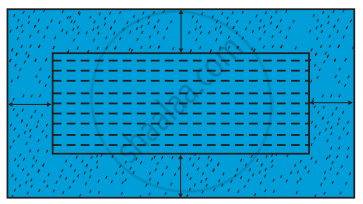
R.D. Sharma solutions for Mathematics [English] Class 10 4 Quadratic Equations EXERCISE 4.11 [Pages 4.52 - 4.53]
BASIC
A takes 10 days less than the time taken by B to finish a piece of work. If both A and B together can finish the work in 12 days, find the time taken by B to finish the work.
If two pipes function simultaneously, a reservoir will be filled in 12 hours. One pipe fills the reservoir 10 hours faster than the other. How many hours will the second pipe take to fill the reservoir?
BASED ON LOTS
Two water taps together can fill a tank in `9 3/8` hours. The tap of larger diameter takes 10 hours less than the smaller one to fill the tank separately. Find the time in which each tap can separately fill the tank.
Two pipes running together can fill a tank in `11 1/9` minutes. If one pipe takes 5 minutes more than the other to fill the tank separately, find the time in which each pipe would fill the tank separately.
To fill a swimming pool two pipes are used. If the pipe of larger diameter used for 4 hours and the pipe of smaller diameter for 9 hours, only half of the pool can be filled. Find, how long it would take for each pipe to fill the pool separately, if the pipe of smaller diameter takes 10 hours more than the pipe of larger diameter to fill the pool?
Two water taps together can fill a tank in `1 7/8` hours. The tap with a longer diameter takes 2 hours less than the tap with a smaller one to fill the tank separately. Find the time in which each tap can fill the tank separately.
R.D. Sharma solutions for Mathematics [English] Class 10 4 Quadratic Equations EXERCISE 4.12 [Pages 4.56 - 4.57]
BASIC
A piece of cloth costs Rs. 35. If the piece were 4 m longer and each meter costs Rs. 1 less, the cost would remain unchanged. How long is the piece?
Some students planned a picnic. The budget for the food was Rs. 480. As eight of them failed to join the party, the cost of the food for each member increased by Rs. 10. Find how many students went for the picnic.
If the list price of a toy is reduced by Rs. 2, a person can buy 2 toys more for Rs. 360. Find the original price of the toy.
Rs. 9000 were divided equally among a certain number of persons. Had there been 20 more persons, each would have got Rs. 160 less. Find the original number of persons.
In a class test, the sum of Shefali’s marks in Mathematics and English is 30. Had she got 2 marks more in Mathematics and 3 marks less in English, the product of their marks would have been 210. Find her marks in the two subjects.
A student scored a total of 32 marks in class tests in Mathematics and Science. Had he scored 2 marks less in Science and 4 marks more in Mathematics, the product of his marks would have been 253. Find his marks in the two subjects.
BASED ON LOTS
A dealer sells an article for Rs. 24 and gains as much percent as the cost price of the article. Find the cost price of the article.
A pole has to be erected at a point on the boundary of a circular park of diameter 13 meters in such a way that the difference of its distances from two diametrically opposite fixed gates A and B on the boundary is 7 meters. Is it the possible to do so? If yes, at what distances from the two gates should the pole be erected?
A cottage industry produces a certain number of pottery articles in a day. It was observed on a particular day that the cost of production of each article (in rupees) was 3 more than twice the number of articles produced on that day. If the total cost of production on that day was Rs 90, find the number of articles produced and the cost of each article.
At t minutes past 2 pm, the time needed by the minutes hand of a clock to show 3 pm was found to be 3 minutes less than `t^2/4` minutes. Find t.
R.D. Sharma solutions for Mathematics [English] Class 10 4 Quadratic Equations VERY SHORT ANSWER TYPE QUESTIONS (VSAQs) [Pages 4.57 - 4.58]
Answer each of the following questions either in one word or one sentence or as per requirement of the question:
BASIC
Find the value(s) of 'k' so that the quadratic equation 4x2 + kx + 1 = 0 has real and equal roots.
Write the value of k for which the quadratic equation x2 – kx + 4 = 0 has equal roots.
What is the nature of roots of the quadratic equation 4x2 – 12x – 9 = 0?
Write a quadratic polynomial, sum of whose zeros is \[2\sqrt{3}\] and their product is 2.
Show that x = –3 is a solution of x2 + 6x + 9 = 0.
Show that x = –2 is a solution of 3x2 + 13x + 14 = 0.
Find the discriminant of the quadratic equation \[3\sqrt{3}x^2 + 10x + \sqrt{3} = 0\].
The sides of a right triangle are such that the longest side is 4 m more than the shortest side and the third side is 2 m less than the longest side. Find the length of each side of the triangle. Also, find the difference between the numerical values of the area and the perimeter of the given triangle.
If `x = (-1)/2`, is a solution of the quadratic equation 3x2 + 2kx – 3 = 0, find the value of k.
If x = 3 is one root of the quadratic equation x2 – 2kx – 6 = 0, then find the value of k.
For what value of k, the roots of the equation x2 + 4x + k = 0 are real?
Find the value of k for which the roots of the equation 3x2 – 10x + k = 0 are reciprocal of each other.
Solve the quadratic equation 2x2 – 5x – 1 = 0 for x.
Find the nature of the roots of the quadratic equation x2 – 5x + 9 = 0.
Write a quadratic equation with roots –3 and 5.
BASED ON LOTS
Write the set of values of 'a' for which the equation x2 + ax – 1 = 0 has real roots.
Is there any real value of 'a' for which the equation x2 + 2x + (a2 + 1) = 0 has real roots?
Write the set of values of k for which the quadratic equation has 2x2 + kx – 8 = 0 has real roots.
BASED ON HOTS
If \[1 + \sqrt{2}\] is a root of a quadratic equation with rational coefficients, write its other root.
Write the number of real roots of the equation x2 + 3 |x| + 2 = 0.
Write the sum of real roots of the equation x2 + |x| – 6 = 0.
Write the value of λ for which x2 + 4x + λ is a perfect square.
Write the condition to be satisfied for which equations ax2 + 2bx + c = 0 and \[bx^2 - 2\sqrt{ac}x + b = 0\] have equal roots.
R.D. Sharma solutions for Mathematics [English] Class 10 4 Quadratic Equations FILL IN THE BLANK TYPE QUESTIONS (FBQs) [Page 4.59]
BASIC
If `(k + 1)x^2 + 3/2 x = 7` is a quadratic equation, then k cannot be equal to ______.
Every quadratic equation has exactly ______ roots.
The values of k for which the quadratic equation 2x2 – kx + k = 0 has equal roots are ______.
If `1/2` is a root of the equation `x^2 + kx - 5/4 = 0`, then the value of k is ______.
If one root of the quadratic equation 3x2 – 10x + k = 0 is reciprocal of the other, then k = ______.
The values of k for which the quadratic equation x2 – 4kx + k = 0 has equal roots, are ______.
BASED ON LOTS
If the arithmetic mean of the roots of the equation x2 – 6x + 8 = 0 is ______.
If the arithmetic mean of the roots of the equation x(x – 2) + 4аx = 5 is 3, then a = ______.
BASED ON HOTS
If the equation mx2 + 2x + m = 0 is satisfied by only one real value of x, then the values of m are ______ and ______.
The quadratic equation with rational coefficients having `sqrt(3)/2` as a root is ______.
The total number of values of x satisfying x2 – 3|x| + 2 = 0 is ______.
The number of real roots of the equation x2 + 3x + 2 = 0 is ______.
If the coefficient of x2 and the constant term of a quadratic equation have opposite signs, then the roots of the quadratic equation are ______ and ______.
If the coefficient of x2 and the constant term of a quadratic equation have the same sign and if the coefficient of x term is zero, then the quadratic equation has ______ roots.
Solutions for 4: Quadratic Equations
R.D. Sharma solutions for Mathematics [English] Class 10 chapter 4 - Quadratic Equations
Shaalaa.com has the CBSE, Karnataka Board Mathematics Mathematics [English] Class 10 CBSE, Karnataka Board solutions in a manner that help students grasp basic concepts better and faster. The detailed, step-by-step solutions will help you understand the concepts better and clarify any confusion. R.D. Sharma solutions for Mathematics Mathematics [English] Class 10 CBSE, Karnataka Board 4 (Quadratic Equations) include all questions with answers and detailed explanations. This will clear students' doubts about questions and improve their application skills while preparing for board exams.
Further, we at Shaalaa.com provide such solutions so students can prepare for written exams. R.D. Sharma textbook solutions can be a core help for self-study and provide excellent self-help guidance for students.
Concepts covered in Mathematics [English] Class 10 chapter 4 Quadratic Equations are .
Using R.D. Sharma Mathematics [English] Class 10 solutions Quadratic Equations exercise by students is an easy way to prepare for the exams, as they involve solutions arranged chapter-wise and also page-wise. The questions involved in R.D. Sharma Solutions are essential questions that can be asked in the final exam. Maximum CBSE, Karnataka Board Mathematics [English] Class 10 students prefer R.D. Sharma Textbook Solutions to score more in exams.
Get the free view of Chapter 4, Quadratic Equations Mathematics [English] Class 10 additional questions for Mathematics Mathematics [English] Class 10 CBSE, Karnataka Board, and you can use Shaalaa.com to keep it handy for your exam preparation.
