Advertisements
Online Mock Tests
Chapters
2: Physics and Mathematics
3: Rest and Motion: Kinematics
4: The Forces
5: Newton's Laws of Motion
6: Friction
7: Circular Motion
8: Work and Energy
9: Centre of Mass, Linear Momentum, Collision
10: Rotational Mechanics
11: Gravitation
12: Simple Harmonics Motion
13: Fluid Mechanics
▶ 14: Some Mechanical Properties of Matter
15: Wave Motion and Waves on a String
16: Sound Waves
17: Light Waves
18: Geometrical Optics
19: Optical Instruments
20: Dispersion and Spectra
21: Speed of Light
22: Photometry
23: Heat and Temperature
24: Kinetic Theory of Gases
25: Calorimetry
26: Laws of Thermodynamics
27: Specific Heat Capacities of Gases
28: Heat Transfer
29: Electric Field and Potential
30: Gauss’s Law
31: Capacitors
32: Electric Current in Conductors
33: Thermal and Chemical Effects of Current
34: Magnetic Field
35: Magnetic Field due to a Current
36: Permanent Magnets
37: Magnetic Properties of Matter
38: Electromagnetic Induction
39: Alternating Current
40: Electromagnetic Waves
41: Electric Current through Gases
42: Photoelectric Effect and Wave-Particle Duality
43: Bohr’s Model and Physics of Atom
44: X-rays
45: Semiconductors and Semiconductor Devices
46: The Nucleus
47: The Special Theory of Relativity
![HC Verma solutions for Concepts of Physics Volume 1 and 2 [English] chapter 14 - Some Mechanical Properties of Matter - Shaalaa.com](/images/concepts-of-physics-volume-1-and-2-english_6:9bad16cab2dd4ae1a1a6bac3add1eb27.jpg "HC Verma solutions for Concepts of Physics Volume 1 and 2 [English] chapter 14 - Some Mechanical Properties of Matter")
Advertisements
Solutions for Chapter 14: Some Mechanical Properties of Matter
Below listed, you can find solutions for Chapter 14 of CBSE, Karnataka Board PUC HC Verma for Concepts of Physics Volume 1 and 2 [English].
HC Verma solutions for Concepts of Physics Volume 1 and 2 [English] 14 Some Mechanical Properties of Matter Short Answers [Pages 297 - 298]
The ratio stress/strain remain constant for small deformation of a metal wire. When the deformation is made larger, will this ratio increase or decrease?
When a block a mass M is suspended by a long wire of length L, the elastic potential potential energy stored in the wire is `1/2` × stress × strain × volume. Show that it is equal to `1/2` Mgl, where l is the extension. The loss in gravitational potential energy of the mass earth system is Mgl. Where does the remaining `1/2` Mgl energy go ?
When the skeleton of an elephant and the skeleton of a mouse are prepared in the same size, the bones of the elephant are shown thicker than those of the mouse. Explain why the bones of an elephant are thicker than proportionate. The bones are expected to withstand the stress due to the weight of the animal.
The yield point of a typical solid is about 1%. Suppose you are lying horizontally and two persons are pulling your hands and two persons are pulling your legs along your own length. How much will be the increase in your length if the strain is 1% ? Do you think your yield point is 1% or much less than that?
When rubber sheets are used in a shock absorber, what happens to the energy of vibration?
If a compressed spring is dissolved in acid, what happened to the elastic potential energy of the spring?
A steel blade placed gently on the surface of water floats on it. If the same blade is kept well inside the water, it sinks. Explain.
When some wax is rubbed on a cloth, it becomes waterproof. Explain.
The contact angle between pure water and pure silver is 90°. If a capillary tube made of silver is dipped at one end in pure water, will the water rise in the capillary?
It is said that a liquid rises or is depressed in capillary due to the surface tension. If a liquid neither rises nor depresses in a capillary, can we conclude that the surface tension of the liquid is zero?
The contact angle between water and glass is 0°. When water is poured in a glass to the maximum of its capacity, the water surface is convex upward. The angle of contact in such a situation is more than 90°. Explain.
A uniform vertical tube of circular cross section contains a liquid. The contact angle is 90°. Consider a diameter of the tube lying in the surface of the liquid. The surface to the right of this diameter pulls the surface on the left of it. What keeps the surface on the left in equilibrium?
When a glass capillary tube is dipped at one end in water, water rises in the tube. The gravitational potential energy is thus increased. Is it a violation of conservation of energy?
If a mosquito is dipped into water and released, it is not able to fly till it is dry again. Explain
The force of surface tension acts tangentially to the surface whereas the force due to air pressure acts perpendicularly on the surface. How is then the force due to excess pressure inside a bubble balanced by the force due to the surface tension?
When the size of a soap bubble is increased by pushing more air in it, the surface area increases. Does it mean that the average separation between the surface molecules is increased?
Frictional force between solids operates even when they do not move with respect to each other. Do we have viscous force acting between two layers even if there is no relative motion?
Water near the bed of a deep river is quiet while that near the surface flows. Give reasons.
If water in one flask and castor oil in other are violently shaken and kept on a table, which will come to rest earlier?
HC Verma solutions for Concepts of Physics Volume 1 and 2 [English] 14 Some Mechanical Properties of Matter MCQ [Pages 298 - 299]
A rope 1 cm in diameter breaks if the tension in it exceeds 500 N. The maximum tension that may be given to a similar rope of diameter 2 cm is
500 N
250 N
1000 N
2000 N
The breaking stress of a wire depends on
material of the wire
length of the wire
radius of the wire
shape of he cross section.
A wire can sustain the weight of 20 kg before breaking. If the wire is cut into two equal parts, each part can sustain a weight of
10 kg
20 kg
40 kg
80 kg
Two wires A and B are made of same material. The wire A has a length l and diameter rwhile the wire B has a length 2l and diameter r/2. If the two wires are stretched by the same force, the elongation in A divided by the elongation in B is
1/8
1/4
4
8
A wire elongates by 1.0 mm when a load W is hung from it. If this wire goes over a a pulley and two weights W each are hung at the two ends, he elongation of he wire will be
0.5 m
1.0 mm
2.0 mm
4.0 mm
A heave uniform rod is hanging vertically form a fixed support. It is stretched by its won weight. The diameter of the rod is
smallest at the top and gradually increases down the rod
largest at the top and gradually decreased down the rod
uniform everywhere
maximum in the middle.
When a metal wire is stretched by a load, the fractional change in its volume ∆V/V is proportional to
\[\frac{∆ \text{l}}{\text{ l }}\]
\[\left( \frac{∆ \text{ l }}{\text{ l }} \right)^2\]
\[\sqrt{∆ \text{ l / l}}\]
none of these
The length of a metal wire is l1 when the tension in it T1 and is l2 when the tension is T2. The natural length of the wire is
\[\frac{\text{ l}_1 + \text{l}_2}{2}\]
\[\sqrt{\text{ l}_1 \text{l}_2}\]
\[\frac{\text{l}_1 \text{T}_2 - \text{l}_2 \text{T}_1}{\text{T}_2 - \text{T}_1}\]
\[\frac{\text{l}_1 \text{T}_2 + \text{l}_2 \text{T}_1}{\text{T}_2 + \text{T}_1}\]
A heavy mass is attached to a thin wire and is whirled in a vertical circle. The wire is most likely to break
when the mass is at the highest point
when the mass is at the lowest point
when the wire is horizontal
at an angle of cos−1(1/3) from the upward vertical.
When a metal wire elongates by hanging a load on it, the gravitational potential energy is decreased.
This energy completely appears as the increased kinetic energy of the block.
This energy completely appears as the increased elastic potential energy of the wire
This energy completely appears as heat.
None of these.
By a surface of a liquid we mean
a geometrical plane like x = 0
all molecules exposed to the atmosphere
a layer of thickness of the order of 10−8m
a layer of thickness of the order of 10−4m
An ice cube is suspended in vacuum in a gravity free hall. As the ice melts it
will retain its cubical shape
will change its shape to spherical
will fall down on the floor of the hall
will fly up.
When water droplets merge to form a bigger drop
energy is liberated
energy is absorbed
energy is neither liberated nor absorbed
energy may either be liberated or absorbed depending on the nature of the liquid.
The dimension ML−1T−2 can correspond to
moment of a force
surface tension
modulus of elasticity
coefficient of viscosity
Air is pushed into a soap bubble of radius r to double its radius. If the surface tension of the soap solution in S, the work done in the process is
8 π r2 S
12 π r2 S
16 π r2 S
24 π r2 S
If more air is pushed in a soap bubble, the pressure in it
decreases
increases
remains same
becomes zero.
If two soap bubbles of different radii are connected by a tube,
air flows from bigger bubble to the smaller bubble till the sizes become equal
air flows from bigger bubble to the smaller bubble till the sizes are interchanged
air flows from the smaller bubble to the bigger
there is no flow of air.
Figure shows a capillary tube of radius r dipped into water. If the atmospheric pressure is P0, the pressure at point A is
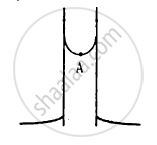
P0
\[P_0 + \frac{2S}{r}\]
\[P_0 - \frac{2S}{r}\]
\[P_0 - \frac{4S}{r}\]
The excess pressure inside a soap bubble is twice the excess pressure inside a second soap bubble. The volume of the first bubble is n times the volume of the second where n is
4
2
1
0.125
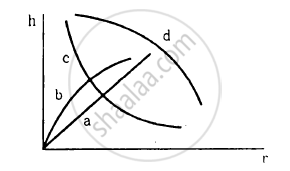
Which of the following graphs may represent the relation between the capillary rise hand the radius r of the capillary?
Water rises in a vertical capillary tube up to a length of 10 cm. If the tube is inclined at 45°, the length of water risen in the tube will be
10 cm
\[10\sqrt{2}\] cm
\[10/\sqrt{2}\] cm
none of these
A 20 cm long capillary tube is dipped in water. The water rises up to 8 cm. If the entire arrangement is put in a freely falling elevator, the length of water column in the capillary tube will be
8 cm
6 cm
10 cm
20 cm
Viscosity is a property of
liquids only
solids only
solids and liquids only
liquids and gases only.
The force of viscosity is
electromagnetic
gravitational
nuclear
weak
The viscous force acting between two layers of a liquid is given by \[\frac{F}{A} = - \eta\frac{dv}{dz}\]. This F/A may be called
pressure
longitudinal stress
tangential stress
volume stress
A raindrop falls near the surface of the earth with almost uniform velocity because
its weight is negligible
the force of surface tension balances its weight
the force of viscosity of air balance its weight
the drops are charged and atmospheric electric field balances its weight.
A piece of wood is taken deep inside a long column of water and released. It will move up
with a constant upward acceleration
with a decreasing upward acceleration
with a deceleration
with a uniform velocity
A solid sphere falls with a terminal velocity of 20 m s−1 in air. If it is allowed to fall in vacuum,
terminal velocity will be 20 m s−1
terminal velocity will be less than 20 m s−1
terminal velocity will be more than 20 m s−1
there will be no terminal velocity
A spherical ball is dropped in a long column of a viscous liquid. The speed of the ball as a function of time may be best represented by the graph
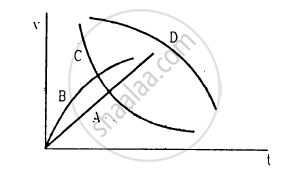
A
B
C
D
HC Verma solutions for Concepts of Physics Volume 1 and 2 [English] 14 Some Mechanical Properties of Matter MCQ [Page 299]
A student plots a graph from his reading on the determination of Young modulus of a metal wire but forgets to put the labels. the quantities on X and Y-axes may be respectively
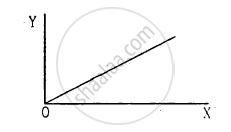
(a) weight hung and length increased
(b) stress applied and length increased
(c) stress applied and strain developed
(d) length increased and the weight hung.
The properties of a surface are different from those of the bulk liquid because the surface molecules
(a) are smaller than other molecules
(b) acquire charge due to collision from air molecules
(c) find different type of molecules in their range of influence
(d) feel a net force in one direction.
The rise of a liquid in a capillary tube depends on
(a) the material
(b) the length
(c) the outer radius
(d) the inner radius of the tube
The contact angle between a solid and a liquid is a property of
(a) the material of the solid
(b) the material of the liquid
(c) the shape of the solid
(d) the mass of the solid
A liquid is contained in a vertical tube of semicircular cross section. The contact angle is zero. The force of surface tension on the curved part and on the flat part are in ratio
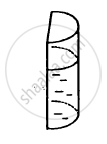
1:1
1:2
π:2
2:π
When a capillary tube is dipped into a liquid, the liquid neither rises nor falls in the capillary.
(a) The surface tension of the liquid must be zero.
(b) The contact angle must be 90°.
(c) The surface tension may be zero.
(d) The contact angle may be 90°.
A solid sphere moves at a terminal velocity of 20 m s−1 in air at a place where g = 9.8 m s−2. The sphere is taken in a gravity-free hall having air at the same pressure and pushed down at a speed of 20 m s−1.
(a) Its initial acceleration will be 9.8 m s−2 downward.
(b) It initial acceleration will be 9.8 m s−2 upward.
(c) The magnitude of acceleration will decrease as the time passes.
(d) It will eventually stop
HC Verma solutions for Concepts of Physics Volume 1 and 2 [English] 14 Some Mechanical Properties of Matter Exercise [Pages 300 - 302]
A load of 10 kg is suspended by a metal wire 3 m long and having a cross-sectional area 4 mm2. Find (a) the stress (b) the strain and (c) the elongation. Young modulus of the metal is 2.0 × 10¹¹ N m−2.
A vertical metal cylinder of radius 2 cm and length 2 m is fixed at the lower end and a load of 100 kg is put on it. Find (a) the stress (b) the strain and (c) the compression of the cylinder. Young modulus of the metal = 2 × 10¹¹ N m−2.
The elastic limit of steel is 8 × 10⁸ N m−2 and its Young modulus 2 × 10¹¹ N m−2. Find the maximum elongation of a half-metre steel wire that can be given without exceeding the elastic limit.
A steel wire and a copper wire of equal length and equal cross-sectional area are joined end to end and the combination is subjected to a tension. Find the ratio of the stresses developed in the two wires .
A steel wire and a copper wire of equal length and equal cross-sectional area are joined end to end and the combination is subjected to a tension. Find the ratio of the strains developed. Y of steel = 2 × 10¹¹N m−2. Y of copper = 1.3 × 10 11 N m−2.
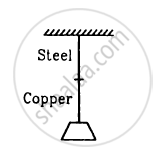
In figure the upper wire is made of steel and the lower of copper. The wires have equal cross section. Find the ratio of the longitudinal strains developed in the two wires.
The two wires shown in figure are made of the same material which has a breaking stress of 8 × 10⁸ N m−2. The area of cross section of the upper wire is 0.006 cm2 and that of the lower wire is 0.003 cm2. The mass m1 = 10 kg, m2 = 20 kg and the hanger is light. Find the maximum load that can be put on the hanger without breaking a wire. Which wire will break first if the load is increased?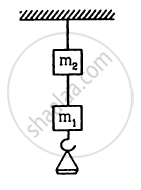
The two wires shown in figure are made of the same material which has a breaking stress of 8 × 10⁸ N m−2. The area of cross section of the upper wire is 0.006 cm2 and that of the lower wire is 0.003 cm2. The mass m1 = 10 kg, m2 = 20 kg and the hanger is light. Repeat the above part if m1 = 10 kg and m2 = 36 kg.
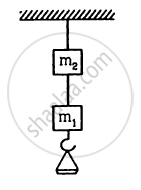
Two persons pull a rope towards themselves. Each person exerts a force of 100 N on the rope. Find the Young modulus of the material of the rope if it extends in length by 1 cm. Original length of the rope = 2 m and the area of cross section = 2 cm2.
A steel rod of cross-sectional area 4 cm2 and 2 m shrinks by 0.1 cm as the temperature decreases in night. If the rod is clamped at both ends during the day hours, find the tension developed in it during night hours. Young modulus of steel = 1.9 × 10¹¹ N m−2.
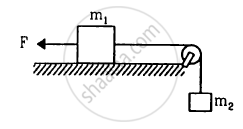
Consider the situation shown in figure. The force F is equal to the m2 g/2. If the area of cross section of the string is A and its Young modulus Y, find the strain developed in it. The string is light and there is no friction anywhere.
A sphere of mass 20 kg is suspended by a metal wire of unstretched length 4 m and diameter 1 mm. When in equilibrium, there is a clear gap of 2 mm between the sphere and the floor. The sphere is gently pushed aside so that the wire makes an angle θ with the vertical and is released. Find the maximum value of θ so that the sphere does not rub the floor. Young modulus of the metal of the wire is 2.0 × 10¹¹ N m−2. Make appropriate approximations.
A steel wire of original length 1 m and cross-sectional area 4.00 mm2 is clamped at the two ends so that it lies horizontally and without tensions. If a load of 2.16 kg is suspended from the middle point of the wire, what would be its vertical depression ? Y of the steel = 2.0 × 10¹¹ N m−2. Take g = 10 m s−2.
A copper wire of cross-sectional area 0.01 cm2 is under a tension of 20N. Find the decrease in the cross-sectional area. Young modulus of copper = 1.1 × 10¹¹ N m−2 and Poisson ratio = 0.32.
`["Hint" : (Delta"A")/"A"=2(Delta"r")/"r"]`
Find the increase in pressure required to decrease the volume of a water sample by 0.01%. Bulk modulus of water = 2.1 × 10⁹ N m−2.
Estimate the change in the density of water in ocean at a depth of 400 m below the surface. The density of water at the surface = 1030 kg m−3 and the bulk modulus of water = 2 × 10⁹ N m−2.
A steel plate of face area 4 cm2 and thickness 0.5 cm is fixed rigidly at the lower surface. A tangential force of 10 N is applied on the upper surface. Find the lateral displacement of the upper surface with respect to the lower surface. Rigidity modulus of steel = 8.4 × 10¹⁰ N m−2.
A 5.0 cm long straight piece of thread is kept on the surface of water. Find the force with which the surface on one side of the thread pulls it. Surface tension of water = 0.076 N m−1.
Find the excess pressure inside (a) a drop of mercury of radius 2 mm (b) a soap bubble of radius 4 mm and (c) an air bubble of radius 4 mm formed inside a tank of water. Surface tension of mercury, soap solution and water are 0.465 N m−1, 0.03 N m−1 and 0.076 N m−1 respectively.
Consider a small surface area of 1 mm2 at the top of a mercury drop of radius 4.0 mm. Find the force exerted on this area (a) by the air above it (b) by the mercury below it and (c) by the mercury surface in contact with it. Atmospheric pressure = 1.0 × 10⁵ Pa and surface tension of mercury = 0.465 N m−1. Neglect the effect of gravity. Assume all numbers to be exact.
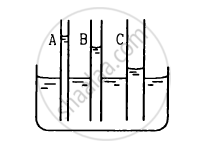
The capillaries shown in figure have inner radii 0.5 mm, 1.0 mm and 1.5 mm respectively. The liquid in the beaker is water. Find the heights of water level in the capillaries. The surface tension of water is 7.5 × 10⁻² N m−1.
The lower end of a capillary tube is immersed in mercury. The level of mercury in the tube is found to be 2 cm below the outer level. If the same tube is immersed in water, up to what height will the water rise in the capillary?
A barometer is constructed with its tube having radius 1.0 mm. Assume that the surface of mercury in the tube is spherical in shape. If the atmospheric pressure is equal to 76 cm of mercury, what will be the height raised in the barometer tube? The contact angle of mercury with glass = 135° and surface tension of mercury = 0.465 N m−1. Density of mercury = 13600 kg m−3.
A capillary tube of radius 0.50 mm is dipped vertically in a pot of water. Find the difference between the pressure of the water in the tube 5.0 cm below the surface and the atmospheric pressure. Surface tension of water = 0.075 N m−1.
Find the surface energy of water kept in a cylindrical vessel of radius 6.0 cm. Surface tension of water = 0.075 J m−2.
A drop of mercury of radius 2 mm is split into 8 identical droplets. Find the increase in surface energy. Surface tension of mercury = 0.465 J m−2.
A capillary tube of radius 1 mm is kept vertical with the lower end in water. (a) Find the height of water raised in the capillary. (b) If the length of the capillary tube is half the answer of part , find the angle θ made by the water surface in the capillary with the wall.
The lower end of a capillary tube of radius 1 mm is dipped vertically into mercury. (a) Find the depression of mercury column in the capillary. (b) If the length dipped inside is half the answer of part (a), find the angle made by the mercury surface at the end of the capillary with the vertical. Surface tension of mercury = 0.465 N m−1 and the contact angle of mercury with glass −135 °.
Two large glass plates are placed vertically and parallel to each other inside a tank of water with separation between the plates equal to 1 mm. Find the rise of water in the space between the plates. Surface tension of water = 0.075 Nm−1.
Consider an ice cube of edge 1.0 cm kept in a gravity-free hall. Find the surface area of the water when the ice melts. Neglect the difference in densities of ice and water.
A wire forming a loop is dipped into soap solution and taken out so that a film of soap solution is formed. A loop of 6.28 cm long thread is gently put on the film and the film is pricked with a needle inside the loop. The thread loop takes the shape of a circle. Find the tension the the thread. Surface tension of soap solution = 0.030 N m−1.
A metal sphere of radius 1 mm and mass 50 mg falls vertically in glycerine. Find (a) the viscous force exerted by the glycerine on the sphere when the speed of the sphere is 1 cm s−1, (b) the hydrostatic force exerted by the glycerine on the sphere and (c) the terminal velocity with which the sphere will move down without acceleration. Density of glycerine = 1260 kg m−3 and its coefficient of viscosity at room temperature = 8.0 poise.
Estimate the speed of vertically falling raindrops from the following data. Radius of the drops = 0.02 cm, viscosity of air = 1.8 × 10⁻⁴ poise, g= 9.9 × 10 ms−2 and density of water = 1000 kg m−3.
Water flows at a speed of 6 cm s−1 through a tube of radius 1 cm. Coefficient of viscosity of water at room temperature is 0.01 poise. Calculate the Reynolds number. Is it a steady flow?
Solutions for 14: Some Mechanical Properties of Matter
HC Verma solutions for Concepts of Physics Volume 1 and 2 [English] chapter 14 - Some Mechanical Properties of Matter
Shaalaa.com has the CBSE, Karnataka Board PUC Mathematics Concepts of Physics Volume 1 and 2 [English] CBSE, Karnataka Board PUC solutions in a manner that help students grasp basic concepts better and faster. The detailed, step-by-step solutions will help you understand the concepts better and clarify any confusion. HC Verma solutions for Mathematics Concepts of Physics Volume 1 and 2 [English] CBSE, Karnataka Board PUC 14 (Some Mechanical Properties of Matter) include all questions with answers and detailed explanations. This will clear students' doubts about questions and improve their application skills while preparing for board exams.
Further, we at Shaalaa.com provide such solutions so students can prepare for written exams. HC Verma textbook solutions can be a core help for self-study and provide excellent self-help guidance for students.
Concepts covered in Concepts of Physics Volume 1 and 2 [English] chapter 14 Some Mechanical Properties of Matter are Introduction of Mechanical Properties of Fluids, Archimedes' Principle, Stoke's Law, Continuous and Discontinuous Functions, Torricelli's Law, Variation of Pressure with Depth, Atmospheric Pressure and Gauge Pressure, Hydraulic Machines, Streamline and Turbulent Flow, Applications of Bernoulli’s Equation, Thrust and Pressure, Pascal’s Law, Surface Tension, Reynold's Number, Effect of Gravity on Fluid Pressure, Terminal Velocity, Critical Velocity, Excess of Pressure Across a Curved Surface, Viscous Force or Viscosity, Stress-strain Curve, Stress and Strain, Hooke’s Law, Elastic Modulus>Shear Modulus (Modulus of Rigidity), Elastic Modulus>Bulk Modulus, Application of Elastic Behaviour of Materials, Elastic Energy, Elastic Behavior of Solids, Elastic Modulus>Poisson’s Ratio, Elastic Modulus>Young’s Modulus.
Using HC Verma Concepts of Physics Volume 1 and 2 [English] solutions Some Mechanical Properties of Matter exercise by students is an easy way to prepare for the exams, as they involve solutions arranged chapter-wise and also page-wise. The questions involved in HC Verma Solutions are essential questions that can be asked in the final exam. Maximum CBSE, Karnataka Board PUC Concepts of Physics Volume 1 and 2 [English] students prefer HC Verma Textbook Solutions to score more in exams.
Get the free view of Chapter 14, Some Mechanical Properties of Matter Concepts of Physics Volume 1 and 2 [English] additional questions for Mathematics Concepts of Physics Volume 1 and 2 [English] CBSE, Karnataka Board PUC, and you can use Shaalaa.com to keep it handy for your exam preparation.
