Advertisements
Advertisements
Question
The excess pressure inside a soap bubble is twice the excess pressure inside a second soap bubble. The volume of the first bubble is n times the volume of the second where n is
Options
4
2
1
0.125
Advertisements
Solution
Let the excess pressure inside the second bubble be P.
∴ Excess pressure inside the first bubble = 2P
Let the radius of the second bubble be R.
Let the radius of the first bubble be x.
\[\text{ Excess pressure inside the 2 nd soap bubble :} \]
\[P = \frac{4S}{R} . . . (1)\]
\[\text{ Excess pressure inside the 1st soap bubble: }\]
\[2P = \frac{4S}{x}\]
\[\text{ From (1), we get :} \]
\[2\left( \frac{4S}{R} \right) = \frac{4S}{x}\]
\[ \Rightarrow x = \frac{R}{2}\]
\[\text{ Volume of the first bubble }= \frac{4}{3} \pi x^3 \]
\[\text{ Volume of the second bubble } = \frac{4}{3} \pi R^3 \]
\[ \Rightarrow \frac{4}{3} \pi x^3 = n\frac{4}{3} \pi R^3 \]
\[ \Rightarrow x^3 = {nR}^3 \]
\[ \Rightarrow \left( \frac{R}{2} \right)^3 = {nR}^3 \]
\[ \Rightarrow n = \frac{1}{8} = 0 . 125\]
APPEARS IN
RELATED QUESTIONS
Water rises to a height 3.2 cm in a glass capillary tube. Find the height to which the same water will rise in another glass capillary having half area of cross section.
'n' droplets of equal size of radius r coalesce to form a bigger drop of radius R. The energy liberated is equal to...................
(T =Surface tension of water)
`(a) 4piR^2T[n^(1/3)-1]`
`(b) 4pir^2T[n^(1/3)-1]`
`(c) 4piR^2T[n^(2/3)-1]`
`(d)4 pir^2T[n^(2/3)-1]`
Explain why Surface tension of a liquid is independent of the area of the surface
The force of surface tension acts tangentially to the surface whereas the force due to air pressure acts perpendicularly on the surface. How is then the force due to excess pressure inside a bubble balanced by the force due to the surface tension?
Find the surface energy of water kept in a cylindrical vessel of radius 6.0 cm. Surface tension of water = 0.075 J m−2.
Find the force exerted by the water on a 2 m2 plane surface of a large stone placed at the bottom of a sea 500 m deep. Does the force depend on the orientation of the surface?
A drop of mercury of radius 0.2 cm is broken into 8 droplets of the same size. Find the work done if the surface tension of mercury is 435.5 dyn/cm.
The water droplets are spherical in free fall due to ______
Define surface tension.
Describe an experiment to prove that friction depends on the nature of a surface.
Explain elasticity using intermolecular forces.
Water rises in a capillary tube of radius r upto a height h. The mass of water in a capillary is m. The mass of water that will rise in a capillary of radius `"r"/4` will be ______.
Two spherical rain drops reach the surface of the earth with terminal velocities having ratio 16 : 9. The ratio of their surface area is ______.
A water drop of radius R' splits into 'n' smaller drops, each of radius 'r'. The work done in the process is ______.
T = surface tension of water
Under isothermal conditions, two soap bubbles of radii 'r1' and 'r2' coalesce to form a big drop. The radius of the big drop is ______.
Two mercury droplets of radii 0.1 cm. and 0.2 cm. collapse into one single drop. What amount of energy is released? The surface tension of mercury T = 435.5 × 10⁻³ Nm–1.
The sufrace tension and vapour pressure of water at 20°C is 7.28 × 10⁻² Nm–1 and 2.33 × 10³ Pa, respectively. What is the radius of the smallest spherical water droplet which can form without evaporating at 20°C?
Eight droplets of water each of radius 0.2 mm coalesce into a single drop. Find the decrease in the surface area.
In a U-tube, the radii of two columns are respectively r1 and r2. When a liquid of density ρ(θ = 0°) is filled in it, a level difference of h is observed on two arms, then the surface tension of the liquid is ______.
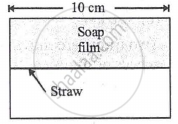
A soap film of surface tension 3 × 10⁻² formed in a rectangular frame can support a straw as shown in Fig. If g = 10 ms-12, the mass of the straw is ______.