Advertisements
Advertisements
Question
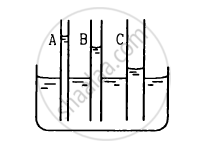
The capillaries shown in figure have inner radii 0.5 mm, 1.0 mm and 1.5 mm respectively. The liquid in the beaker is water. Find the heights of water level in the capillaries. The surface tension of water is 7.5 × 10⁻² N m−1.
Advertisements
Solution
Given:
Surface tension of water T = 7.5 × 10⁻² N/m
Taking cos θ = 1:
Radius of capillary A (rA) = 0.5 mm = 0.5 × 10⁻³ m
Height of water level in capillary A:
\[\text{h}_\text{A } = \frac{2\text{T} \cos \theta}{\text{r}_\text{A} \rho \text{ g}}\]
\[ = \frac{2 \times 7 . 5 \times {10}^{- 2}}{0 . 5 \times {10}^{- 3} \times 1000 \times 10}\]
\[ = 3 \times {10}^{- 2}\text{ m = 3 cm}\]
Radius of capillary B (rB) = 1 mm = 1 × 10⁻³ m
Height of water level in capillary B:
\[\text{h}_\text{B} = \frac{2\text{T}\cos \theta}{\text{r}_\text{B} \rho \text{ g}}\]
\[ = \frac{2 \times 7 . 5 \times {10}^{- 2}}{1 \times {10}^{- 3} \times {10}^3 \times 10}\]
\[ = 15 \times {10}^{- 3} \text{ m = 1 . 5 cm }\]
Radius of capillary C (rC) = 1.5 mm = 1.5 × 10⁻³ m
Height of water level in capillary C:
\[\text{h}_\text{C} = \frac{2\text{T} \cos \theta}{\text{r}_\text{ C} \rho \text{ g}}\]
\[ = \frac{2 \times 7 . 5 \times {10}^{- 2}}{1 . 5 \times {10}^{- 3} \times {10}^3 \times 10}\]
\[ = \frac{15}{1 . 5} \times {10}^{- 3} \text{ m = 1 cm} \]
APPEARS IN
RELATED QUESTIONS
Explain why Surface tension of a liquid is independent of the area of the surface
Explain why A drop of liquid under no external forces is always spherical in shape
Define surface tension and surface energy.
The total free surface energy of a liquid drop is `pisqrt2` times the surface tension of the liquid. Calculate the diameter of the drop in S.l. unit.
The contact angle between pure water and pure silver is 90°. If a capillary tube made of silver is dipped at one end in pure water, will the water rise in the capillary?
A uniform vertical tube of circular cross section contains a liquid. The contact angle is 90°. Consider a diameter of the tube lying in the surface of the liquid. The surface to the right of this diameter pulls the surface on the left of it. What keeps the surface on the left in equilibrium?
When a glass capillary tube is dipped at one end in water, water rises in the tube. The gravitational potential energy is thus increased. Is it a violation of conservation of energy?
The water droplets are spherical in free fall due to ______
How does the friction arise between the surfaces of two bodies in relative motion?
Describe an experiment to prove that friction depends on the nature of a surface.
How is surface tension related to surface energy?
What are the factors affecting the surface tension of a liquid?
Water rises upto a height h in a capillary tube on the surface of the earth. The value of h will increase, if the experimental setup is kept in [g = acceleration due to gravity]
A molecule of water on the surface experiences a net ______.
A water drop of radius R' splits into 'n' smaller drops, each of radius 'r'. The work done in the process is ______.
T = surface tension of water
The upward force of 105 dyne due to surface tension is balanced by the force due to the weight of the water column and 'h' is the height of water in the capillary. The inner circumference of the capillary is ______.
(surface tension of water = 7 × 10⁻² N/m)
The length of a needle floating on water is 2 cm. The additional force due to surface tension required to pull the needle out of water will be (S.T. of water = 7.0 × 10⁻² N/m).
The excess pressure inside a liquid drop is 500 Nm-2. If the radius of the drop is 2 mm, the surface tension of the liquid is x × 10-3 Nm-1. The value of x is ______.
Find the work done when a drop of mercury of radius 2 mm breaks into 8 equal droplets. [Surface tension of mercury = 0.4855 J/m2].
