Advertisements
Advertisements
Question
A hollow spherical body of inner and outer radii 6 cm and 8 cm respectively floats half-submerged in water. Find the density of the material of the sphere.
Advertisements
Solution
Given:
Inner radius of the hollow spherical body, r1 = 6 cm
Outer radius of the hollow spherical body, r2 = 8 cm
Let the density of the material of the sphere be ρ and the volume of the water displaced by the hollow sphere be V.
If `rho _w` is the density of water, then:
\[\text{Weight of the liquid displaced }= \left( \frac{\text{V}}{2} \right)( \rho_\text{w} ) \times \text{g}\]
\[\text{ We know }: \]
\[\text{ Upward thrust = Weight of the liquid displaced }\]
\[ \therefore \left( \frac{4}{3}\pi r_3^2 - \frac{4}{3}\pi r_1^3 \right)\rho = \left( \frac{1}{2} \right)\frac{4}{3}\pi r_2^3 \times \rho_\text{w} \]
\[ \Rightarrow \left( r_2^3 - r_1^3 \right) \times \rho = \left( \frac{1}{2} \right) r_2^3 \times 1\]
\[ \Rightarrow (8 )^3 - (6 )^3 \times \rho = \left( \frac{1}{2} \right)(8 )^3 \times 1\]
\[ \Rightarrow \rho = \frac{512}{2 \times (512 - 216)}\]
\[ = \frac{512}{2 \times 296}=0.865 \text{ gm/cc =865kg/m}^3\]
APPEARS IN
RELATED QUESTIONS
Explain why A drop of liquid under no external forces is always spherical in shape
The force of surface tension acts tangentially to the surface whereas the force due to air pressure acts perpendicularly on the surface. How is then the force due to excess pressure inside a bubble balanced by the force due to the surface tension?
If water in one flask and castor oil in other are violently shaken and kept on a table, which will come to rest earlier?
If more air is pushed in a soap bubble, the pressure in it
If two soap bubbles of different radii are connected by a tube,
The lower end of a capillary tube is immersed in mercury. The level of mercury in the tube is found to be 2 cm below the outer level. If the same tube is immersed in water, up to what height will the water rise in the capillary?
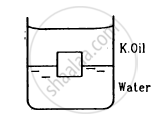
A cube of ice floats partly in water and partly in K.oil (in the following figure). Find the ratio of the volume of ice immersed in water to that in K.oil. Specific gravity of K.oil is 0.8 and that of ice is 0.9.
A cubical box is to be constructed with iron sheets 1 mm in thickness. What can be the minimum value of the external edge so that the cube does not sink in water? Density of iron = 8000 kg/m3 and density of water = 1000 kg/m3.
The surface tension of a liquid at critical temperature is ______
A drop of oil placed on the surface of water spreads out. But a drop of water place on oil contracts to a spherical shape. Why?
Obtain an expression for the excess of pressure inside a
- liquid drop
- liquid bubble
- air bubble
A capillary of diameter d mm is dipped in water such that the water rises to a height of 30 mm. If the radius of the capillary is made `(2/3)` of its previous value, then compute the height up to which water will rise in the new capillary?
The surface tension of the two liquids is respectively 20 and 60 dyne cm-1. The liquids drop from the ends of two tubes of the same radius. The ratio of the weights of the two drops is ______
Water rises upto a height h in a capillary tube on the surface of the earth. The value of h will increase, if the experimental setup is kept in [g = acceleration due to gravity]
Under isothermal conditions, two soap bubbles of radii 'r1' and 'r2' coalesce to form a big drop. The radius of the big drop is ______.
Soap solution is used for cleaning dirty clothes because ______.
If a drop of liquid breaks into smaller droplets, it results in lowering of temperature of the droplets. Let a drop of radius R, break into N small droplets each of radius r. Estimate the drop in temperature.
Surface tension is exhibited by liquids due to force of attraction between molecules of the liquid. The surface tension decreases with increase in temperature and vanishes at boiling point. Given that the latent heat of vaporisation for water Lv = 540 k cal kg–1, the mechanical equivalent of heat J = 4.2 J cal–1, density of water ρw = 103 kg l–1, Avagadro’s No NA = 6.0 × 1026 k mole–1 and the molecular weight of water MA = 18 kg for 1 k mole.
- Estimate the energy required for one molecule of water to evaporate.
- Show that the inter–molecular distance for water is `d = [M_A/N_A xx 1/ρ_w]^(1/3)` and find its value.
- 1 g of water in the vapor state at 1 atm occupies 1601 cm3. Estimate the intermolecular distance at boiling point, in the vapour state.
- During vaporisation a molecule overcomes a force F, assumed constant, to go from an inter-molecular distance d to d ′. Estimate the value of F.
- Calculate F/d, which is a measure of the surface tension.
When an air bubble of radius r rises from the bottom to the surface of a lake, its radius becomes `(5r)/4`. Taking the atmospheric pressure to be equal to the 10 m height of the water column, the depth of the lake would approximately be ______.
(ignore the surface tension and the effect of temperature)
In most liquids, with the rise in temperature, the surface tension of a liquid ______.
