Advertisements
Advertisements
Question
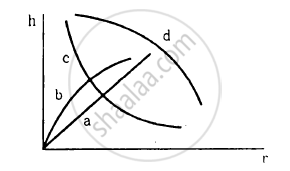
Which of the following graphs may represent the relation between the capillary rise hand the radius r of the capillary?
Advertisements
Solution
\[\text{ The relationship between height h and radius r is given by: } \]
\[\text{ h } = \frac{2Scos\theta}{r\rho g}\]
\[\text{ If S, }\theta, \rho \text{ and g are considered constant, we have:} \]
\[\text{ h } \propto \frac{1}{r}\]
This equation has the characteristic of a rectangular hyperbola. Therefore, curve (c) is a rectangular hyperbola.
APPEARS IN
RELATED QUESTIONS
Explain why Surface tension of a liquid is independent of the area of the surface
Explain why A drop of liquid under no external forces is always spherical in shape
The total free surface energy of a liquid drop is `pisqrt2` times the surface tension of the liquid. Calculate the diameter of the drop in S.l. unit.
The force of surface tension acts tangentially to the surface whereas the force due to air pressure acts perpendicularly on the surface. How is then the force due to excess pressure inside a bubble balanced by the force due to the surface tension?
Air is pushed into a soap bubble of radius r to double its radius. If the surface tension of the soap solution in S, the work done in the process is
If two soap bubbles of different radii are connected by a tube,
Water rises in a vertical capillary tube up to a length of 10 cm. If the tube is inclined at 45°, the length of water risen in the tube will be
A capillary tube of radius 1 mm is kept vertical with the lower end in water. (a) Find the height of water raised in the capillary. (b) If the length of the capillary tube is half the answer of part , find the angle θ made by the water surface in the capillary with the wall.
Two large glass plates are placed vertically and parallel to each other inside a tank of water with separation between the plates equal to 1 mm. Find the rise of water in the space between the plates. Surface tension of water = 0.075 Nm−1.
Consider an ice cube of edge 1.0 cm kept in a gravity-free hall. Find the surface area of the water when the ice melts. Neglect the difference in densities of ice and water.
Why is the surface tension of paints and lubricating oils kept low?
The water droplets are spherical in free fall due to ______
How does surface tension help a plant?
What are the factors affecting the surface tension of a liquid?
Under isothermal conditions, two soap bubbles of radii 'r1' and 'r2' coalesce to form a big drop. The radius of the big drop is ______.
Soap solution is used for cleaning dirty clothes because ______.
If a drop of liquid breaks into smaller droplets, it results in lowering of temperature of the droplets. Let a drop of radius R, break into N small droplets each of radius r. Estimate the drop in temperature.
When one end of the capillary is dipped in water, the height of water column is 'h'. The upward force of 105 dyne due to surface tension is balanced by the force due to the weight of water column. The inner circumference of capillary is ______.
(Surface tension of water = 7 × 10⁻² N/m)
A drop of water of radius 8 mm breaks into number of droplets each of radius 1 mm. How many droplets will be formed?
