Advertisements
Advertisements
Question
How does surface tension help a plant?
Advertisements
Solution
Water molecules rise up due to surface tension. Xylem tissues are very narrow vessels present in plants. Water molecules are absorbed by the roots and these vessels help the water to rise upward due to “capillarity action” which is caused by the surface tension of water.
APPEARS IN
RELATED QUESTIONS
Angle of contact for the pair of pure water with clean glass is _______.
In a conical pendulum, a string of length 120 cm is fixed at rigid support and carries a mass
of 150 g at its free end. If the mass is revolved in a horizontal circle of radius 0.2 m around a
vertical axis, calculate tension in the string (g = 9.8 m/s2)
When a sparingly soluble substance like alcohol is dissolved in water, surface tension of water
A heavy mass is attached to a thin wire and is whirled in a vertical circle. The wire is most likely to break
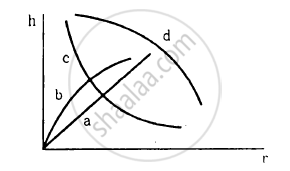
Which of the following graphs may represent the relation between the capillary rise hand the radius r of the capillary?
A 20 cm long capillary tube is dipped in water. The water rises up to 8 cm. If the entire arrangement is put in a freely falling elevator, the length of water column in the capillary tube will be
The rise of a liquid in a capillary tube depends on
(a) the material
(b) the length
(c) the outer radius
(d) the inner radius of the tube
Derive an expression for capillary rise for a liquid having a concave meniscus.
The surface tension of the two liquids is respectively 20 and 60 dyne cm-1. The liquids drop from the ends of two tubes of the same radius. The ratio of the weights of the two drops is ______
Work done to blow a bubble of volume V is W. The work done in blowing a bubble of volume 2V will be ______.
