Advertisements
Advertisements
Question
Mercury has an angle of contact equal to 140° with soda lime glass. A narrow tube of radius 1.00 mm made of this glass is dipped in a trough containing mercury. By what amount does the mercury dip down in the tube relative to the liquid surface outside? Surface tension of mercury at the temperature of the experiment is 0.465 N m–1. Density of mercury = 13.6 × 10³ kg m–3
Advertisements
Solution 1
Angle of contact between mercury and soda lime glass, θ = 140°
Radius of the narrow tube, r = 1 mm = 1 × 10⁻³ m
Surface tension of mercury at the given temperature, s = 0.465 N m–1
Density of mercury, ρ =13.6 × 10³ kg/m3
Dip in the height of mercury = h
Acceleration due to gravity, g = 9.8 m/s2
Surface tension is related with the angle of contact and the dip in the height as:
`s = (hrhogr)/(2costheta)`
`:.h = (2s cos theta)/(rrhog)`
` = (2xx0.465xxcos 140)/(1xx10^(-3)xx13.6xx10^3xx 9.8)`
= - 0.00534 m
= -5.34 mm
Here, the negative sign shows the decreasing level of mercury. Hence, the mercury level dips by 5.34 mm
Solution 2
Radius or tube = r = 1.00 mm = `10^(-3) m`
Surface tension of mercury, `sigma = 0.465 Nm^(-1)`
Density of mercury, `sigma = 13.6 xx 10^3 kg m6(-3)`
Angle of contact, `theta = 140^@`
`:. h = (2sigma cos theta)/(rrhog) = (2xx0.465xxcos 140^@)/(10^(-3)xx 13.6xx10^3xx 9.8)`
`= (2xx0.465xx(-0.7660))/(10^(-3)xx13.6xx10^3xx9.8)`
`= -5.34 xx 10^(-3) m = -5.34 mm`
Negative sign shows that the mercury level is deprssedin the tube
APPEARS IN
RELATED QUESTIONS
The energy of the free surface of a liquid drop is 5π times the surface tension of the liquid. Find the diameter of the drop in C.G.S. system.
When a sparingly soluble substance like alcohol is dissolved in water, surface tension of water
When water droplets merge to form a bigger drop
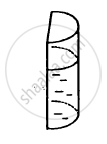
A liquid is contained in a vertical tube of semicircular cross section. The contact angle is zero. The force of surface tension on the curved part and on the flat part are in ratio
Two large glass plates are placed vertically and parallel to each other inside a tank of water with separation between the plates equal to 1 mm. Find the rise of water in the space between the plates. Surface tension of water = 0.075 Nm−1.
Find the force exerted by the water on a 2 m2 plane surface of a large stone placed at the bottom of a sea 500 m deep. Does the force depend on the orientation of the surface?
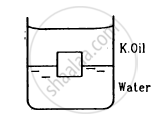
A cube of ice floats partly in water and partly in K.oil (in the following figure). Find the ratio of the volume of ice immersed in water to that in K.oil. Specific gravity of K.oil is 0.8 and that of ice is 0.9.
The energy stored in a soap bubble of diameter 6 cm and T = 0.04 N/m is nearly ______.
The water droplets are spherical in free fall due to ______
Water rises to a height of 20 mm in a capillary tube. If the radius made 1/3rd of its previous value, to what height will the water now rise in the tube?
Obtain an expression for the capillary rise or fall using the forces method.
Numerical Problem.
A stone weighs 500 N. Calculate the pressure exerted by it if it makes contact with a surface of area 25 cm2.
How does the friction arise between the surfaces of two bodies in relative motion?
A spherical soap bubble A of radius 2 cm is formed inside another bubble B of radius 4 cm. Show that the radius of a single soap bubble which maintains the same pressure difference as inside the smaller and outside the larger soap bubble is lesser than the radius of both soap bubbles A and B.
The wear and tear in the machine part is due to ______.
The angle of contact at the interface of water-glass is 0°, Ethylalcohol-glass is 0°, Mercury-glass is 140° and Methyliodide-glass is 30°. A glass capillary is put in a trough containing one of these four liquids. It is observed that the meniscus is convex. The liquid in the trough is ______.
This model of the atmosphere works for relatively small distances. Identify the underlying assumption that limits the model.
The surface tension of soap solution is 25 × 10-3 Nm-1. The excess of pressure inside a soap bubble of diameter 1 cm is ______.
In most liquids, with the rise in temperature, the surface tension of a liquid ______.
