Advertisements
Advertisements
Question
The free surface of oil in a tanker, at rest, is horizontal. If the tanker starts accelerating the free surface will be titled by an angle θ. If the acceleration is a ms–2, what will be the slope of the free surface?
Advertisements
Solution
The behaviour of a liquid contained in a horizontally accelerated vessel can be understood by understanding the behaviour of a pendulum suspended from the ceiling of a horizontally accelerated trolley.
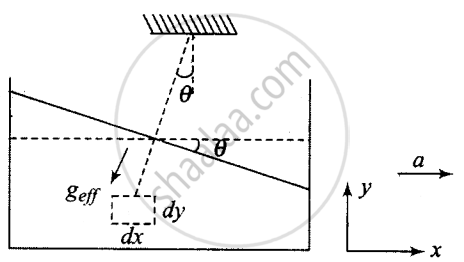
Every fluid element attains an equilibrium position under the action of gravity and pseudo-force. The free surface of the liquid orients itself perpendicular to the direction of net effective gravity.
tan θ = a/g
Suppose a tanker accelerates along the x-axis with acceleration a, the free surface of the tanker will not be horizontal because pseudo force acts as shown in the diagram.
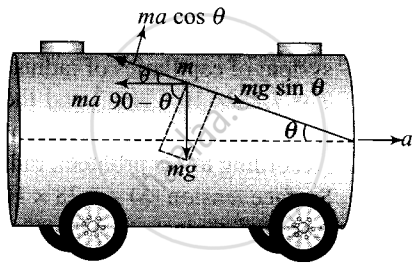
Consider an elementary particle of the oil of mass m.
The acting forces on the particle with respect to the tanker are shown in the figure alongside.
Now, balancing forces (as the particle is in equilibrium) along the inclined direction of the surface.
ma = pseudo force
mg = weight of small part of the oil.
Along the free surface,
Net force = 0
⇒ ma cos θ = mg sin θ
⇒ a = g tan θ
⇒ θ = tan-1(a/g)
APPEARS IN
RELATED QUESTIONS
Derive Laplace’s law for spherical membrane of bubble due to surface tension.
Draw a neat labelled diagram showing forces acting on the meniscus of water in a capillary tube.
Explain why Surface tension of a liquid is independent of the area of the surface
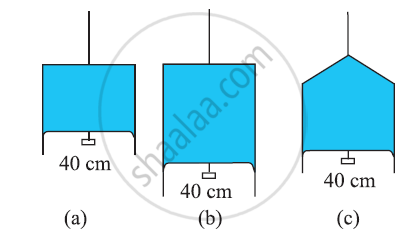
Figure (a) shows a thin liquid film supporting a small weight = 4.5 × 10⁻² N. What is the weight supported by a film of the same liquid at the same temperature in Fig. (b) and (c)? Explain your answer physically.
What is the excess pressure inside a bubble of soap solution of radius 5.00 mm, given that the surface tension of soap solution at the temperature (20 °C) is 2.50 × 10⁻² N m–1? If an air bubble of the same dimension were formed at depth of 40.0 cm inside a container containing the soap solution (of relative density 1.20), what would be the pressure inside the bubble? (1 atmospheric pressure is 1.01 × 10⁵ Pa).
In a conical pendulum, a string of length 120 cm is fixed at rigid support and carries a mass
of 150 g at its free end. If the mass is revolved in a horizontal circle of radius 0.2 m around a
vertical axis, calculate tension in the string (g = 9.8 m/s2)
If a mosquito is dipped into water and released, it is not able to fly till it is dry again. Explain
A wire forming a loop is dipped into soap solution and taken out so that a film of soap solution is formed. A loop of 6.28 cm long thread is gently put on the film and the film is pricked with a needle inside the loop. The thread loop takes the shape of a circle. Find the tension the the thread. Surface tension of soap solution = 0.030 N m−1.
Water rises to a height of 20 mm in a capillary tube. If the radius made 1/3rd of its previous value, to what height will the water now rise in the tube?
Explain the phenomena of surface tension on the basis of molecular theory.
Obtain an expression for the capillary rise or fall using the forces method.
A certain number of spherical drops of a liquid of radius R coalesce to form a single drop of radius R and volume V. If T is the surface tension of the liquid, then
How is surface tension related to surface energy?
What are the factors affecting the surface tension of a liquid?
Why coffee runs up into a sugar lump (a small cube of sugar) when one corner of the sugar lump is held in the liquid?
A square frame of each side L is dipped in a soap solution and taken out. The force acting on the film formed is _____.
(T = surface tension of soap solution).
Two small drops of mercury each of radius 'R' coalesce to form a large single drop. The ratio of the total surface energies before and after the change is ____________.
Soap solution is used for cleaning dirty clothes because ______.
Eight droplets of water each of radius 0.2 mm coalesce into a single drop. Find the decrease in the surface area.
Work done to blow a bubble of volume V is W. The work done in blowing a bubble of volume 2V will be ______.
