Advertisements
Advertisements
प्रश्न
The free surface of oil in a tanker, at rest, is horizontal. If the tanker starts accelerating the free surface will be titled by an angle θ. If the acceleration is a ms–2, what will be the slope of the free surface?
Advertisements
उत्तर
The behaviour of a liquid contained in a horizontally accelerated vessel can be understood by understanding the behaviour of a pendulum suspended from the ceiling of a horizontally accelerated trolley.
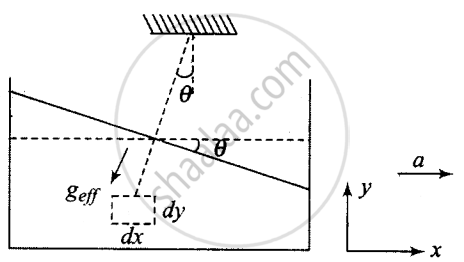
Every fluid element attains an equilibrium position under the action of gravity and pseudo-force. The free surface of the liquid orients itself perpendicular to the direction of net effective gravity.
tan θ = a/g
Suppose a tanker accelerates along the x-axis with acceleration a, the free surface of the tanker will not be horizontal because pseudo force acts as shown in the diagram.
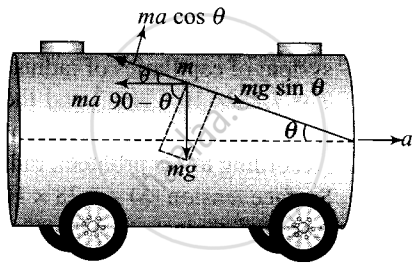
Consider an elementary particle of the oil of mass m.
The acting forces on the particle with respect to the tanker are shown in the figure alongside.
Now, balancing forces (as the particle is in equilibrium) along the inclined direction of the surface.
ma = pseudo force
mg = weight of small part of the oil.
Along the free surface,
Net force = 0
⇒ ma cos θ = mg sin θ
⇒ a = g tan θ
⇒ θ = tan-1(a/g)
APPEARS IN
संबंधित प्रश्न
The energy of the free surface of a liquid drop is 5π times the surface tension of the liquid. Find the diameter of the drop in C.G.S. system.
What is the excess pressure inside a bubble of soap solution of radius 5.00 mm, given that the surface tension of soap solution at the temperature (20 °C) is 2.50 × 10⁻² N m–1? If an air bubble of the same dimension were formed at depth of 40.0 cm inside a container containing the soap solution (of relative density 1.20), what would be the pressure inside the bubble? (1 atmospheric pressure is 1.01 × 10⁵ Pa).
The total free surface energy of a liquid drop is `pisqrt2` times the surface tension of the liquid. Calculate the diameter of the drop in S.l. unit.
State any two characteristics of the angle of contact
Calculate the work done in increasing the radius of a soap bubble in air from 1 cm to 2 cm. The surface tension of soap solution is 30 dyne/cm. (Π = 3.142).
The force of surface tension acts tangentially to the surface whereas the force due to air pressure acts perpendicularly on the surface. How is then the force due to excess pressure inside a bubble balanced by the force due to the surface tension?
An ice cube is suspended in vacuum in a gravity free hall. As the ice melts it
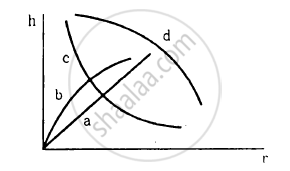
Which of the following graphs may represent the relation between the capillary rise hand the radius r of the capillary?
The lower end of a capillary tube of radius 1 mm is dipped vertically into mercury. (a) Find the depression of mercury column in the capillary. (b) If the length dipped inside is half the answer of part (a), find the angle made by the mercury surface at the end of the capillary with the vertical. Surface tension of mercury = 0.465 N m−1 and the contact angle of mercury with glass −135 °.
A solid sphere of radius 5 cm floats in water. If a maximum load of 0.1 kg can be put on it without wetting the load, find the specific gravity of the material of the sphere.
A drop of mercury of radius 0.2 cm is broken into 8 droplets of the same size. Find the work done if the surface tension of mercury is 435.5 dyn/cm.
Insect moves over the surface of water because of ______.
Obtain an expression for the capillary rise or fall using the forces method.
How is surface tension related to surface energy?
Two spherical rain drops reach the surface of the earth with terminal velocities having ratio 16 : 9. The ratio of their surface area is ______.
The excess of pressure, due to surface tension, on a spherical liquid drop of radius 'R' is proportional to ______.
Soap solution is used for cleaning dirty clothes because ______.
Is surface tension a vector?
Two blocks of masses m and M are connected by means of a metal wire of cross-sectional area A passing over a frictionless fixed pully as shown in the figure. The system is then released. If M = 2m, then the stress produced in the wire is ______.

Define angle of contact.
